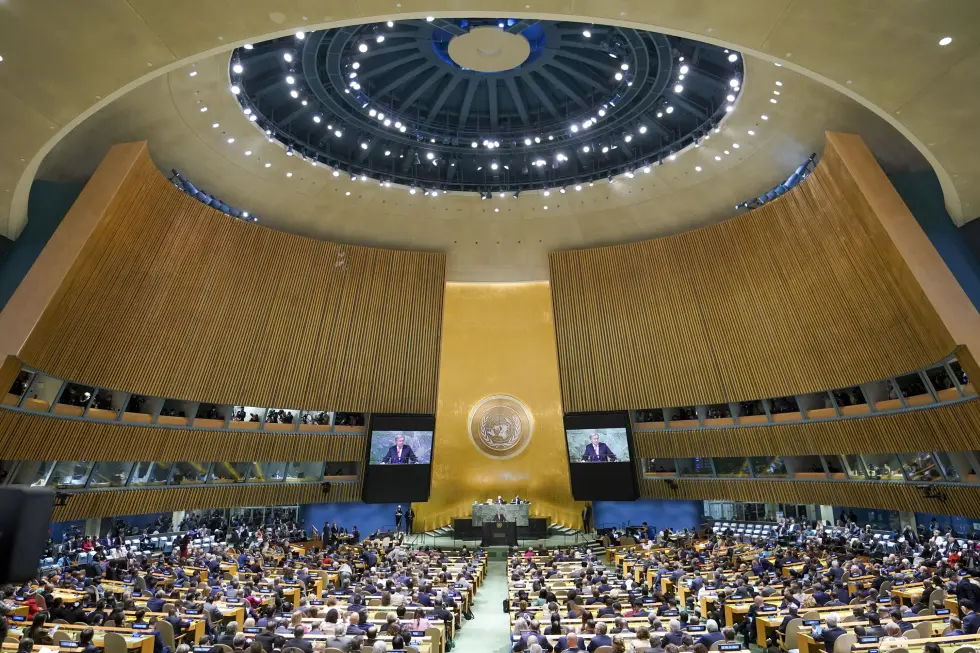
The 77th session of the United Nations General Assembly (UNGA) concluded on Monday, notably the first in-person since the beginning of the COVID-19 pandemic. The General Debate gave the floor to 190 speakers, including 76 Heads of State, 50 Heads of Government, four Vice-Presidents, five Deputy Prime Ministers, 48 Ministers, and seven Heads of Delegations. Illustrating the themes of the session, General Assembly President Csaba Kőrösi remarked:
“Fresh pages of history are being written, with new divisions and new alliances, new grievances, and new successes on them”.
Perhaps nowhere does the observation hold more weight than in the case of Afghanistan, with no representation in the annual session in the UNGA for the second consecutive year. However, representatives of a few countries; including Pakistan, China, Tajikistan, Uzbekistan, Kazakhstan, Turkey, Qatar, and Saudi Arabia, mentioned Afghanistan, their statements reflecting the broad spectrum of perceptions and interests in relation to the country.
Citing Afghanistan in Pivotal Speeches
In the UNGA, for his part, Pakistan’s premier Shehbaz Sharif highlighted the unique challenges confronting the neighboring country. He spoke of nearly 30 million Afghans who are without a functional economy and banking system, while also stressing the importance of ensuring that Afghan girls and women have access to education and employment. Asserting Pakistan’s stake in the stability and peace of Afghanistan, he warned of the dangers of isolating the Afghan Interim Government, which could exacerbate the suffering of the Afghan people. He urged the international community to respond positively to the UN secretary-general’s appeal for $4.2 billion in humanitarian and economic assistance.
Moreover, he acknowledged sharing international concerns regarding the threat of terrorism posed by the groups such as ISIL-K, TTP, Al-Qaeda, ETIM, and IMU operating from Afghanistan, calling for the support and cooperation of the Afghan authorities in dealing with them thoroughly.
Notably, the latter remarks triggered a furor in Afghanistan, eliciting both a diplomatic response and incendiary rhetoric. A statement, issued by the Ministry of Foreign Affairs of the Islamic Emirate of Afghanistan (IEA), listing prominently the United States and Pakistan, dismissed concerns, deeming them incorrect and baseless. The statement further denounced the larger global community for its accusatory public stances, and called for positive, private engagement. Other counter proclamations, such as those from Deputy Foreign Affairs Minister Abbas Stanikzai were at their best fiery and imprudent.
Unsurprisingly, similar anxieties were expressed by other countries with a degree of interest in Afghanistan’s affairs.
China’s Foreign Minister Wang in his speech recognized Afghanistan’s evolution from unrest to order, asserting the need for an inclusive political framework and moderate policies to achieve socio-economic prosperity, with thwarting terrorism and regional integration essential for the fulfillment of these goals.
Echoing similar sentiments, Uzbekistan’s Foreign Minister Vladimir Norov affirmed the importance of preventing the isolation of Afghanistan, noting that abandoning it at this juncture will undoubtedly have adverse consequences for regional and international security.
The Foreign Minister of Tajikistan Sirodjiddin Muhriddin in his address, in the UNGA, adopted a more forceful posture, and shared qualms about the strengthening of radical groups in Afghanistan, warning that the country was becoming a “springboard for spreading the Taliban’s radical extremism“. Furthermore, he asserted it to be a contributing factor in crystallizing and cultivating a fresh hotbed of tensions near his country’s 1,400-kilometer border with Afghanistan.
The Emir of Qatar Sheikh Tamim bin Hamad Al-Thani in his address , in the UNGA, reflected among other issues the need to preserve and build on the Doha peace deal between the IEA and the United States, reminding of its provisions including preventing Afghanistan from becoming a haven for terrorists and radical individuals and groups. Additionally, Turkish President Recep Tayyip Erdogan took the opportunity to call on the interim government to take vital steps forward to ensure fundamental human rights and liberties.
Malice or Coaction?
Taking into consideration the stakes these countries have had in Afghanistan more recently, it is paramount to question whether all of their shared apprehensions are indicative of malicious intent, or a genuine desire for greater stability.
It is perhaps opportune to recall that the Taliban, in 2013, set up a diplomatic mission in the Qatari capital, with America’s consent, launching a Pakistan-led peace process that would ultimately end the war in Afghanistan. Proceeding in line with the regional vision for connectivity through Afghanistan and several undertakings for its actualization, including initiatives like China-Pakistan Economic Corridor (CPEC) extension in Afghanistan, Lapis Lazuli Corridor linking Afghanistan to Europe via Turkmenistan, Azerbaijan, Georgia, and Turkey, Central Asia-South Asia (CASA-1000), Turkmenistan-Afghanistan-Pakistan-India (TAPI) gas pipeline and the Central Asia Regional Economic Cooperation (CAREC), etc – On September 29, the first freight train from China carrying 12 containers reached Afghanistan, having started its journey from the Kashgar city of China 12 days prior before traversing Kyrgyzstan and Uzbekistan to reach Afghan territory.
The Heart of Asia
The endeavor for transnational linkages, especially those pertaining to geography, visualize Afghanistan as the heart of all such ambitions, for which security is a legitimate apolitical prerequisite. Nonetheless, it is integral for all key stakeholders to forgo undue suspicion as well as explosive verbiage that can be seized by spoilers as an opportunity for inducing greater nuisance. Accordingly, interoperability stretching across conventional domains shall be the only way forward for the region.