The educational institution, intended as a sanctuary of learning and a cornerstone of national development, presents a paradox to conflict analysis. For the Tehreek-e-Taliban Pakistan (TTP), schools and universities are central, deliberate targets. This sustained campaign against education constitutes a sophisticated, multi-layered war.
Its objectives are deeply rooted in a three-fold imperative: an ideological commitment to enforce a fundamentalist world view, a cultural strategy aimed at reversing modernity and instilling pervasive societal coercion, and finally, a strategic goal of systematically dismantling the authority and legitimacy of the Pakistani state.
The TTP, coalescing into an organized militant alliance around 2007, swiftly identified the state-run education system as an enemy infrastructure. Their initial campaign concentrated on establishing territorial dominion in the tribal belt and the Swat Valley of Khyber Pakhtunkhwa (KP), marked by the targeted destruction of physical assets. Data confirm the profound scale of this initial phase. Over 1000 schools were damaged or completely destroyed, with girls’ schools disproportionately affected, across the former Federally Administered Tribal Areas (FATA) and KP provinces by 2017. The TTP’s grip on the Swat Valley alone resulted in the forced closure of over 900 girls’ schools, culminating in the immediate displacement of approximately 120,000 students.
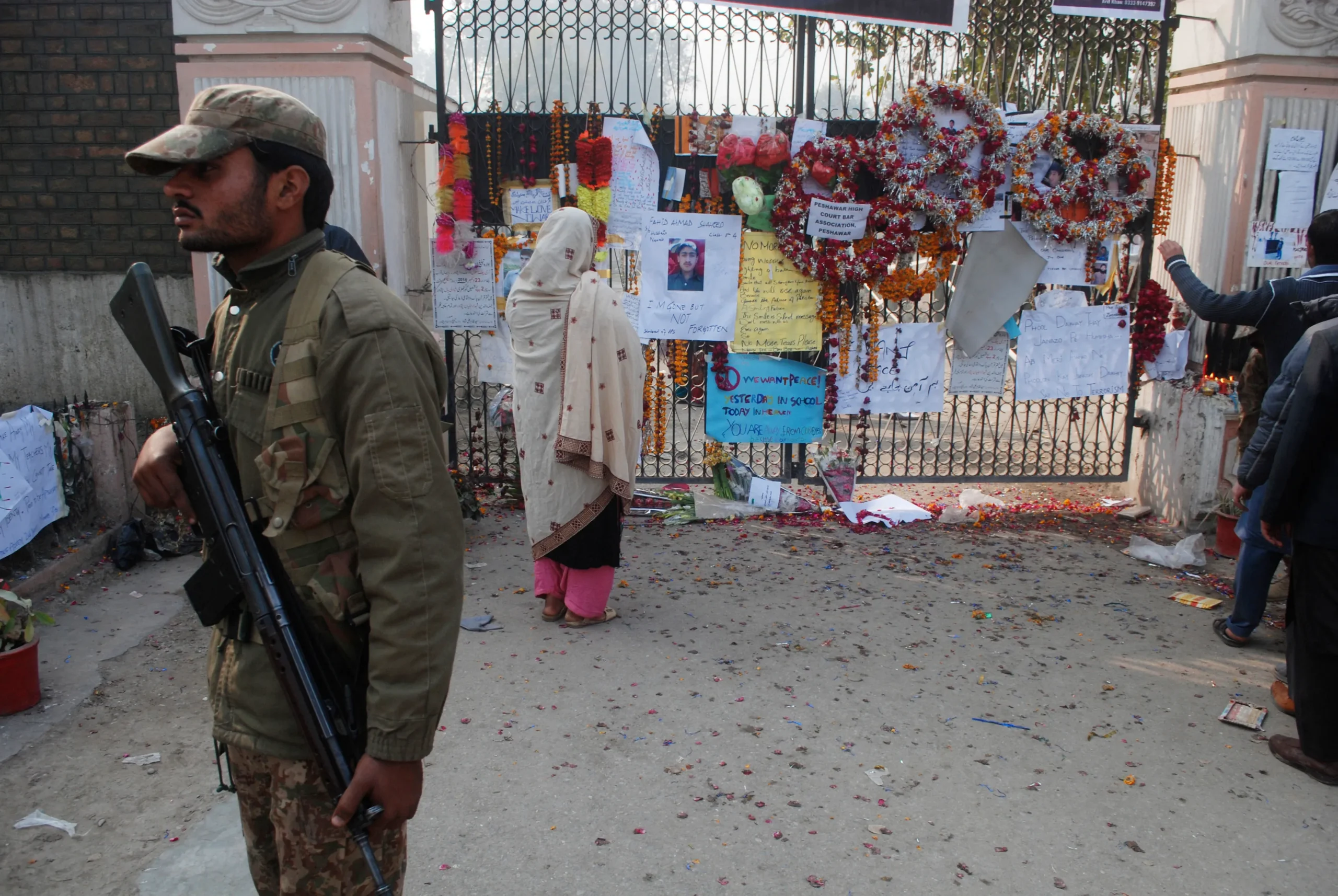
The campaign progressed from structural sabotage to devastating, high-casualty assaults designed for maximal political effect. The grim inflection point occurred on December 16, 2014, with the Army Public School (APS) Peshawar massacre. In this singular, barbaric act, TTP operatives murdered 149 people, the vast majority being children. This was explicitly framed by the group as direct retribution for a major military offensive, signifying a chilling strategic pivot: the calculated targeting of the military’s own families via a defenseless civilian facility.
This pattern of striking symbolic state educational sites continued with the January 2016 attack on Bacha Khan University in Charsadda. The enduring nature of this strategy was recently reaffirmed by the November 2025 attempt to storm the Cadet College Wana in South Waziristan, a clear effort to replicate the strategic impact of the APS tragedy by hitting state symbols linked to security forces. Between 2007 and 2015, there were 867 attacks on educational institutions in Pakistan, resulting in 392 fatalities and 724 injuries, quantifying the lethality of this sustained assault on the nation’s future.
The core driver of the TTP’s violence is a fundamental epistemological clash over the source and validation of knowledge. They reject the modern Pakistani curriculum, which they dismiss as Tarbiyat (state indoctrination), and seek its replacement with their stringent interpretation of Islamic instruction, or Taleem, delivered exclusively through controlled religious seminaries. The goal is not merely to alter pedagogy but to produce a populace loyal to their envisioned Islamic Emirate, precluding critical thinking or commitment to the civic state.
This ideological mandate finds its most consistent and brutal expression on the gendered battleground. The TTP views the education of girls as an existential threat to their patriarchal ideal, fundamentally incompatible with their interpretation of Purdah and traditional Islamic social roles. By systematically targeting girls’ schools and female instructors, they aim to eliminate women from the public sphere.
The empirical consequences of this ideological focus are starkly visible in regional education metrics. While Pakistan’s national literacy rate hovers around 60.65 %, the overall literacy rate for the merged districts of FATA is drastically lower, recently estimated at 32%. The disparity is deeply gendered, defining a human capital catastrophe. The adult female literacy rate in the tribal belt was recorded at a devastatingly low 16%, compared to the male rate of 56%. This militant campaign is the direct mechanism fueling this immense gap.
Moving beyond the religious mandate, the TTP strategically leverages school attacks to achieve sophisticated cultural and societal objectives rooted in mass coercion. The deliberate choice of the school environment is a form of engineered terror, calibrated to generate maximal psychological trauma. By striking the most vulnerable, unarmed children, the militants ensure that the shock permeates every level of society. The cultural objective is societal self-coercion. The resulting paralyzing fear forces parents and community elders to close schools and keep their children home, effectively implementing the TTP’s anti-education edicts through community choice rather than constant militant presence. Research confirms the success of this strategy, demonstrating that areas with high exposure to terrorism experienced a substantial decline in enrollment, with certain studies noting a reduction for girls of approximately 10.5% in conflict-ridden regions.
Educational institutions embody the state’s civic and cultural authority. Their destruction is a potent semiotic act that broadcasts the state’s failure to provide fundamental security. By subverting public trust in the government’s protective capacity, the TTP undermines state legitimacy. The modern curriculum is framed as a conduit for globalization and moral decay, making its elimination a cultural purification necessary to revert society to a deeply conservative and isolated social structure. Correspondingly, in the traditionally autonomous tribal regions, modern education represents a challenge to inherited power structures and local customs by offering alternative avenues for economic mobility. The TTP’s sustained violence targets this cultural liberalization, aiming to re-entrench a conservative social order. By eliminating accessible modern schooling, they restrict opportunities for youth, fostering dependence on the traditional, conservative systems, often those sympathetic or affiliated with the militant cause.
Strategically, the TTP weaponizes educational targets as a highly efficient tool for political pressure and resource gain. High-profile massacres are essential strategic maneuvers designed to challenge Islamabad’s writ and dominate the national security narrative. These attacks generate immense domestic pressure, compelling the government to divert vast, long-term security resources toward safeguarding civilian infrastructure. This forced reallocation draws resources and focus away from proactive offensive counter-insurgency operations. The chaos generated is immediately leveraged as propaganda, illustrating the state’s functional impotence and eroding the government’s legitimacy both regionally and internationally.
Furthermore, the systematic destruction and closure of public schools engineer a critical educational void in the civic structure. This vacuum is efficiently exploited by TTP-affiliated networks. By providing the only source of structured learning in a climate of fear and displacement, the TTP gains a crucial resource pipeline for indoctrination and recruitment. The strategic control over the human capital development ensures the long-term sustainability and ideological continuity of the militant enterprise.
In conclusion, the TTP’s campaign against educational institutions is a calculated, holistic effort to achieve long term objectives. It is an act of intellectual and developmental sabotage that seamlessly fuses ideological imperatives for a conservative social order with cultural coercion to instill fear, and it employs strategic violence to challenge the state’s foundational authority. The measure of this devastation extends beyond immediate casualties, quantified chillingly by the profound educational deficit, evidenced by the low female literacy rate in conflict-affected regions. Despite the calculated nature of this systematic war on knowledge, the resilience demonstrated by communities, students, and teachers who continue to pursue learning remains the most vital form of cultural and intellectual resistance against the TTP’s narrative of ignorance and terror.