Pakistan’s Successful Shaheen-II Missile Training Launch

Pakistan successfully tests Shaheen-II missile, focusing on troop training and performance evaluation, amid rising regional tensions.

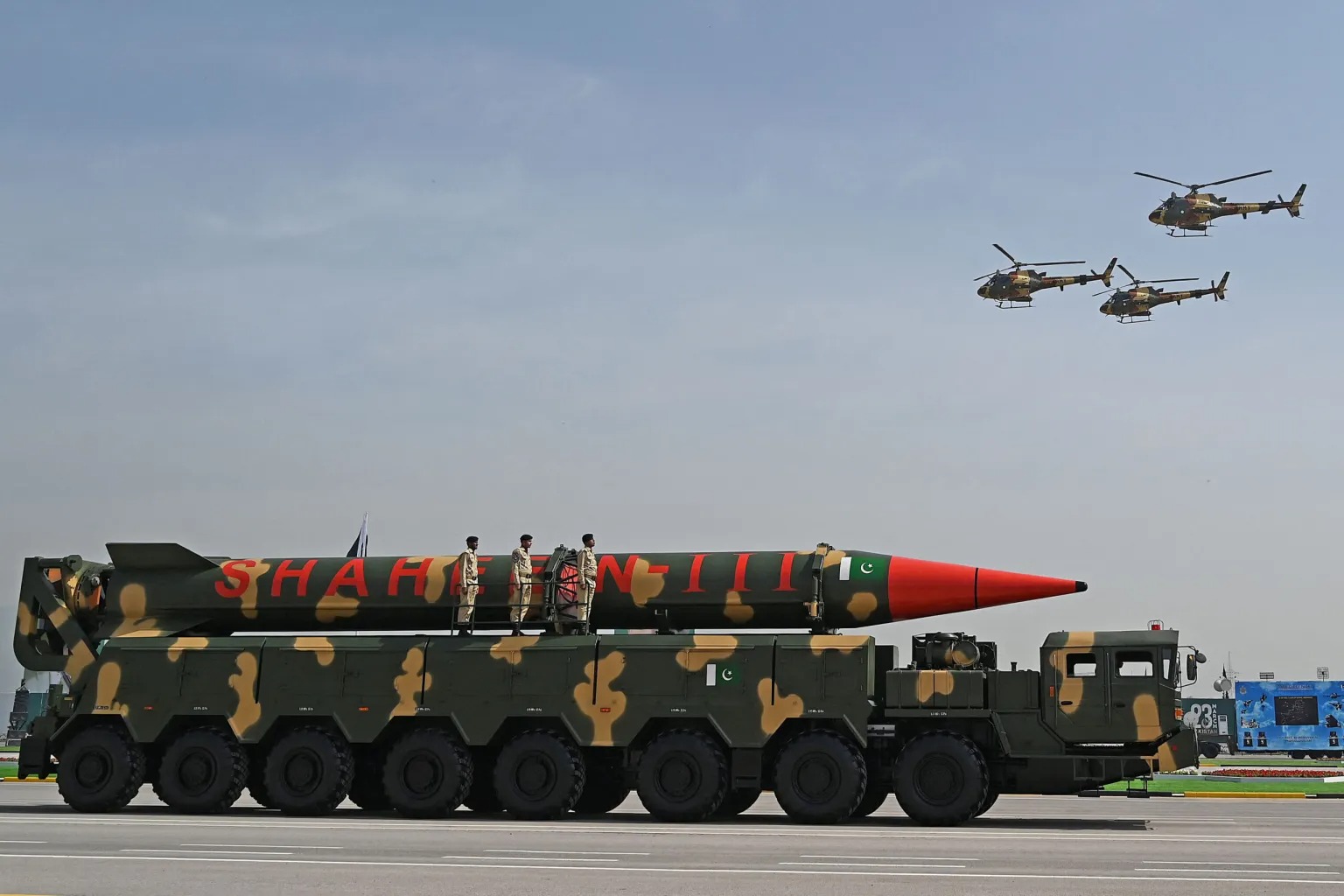
ISLAMABAD: On Tuesday, Pakistan’s army successfully launched a training exercise for its surface-to-surface ballistic missile Shaheen-II. The military’s media wing explained that the exercise aimed to train troops. The exercise also aimed to evaluate the performance of sub-systems. Additionally, this evaluation was crucial for ensuring improved missile accuracy.

Pakistan views its missile development as a deterrent against its nuclear-armed neighbor, India. Pakistan and India have fought three wars since independence from Britain in 1947. Furthermore, both nations have been developing missiles of varying ranges since they conducted nuclear tests in May 1998. In December 2023, the Pakistan Army successfully conducted a flight test of the Fatah-II missile. The Fatah-II missile has a range of 400 kilometers.

Pakistan and India continue to test missiles and build their weapons. Analysts warn that Asia may be sliding into an accelerating arms race.

“Pakistan today conducted successful training launch of surface-to-surface ballistic missile Shaheen-II,” the Inter-Services Public Relations (ISPR) said. “The training launch was aimed at training of troops, validating various technical parameters and performance evaluation of different sub-systems incorporated for improved accuracy and enhanced survivability.”

The military’s media wing reported that senior officers from the Strategic Plans Division, Army Strategic Forces Command, and scientists and engineers from strategic organizations witnessed the launch. The director general of the Strategic Plans Division appreciated the technical prowess, dedication, and commitment of the scientists. Their efforts contributed to the landmark achievement.

“The President, Prime Minister of Pakistan, Chairman Joint Chiefs of Staff Committee and Services Chiefs congratulated the scientists and engineers on this achievement,” the ISPR concluded.

This news is sourced from Arab News and is intended for informational purposes only.

News Desk

Your trusted source for insightful journalism. Stay informed with our compelling coverage of global affairs, business, technology, and more.

Recent

Blood and Gold: How Sudan’s War Became the World’s Greatest Human Rights Failure:

Blood and Gold: How Sudan’s War Became the World’s Greatest Human Rights Failure

Sudan’s war is not misunderstood, it is deliberately ignored. Fuelled by a gold economy tied to foreign profiteers, the conflict has dismantled the country while the world watches in silence. As the RSF and SAF wage a war built on extraction and exploitation, millions are displaced, starved, and erased from global concern. Sudan’s suffering exposes a deeper truth: human rights protections collapse where profit thrives and African lives remain invisible.

Read More »
The New Bollywood

The New Bollywood

Bollywood, once India’s most effective soft-power tool, is undergoing a dramatic ideological overhaul. Films like Dhurandhar and The Taj Story reflect a new cinematic nationalism rooted in historical revisionism, internal othering, and aggressive anti-Pakistan narratives, reshaping both India’s identity and its global cultural reach.

Read More »
Afghanistan’s Trade Boycott: Strategic Miscalculation With Fiscal Consequences

Afghanistan’s Trade Boycott: Strategic Miscalculation With Fiscal Consequences

Afghanistan’s 2025 trade boycott of Pakistan exposes a strategic miscalculation. Despite efforts to shift toward Iran and Central Asia, Kabul remains structurally dependent on Pakistan’s mature trade corridors, customs revenue, labour mobility, and logistical efficiency. Alternative routes carry higher costs, sanctions risks, and operational delays, leaving the Taliban with mounting fiscal losses and regional constraints.

Read More »
The Defund Taliban Campaign

The Defund Taliban Campaign

The Defund Taliban Campaign examines how indirect US funding and a $7 billion abandoned arsenal have turned the Taliban into a regional force multiplier for militant groups.

Read More »
The Taliban’s new fatwa banning foreign militancy signals a shift in doctrine, but rising regional attacks and ideological fractures raise questions about its enforceability.

Doctrine vs Reality: Can the Taliban Enforce Their Ban on Foreign Militants?

The Taliban’s new fatwa banning foreign militants has been hailed by officials in Kabul as a decisive theological shift. But rising attacks in the north, continued TTP operations, and mounting pressure from Washington expose a widening gap between doctrine and reality. As regional powers demand proof of enforcement, the decree risks becoming another symbolic gesture unless it translates into measurable action on the ground.

Read More »