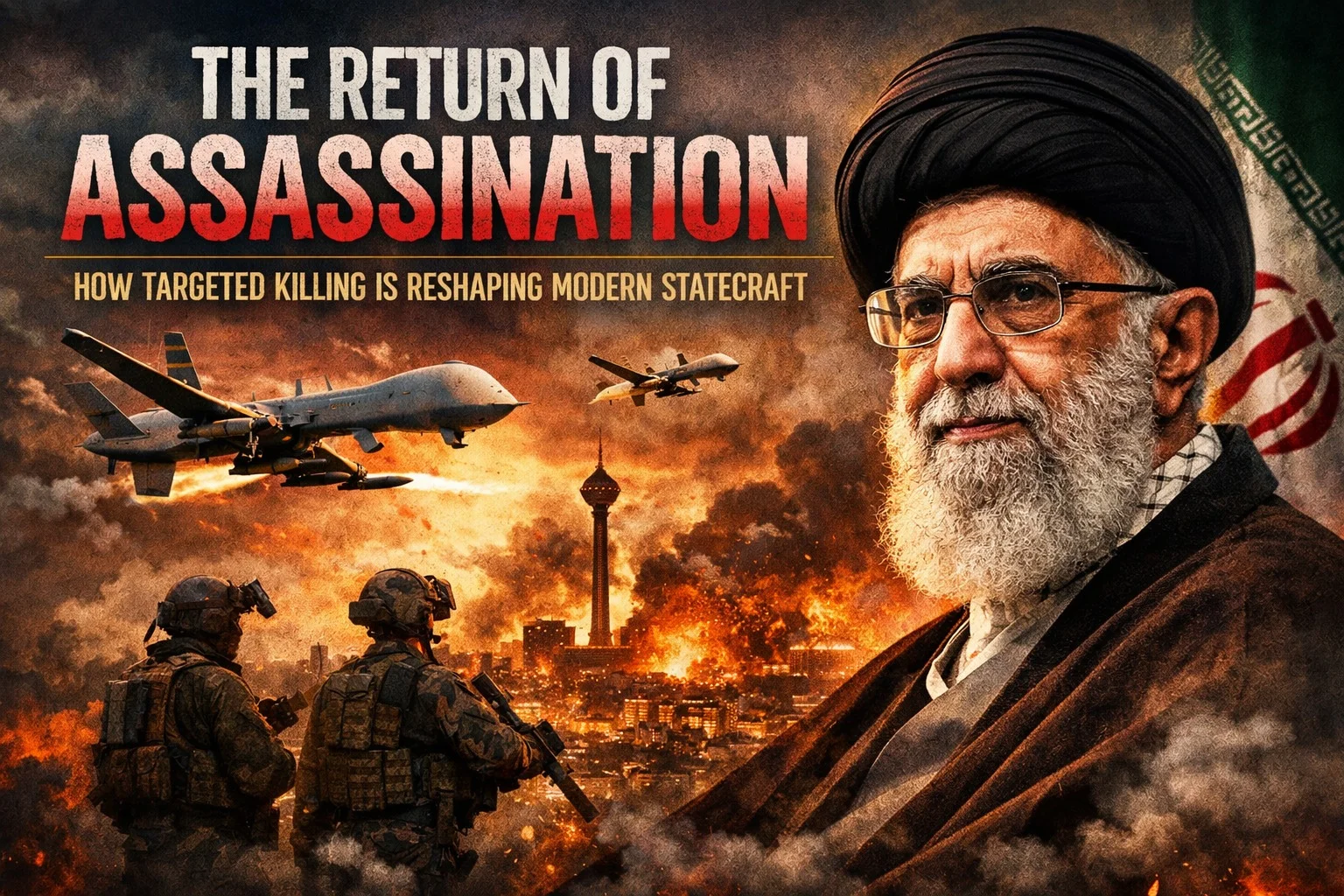
This morning, something significant happened that most commentators will miss because they are too focused on the missiles and the body counts.
Iran blinked.
President Masoud Pezeshkian, speaking on behalf of the Provisional Leadership Council that replaced Ayatollah Khamenei after his assassination on February 28, issued a formal public apology to Saudi Arabia and its Gulf neighbors. He announced that Iran’s military has been ordered to halt all strikes on regional countries, unless those countries are used as launchpads for attacks on Iran. The condition was precise, and it was not accidental.
The day before, Saudi Defense Minister Prince Khalid bin Salman had met Pakistan’s Chief of Defence Forces and Army Staff, Field Marshal Asim Munir, in Riyadh. The meeting was held explicitly under the framework of the Strategic Mutual Defense Agreement, the NATO-style pact signed by both countries in September 2025, which holds that an attack on one is an attack on both. Pakistan’s Foreign Minister Ishaq Dar had already privately warned Tehran that the agreement was active, and Iran had in turn asked Islamabad for assurances that Saudi soil would not be used against it.
The condition Iran announced publicly this morning is word for word what Pakistan privately negotiated. That is not a coincidence. Pakistan served as the bridge that brought Iran’s Gulf campaign to a conditional halt. Now it faces a harder question: what comes next?
The Case for a Visible Presence
The ceasefire Tehran announced is conditional and fragile. Pezeshkian himself admitted in his address that Iranian forces had been firing without full command authorization because their commanders were dead. An army acting without a coherent chain of command does not stop firing because its president asks politely. It stops when the cost calculation changes.
That is precisely where Pakistan can play a decisive role, and where the terms of the SMDA now demand it act. Pakistan operates a modern, combat-proven air force. Its fleet includes state of the art J-10C aircraft. Armed with beyond visual range PL-15 air-to-air missiles, the aircraft shot down 7 Indian Air Force fighter jets during the May 2025 stand-off. Besides, it also fields the combat proven JF-17 Thunder Block III, and F-16s fighter jets, and Erieye airborne early warning aircraft. This is not a ceremonial force. It is a credible one.
The argument is not for Pakistan to send jets into combat. The argument is for Pakistan to formally declare its treaty obligations active and station a visible, graduated military presence in Saudi Arabia: liaison and command coordination personnel first, air defense integration teams second, and a credible threat of forward-deployed combat aircraft as the final step if Iranian strikes resume. Each stage raises the cost of resumed Iranian aggression without crossing the threshold into direct warfare.
For Iran’s Provisional Council, which has just signaled it wants to separate its war with the US and Israel from its relations with its neighbors, a Pakistani military footprint in Saudi Arabia is a clear message: the cost of resuming Gulf strikes now includes potential engagement with a nuclear-armed state that has no territorial dispute with Iran, no political stake in regime change, and every contractual obligation to respond. That is a different calculation from anything Iran has faced this week.
The Risks are Real and Should not be Dismissed
Pakistan is not making this decision in a vacuum. Roughly 15 to 20 percent of its population is Shia Muslim, with deep cultural and religious ties to Iran. The government has already faced street protests over its perceived tilt toward the western-Saudi axis. Stationing assets visibly in Saudi Arabia is a photograph, a headline, and a political liability all at once.
There is also the command-and-control problem. If Iranian hardliners within the IRGC are already acting independently of their own political leadership, a Pakistani presence does not guarantee they will calculate rationally. A rogue strike on base hosting Pakistani personnel would trigger automatic obligations that Islamabad may not be prepared to honor at full scale.
And then there is the eastern flank. Pakistan fought India four days in May 2025. Its military is not in a position to absorb an open-ended second front in the Gulf while managing a still-tense border at home. Any deployment must be measured precisely against what Pakistan can sustain without hollowing out its own defenses.
Why Pakistan Should Act Anyway
The 2015 Yemen episode haunts this discussion. Pakistan declined a direct Saudi request to join the military coalition, and the relationship never fully recovered its depth. The SMDA was in many ways Saudi Arabia’s attempt to formalize what Riyadh had always assumed: that Pakistan would stand with it when it mattered. Saudi Arabia has now been struck by Iranian missiles and drones. It has invoked the agreement. If Pakistan hedges again, the relationship does not just cool. It ends.
The strategic and economic consequences of that outcome are severe. Millions of Pakistani workers depend on Gulf employment. Saudi financial support has been a recurring lifeline through Pakistan’s debt crises. The relationship is not sentimental. It is structural.
Beyond the bilateral, there is the larger signal. The Middle East is being redrawn this week. The old architecture of deterrence, American bases, Gulf state spending, and Iranian proxy networks, is either burning or reorganizing. Countries that position themselves as stabilizers in this moment will have leverage that latecomers cannot buy. Pakistan has a treaty, a competent military, credibility with both sides of the Sunni-Shia divide, and a leader in Asim Munir who has already demonstrated he is willing to show up in Riyadh when others stay home.
The graduated presence model gives Pakistan a way to honor its obligations without writing a blank check. Start with what is visible but not yet kinetic. Signal the commitment. Let the deterrence work. And if Iran’s Provisional Council is serious about separating its war with the US and Israel from its relations with its neighbors, this is exactly the kind of credible, bounded signal that makes that separation possible to sustain.
The bridge Pakistan built yesterday was made of phone calls and a quiet meeting in Riyadh. Iran’s ceasefire announcement this morning was the first sign that it held.
Pakistan has done the diplomacy. Now it needs to do the deterrence.