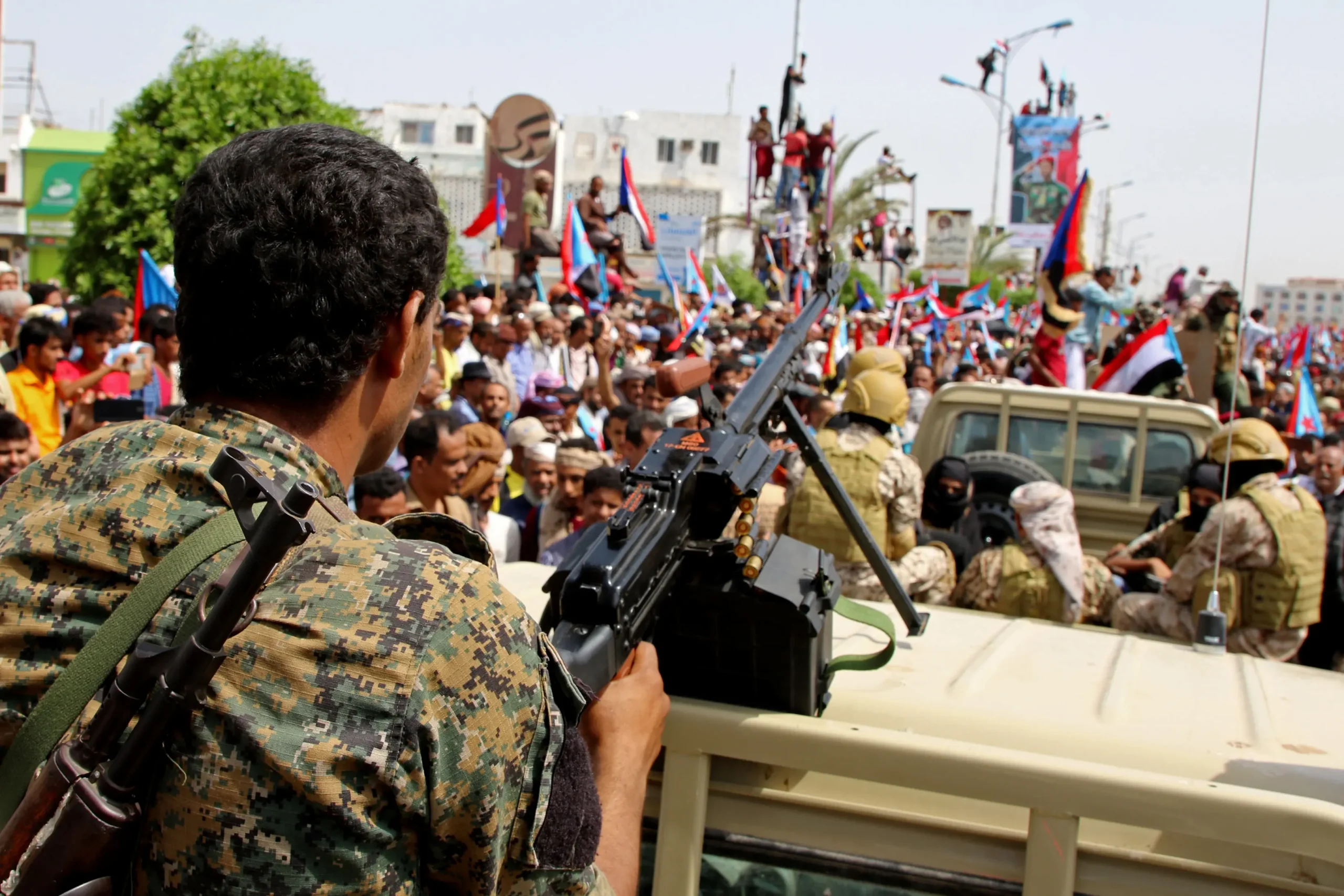
The smoke rising over Seiyun in early December signaled more than just a military escalation in Yemen’s Hadhramawt province. As forces loyal to the Southern Transitional Council (STC) expelled Saudi-backed troops from the strategic city, the images broadcast globally represented the physical dismantling of the post-Arab Spring order. The era of the lockstep alliance between Riyadh and Abu Dhabi is over. The expulsion of Saudi influence by proxies armed and funded by the United Arab Emirates was not a friendly fire incident. It was the violent manifestation of a geopolitical divorce that has been festering for half a decade.
For years, the Gulf monarchies operated as a unified front, primarily driven by a shared antipathy toward the Muslim Brotherhood and a desire to contain Iranian expansionism. That binary is now obsolete. As 2025 draws to a close, the strategic imperatives of the two capitals have irrevocably diverged. Abu Dhabi is aggressively carving out a thalassocracy, a maritime empire reliant on rapid normalization with Israel and the control of key choke points to secure a post-oil economy distinct from its larger neighbor. Conversely, Riyadh is pivoting toward territorial consolidation. Its Saudi First economic hegemony, exemplified by its Regional Headquarters Program, requires regional stability and a détente with Tehran to protect the gigaprojects of Vision 2030.
To understand the ferocity of the current rupture, one must look beyond the immediate tactical maps to the foundational cracks in the Yemeni state. Prior to 1990, Yemen was not a unified entity but two sovereign states with distinct ideological lineages: the tribal, conservative Yemen Arab Republic in the north and the Marxist-aligned People’s Democratic Republic of Yemen in the south. The unification of 1990 was rushed and fraught with immediate economic and political disparities, culminating in the 1994 civil war where the North maintained the union through military conquest.
The UAE has expertly weaponized this historical grievance. For the STC and its supporters, the current campaign is not a rebellion but a restoration of sovereignty and a correction of the mistake of 1990. Abu Dhabi recognized what Riyadh largely ignored, the Southern sentiment was a dormant volcano waiting to be tapped.
By aligning with Southern separatists, the UAE cultivated a proxy force ideologically committed to the disintegration of the Yemeni state. This stands in direct opposition to the Saudi strategic imperative, which views the preservation of the 1990 borders as essential for its own national security.
Yemen: The Primary Theater of Conflict
By December 2025, the tactical situation in Yemen had shifted drastically. The STC’s Operation Promising Future, which resulted in the seizure of PetroMasila oil infrastructure in Hadhramawt, was an economic stranglehold designed to deprive the Saudi-backed Presidential Leadership Council (PLC) of its remaining revenue streams. The subsequent withdrawal of Saudi troops from the Presidential Palace in Aden was a symbolic concession. Riyadh effectively admitted it could no longer guarantee the safety of its chosen government within the temporary capital.
One of the primary justifications presented by the UAE for the escalation of hostilities is the status of the Al-Islah party. The UAE and the STC have effectively employed an efficient strategy, labeling any opposition in Hadhramawt, including neutral tribes and the Saudi-backed Nation Shield Forces, as Muslim Brotherhood or terrorist cells. This classification serves a dual purpose. It justifies military aggression to Western observers wary of Islamism and provides a pretext to dismantle Saudi Arabia’s tribal influence networks.
However, the reality on the ground contradicts the Emirati narrative. Al-Islah in Hadhramawt operates less as a rigid ideological structure and more as a social network deeply embedded in local tribal dynamics. The history of assassinations targeting Islah leaders in Mukalla and Aden by Al-Qaeda in the Arabian Peninsula (AQAP) belies the STC’s claim of an alliance between the two. Riyadh’s continued support for Islah is born of pragmatism rather than ideological affinity. The Saudis view the party as the only organized ground force capable of serving as a bulwark against the Houthis. It is a marriage of necessity that Abu Dhabi refuses to tolerate, viewing political Islam as an existential threat to its dynastic model.
Perhaps the most striking development is the open courtship between the STC and Tel Aviv. Unlike the PLC, which remains tethered to traditional Arab League positions, STC President Aidarous al-Zubaidi has explicitly framed his movement as a natural partner for Israel. He presents the STC as a secular, anti-Islamist, and anti-Houthi barrier on the Red Sea.
The diverging endgames are now clear. The UAE seeks a fragmented Yemen, with a pliable South serving as an Emirati client state that secures the Empire of Ports encompassing Aden, Mukalla, Socotra, and Perim Island. Saudi Arabia seeks a unified, federal Yemen.
Sudan: Resource Wars and Red Sea Security
The divergence is not contained within the Arabian Peninsula. In Sudan, the conflict between the Sudanese Armed Forces (SAF) and the Rapid Support Forces (RSF) has metastasized from a civil war into a proxy conflict that mirrors the Saudi-Emirati split in Yemen.
The UAE’s backing of Mohamed Hamdan Dagalo (Hemedti) and the RSF is driven by a stark transactional logic that prioritizes extraction over state-building. This relationship is physically manifested in the controversial Amdjarass air bridge via Chad. Despite Abu Dhabi’s insistence that the operation is purely humanitarian, UN reports and satellite imagery suggest a different reality: a dedicated logistics corridor supplying the RSF with advanced munitions, thermobaric weaponry, and surveillance drones. This external support was the decisive factor in the RSF’s capture of El Fasher in late 2025, a victory that shattered the stalemate and gave the militia control over Darfur’s vast mineral wealth.
For Abu Dhabi, the RSF is a highly profitable venture. The militia secures the Jebel Amer gold mines, feeding Dubai’s bullion markets with billions in illicit gold, and provides a reservoir of battle-hardened mercenaries for Emirati operations across the MENA region. This militia-state model allows the UAE to bypass the messy bureaucracy of Khartoum and deal directly with a client capable of delivering resources without the constraints of sovereignty.
Saudi Arabia’s calculus is fundamentally different. Riyadh views the RSF’s ascendancy not as a business opportunity, but as an existential threat to the Kingdom’s Red Sea Coast vision. The disintegration of the Sudanese state threatens to turn the western bank of the Red Sea into a lawless zone of piracy and trafficking, directly imperiling the security of Neom and the Red Sea Project, the crown jewels of Vision 2030. Riyadh cannot afford a Somalia-style collapse on its western flank, where 1,800 kilometers of coastline could fall under the sway of militias and foreign mercenaries.
This anxiety drove the official rupture in mid-2025, when the Port Sudan-based government formally cancelled the $6 billion Abu Amama port deal with the UAE. This cancellation was not a unilateral Sudanese decision but a strategic victory for Riyadh, effectively severing a key tentacle of the Emirati “Empire of Ports” strategy.
Even the peace process has become a theater of competition. The US-Saudi Jeddah Platform has stagnated, largely because Riyadh refuses to legitimize the RSF as a political equal to the state, a status the UAE has aggressively pushed for in parallel negotiation tracks. When the RSF attempted to declare a parallel government in Nyala in early 2025, Saudi Arabia was the primary diplomatic force blocking its regional recognition, fearing a Libya scenario of permanent partition. The result is a diplomatic deadlock where the UAE funds the force dismantling the state, while Saudi Arabia funds the state struggling to survive, leaving Sudan caught in the crossfire of a Gulf power struggle that shows no sign of abating.
The Geopolitical Realignment
This regional fracturing is occurring against the backdrop of a decisive American strategic withdrawal. The 2025 US National Security Strategy, released in December, formalized the shift from crisis management to commercial partnership, signaling the end of the Carter Doctrine era. The US is no longer the Gulf’s unconditional security guarantor. This American policy change was years in the making.
In this vacuum, the UAE has doubled down on the Abraham Accords, viewing integration with Israeli intelligence and technology architectures as its primary shield. We are witnessing the calcification of a new alliance structure in the Middle East. It is no longer useful to speak of The Gulf as a monolithic political block. Instead, a specific trilateral axis has emerged, connecting Abu Dhabi and Tel Aviv with a network of like-minded secular non-state actors, including the STC in Yemen, the RSF in Sudan, and Khalifa Haftar’s forces in Libya.
This represents the new Emirati doctrine taken to its logical conclusion. The UAE has decoupled itself from Saudi Arabia’s geopolitical orbit, moving far beyond the era of the Beijing Agreement of March 2023 where Riyadh sought security through Chinese mediation. It is no longer the junior partner assisting the Saudi giant but an independent power pole with its own distinct vision. This independence has mutated into active competition. Abu Dhabi has demonstrated a willingness to back actors that directly undermine Saudi national security if it serves Emirati maritime or economic interests.
Saudi Arabia is left to manage the status quo through traditional state-to-state diplomacy, prioritizing stability to enable its economic transformation. The UAE, however, is aggressively reshaping the region using agile, non-state proxies. The alliance of the counter-revolution is dead, the era of intra-Gulf competition has begun.