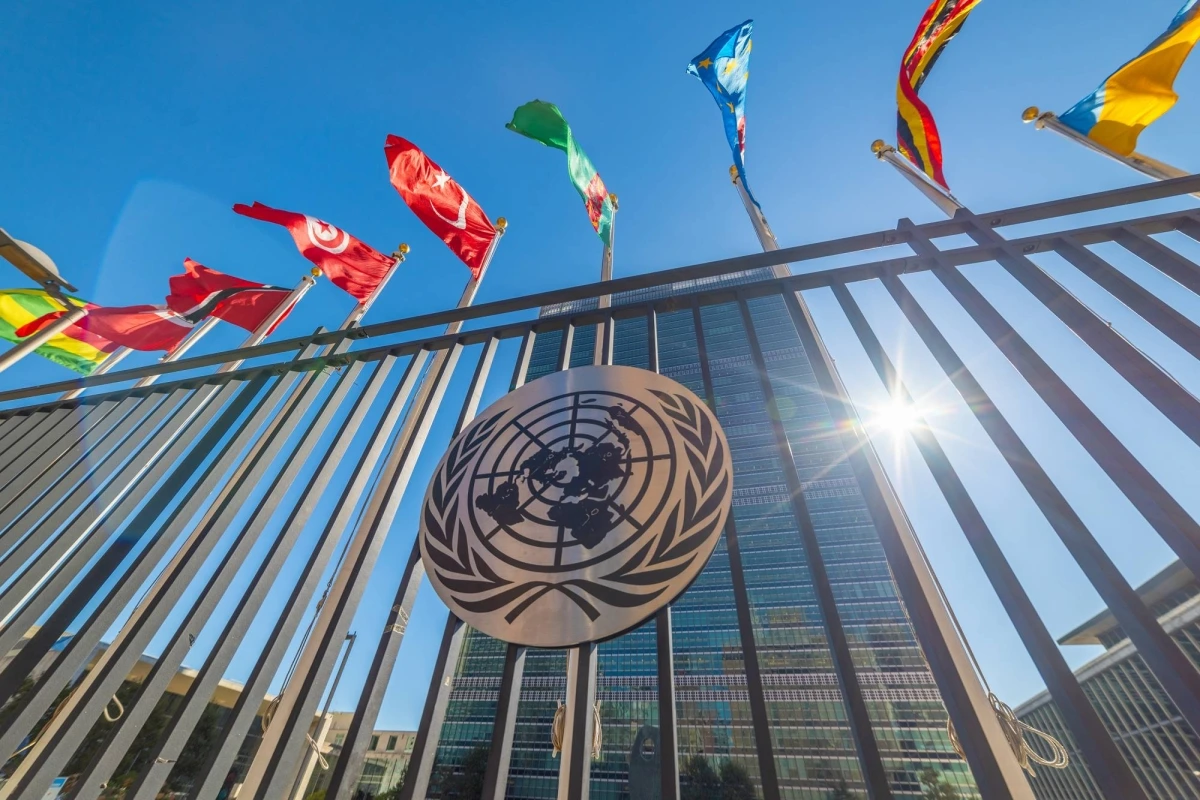
United Nations Charter was signed in 1945, The United Nations, conceived in the ashes of the Second World War with the mission “to save succeeding generations from the scourge of war,” now stands at a perilous crossroads. It represented humanity’s most determined effort to exorcise the ghost of its failed predecessor. The League of Nations (LoN) was a noble idea that died a slow, agonizing death in the 1930s. Its primary flaw was structural: the requirement of unanimity guaranteed paralysis, ensuring that collective action failed precisely when it was most needed.
Today, eight decades later, as the world reels from unresolved conflicts in Gaza, Ukraine, Sudan, and Yemen, a terrifying question has moved from the academic sphere to the diplomatic front page: Has the UN, through structural decay and geopolitical deadlock, become the very institution it was created to avoid a League of Nations 2.0?
The answer, examining the organization’s political function, is a sobering yes. The UN is suffering from the same fatal illness as the LoN, only this time, the poison is more insidious. Eighty years later, the United Nations risks becoming the League of Nations 2.0 a well-intentioned architecture built on the same utopian faith *E.H. Carr* once warned against: believing that moral idealism can override the machinery of power.
From Unanimity to the Veto: The Fatal Design Flaw
The architects of the UN, primarily Franklin D. Roosevelt and Winston Churchill in 1945, consciously studied the LoN’s demise. They observed how the League’s authority crumbled when major powers began to walk out: first, Japan over its invasion of Manchuria (1931), followed by Germany and Italy in the mid-1930s after the Abyssinia crisis. These departures, coupled with the critical absence of the United States from its inception, signaled that the League lacked both the universality and the credible enforcement capacity to maintain order.
The UN was designed to fix this through a pragmatic compromise: the Veto Power granted. Their solution, enshrined in Article 27 of the Charter, exclusively to the five permanent members (P5). This was intended not as a flaw, but as a safeguard a guarantee that the organization would never take binding enforcement action against one of the world’s most powerful nations, thus ensuring their continuous participation. The UN also promised universality. Membership grew from 51 to 193 states. Chapter VII of the Charter gave it legal authority to impose sanctions or use force. The framers intentionally chose structural survival over idealized efficacy.
But this strategic safeguard has now been weaponized, transforming the UN’s “pragmatism” into political paralysis. As historian *Paul Kennedy* observed in *The Parliament of Man*, “the United Nations reflects the power realities of 1945, not the aspirations of 2025.” Its institutions were designed for a bipolar world, yet it now struggles to stay relevant in a multipolar century.
The Paralysis of the P5: Veto-Induced Sabotage
Where the League suffered from passive inability to act due to legal gridlock, the UN suffers from active obstructionism. The Veto is the central instrument in the geopolitical “unilateralism vs. multilateralism” battle, allowing great powers to actively block action against their own interests or those of their allies. Consider the data: Russia (and former Soviet Union) has used its veto over 150 times, largely concerning conflicts in Syria, Ukraine, and protecting allied interests. The United States has used it over 90 times, with nearly all recent vetoes (since 2020) concerning Israel/Palestine issues.
When the U.S. vetoed resolutions condemning Israel’s bombardment of Gaza in 2023, and Russia blocked action against its own invasion of Ukraine, the world saw what smaller states have always known: that the veto is not protection it is impunity wrapped in diplomacy. As Pakistan’s former Ambassador *Munir Akram* observed, “the UN cannot champion justice while justice itself is subject to veto.”
The International Court of Justice ruled that Israel’s actions may amount to genocide; yet the Council’s chambers echoed only with the quiet of procedural deadlock. The General Assembly passed resolutions but, like the League’s resolutions before World War II, they were toothless expressions of conscience, not instruments of change. The UN Charter’s promise of “collective security” has been replaced by the politics of exemption. When aggression aligns with the interests of a P5 member, the Council turns diplomatic; when it does not, it turns punitive. The same institution that swiftly authorized interventions in Iraq and Libya has remained paralyzed over Kashmir and Palestine for decades.
This obstructionism has produced zero tangible results in critical conflicts, exposing the UN as a paper tiger. It failed to prevent atrocities in Rwanda (1994) and Srebrenica (1995). Long-standing political issues like Palestine, Ukraine, and Kashmir remain perpetually unresolved. The organization has also failed to restrain unilateral aggression, such as the Iraq War (2003), pursued without legitimate Security Council authorization, highlighting its inability to challenge the world’s hegemons.
The Iraq War and Failed Authority: The UN’s framers had a critical insight the LoN failed because no great power owned it. The UN’s success, therefore, was built on American dependency and commitment. That commitment is now eroding. Compounded by failures to achieve any tangible results in major crises, the UN’s authority is increasingly questioned. The 2003 Iraq War, pursued without UN Security Council (UNSC) justification, served as a catastrophic challenge to the UN’s enforcement capacity, signaling to the world that unilateral military action could supersede the global body’s mandate. As mutual distrust is so high that the UN Secretary-General has never been appointed from one of the P5 states. This is not governance; it is a geopolitical deadlock.
The Crisis of Dependency: The Shifting Sands of Ownership
The great strategic difference between the LoN and the UN was ownership. The League was undermined by the U.S. never joining. The UN’s initial success and ability to function were underpinned by the 100% dependency and consistent political will of the United States and its post-war allies. Now, that crucial dependency is eroding. As the global order fragments and a nascent multipolar world favors alternative blocs like BRICS+, the U.S. and other major members increasingly use the organization as a platform for political theatre rather than sincere collective action. This is compounded by profound financial instability, where major members use non-payment to induce a liquidity crisis.
Like the slow withdrawal of nations from the LoN in the 1930s, the current political erosion is a more sophisticated, institutional one: the great powers are not leaving, they are merely ensuring the UN cannot act against them. This results in the same political irrelevance the LoN suffered.
Financial Weaponization: A New Threat
Unlike the League, today’s UN faces a different existential danger: financial weaponization. In 2024, the organization faced a $2.4 billion shortfall in its regular budget and $2.7 billion in unpaid peacekeeping assessments. The U.S., its largest funder, has signaled it may forgo its 27% share of peacekeeping costs by 2026. This is not post-war poverty but deliberate political leverage a funding squeeze that undermines mandates agreed upon by the global community.
Secretary-General António Guterres’s “UN80” reform initiative streamlining operations, cutting staff by up to 20% shows institutional self-awareness. But the optics are grim: an organization marking its 80th anniversary with an austerity drive while crises rage in Gaza, Sudan, and Ukraine.
The UN’s Indispensable Second Identity: An Argument Against Replacement
Despite its catastrophic political failure, the UN is not yet obsolete. Like the LoN, which fostered the International Labour Organization (ILO), the UN’s resilience lies in its functional legacy its identity as a global network of agencies. To be fair, the parallel to the LoN which failed its core mission but left a critical legacy of technical cooperation is not perfect. The UN’s resilience lies in its “triple identity,” especially its role as an expansive network of secretariats and specialized agencies.
While the Security Council is politically gridlocked, the non-military UN is building the world anew. This “Non-Military UN” remains indispensable. The World Health Organization (WHO) has achieved major victories, including the near eradication of smallpox and polio, and was critical during the COVID-19 pandemic. UNESCO preserves world heritage, while UNICEF focuses on child welfare. The UN system provides crucial aid to millions during crises and champions the Sustainable Development Goals (SDGs). It also remains the only truly universal organization unlike regional blocs like the EU or SCO providing the framework for consensus in new domains like digital governance and cybersecurity.
The Road Ahead: Reform or Irrelevance?
The UN is now at a crucial crossroads. It is indispensable but in desperate need of repair. Finnish President Alexander Stubb and other reformers have articulated the necessary path: abolish or restrict the Veto Power to end the power of a single nation to hold the world hostage, and expand the Security Council to include at least five new permanent members from the contemporary world, reflecting the current 8 billion people and nine nuclear powers, with candidates like India, Brazil, Nigeria, and Japan. The current P5 structure reflects the world of 1945, with 2.5 billion people and one nuclear power. It must be expanded to reflect today’s 8 billion people and nine nuclear powers, including emerging global powers like India, Japan, South Africa, Nigeria, and Brazil, giving a stronger voice to the developing nations.
Without these fundamental changes which are themselves structurally blocked by the P5 veto the UN will continue its trajectory as an organization politically neutered in its primary mission. It will function merely as a large, complex, and vital global NGO.
The UN was created because the League of Nations failed to maintain the peace. If the current trajectory continues, we risk a global system in which international disputes are resolved not within the UN’s universal framework, but in the capitals of rival powers, encouraging further risk by aggressor states.
Conclusion:
The terrifying historical echo of the 1930s is sounding today. The UN must urgently reaffirm its political charter, or it too will be remembered as the organization that, despite its noble ideals, was finally killed by the irreconcilable self-interest of its most powerful members. Without radical reform, the organization will continue its trajectory as an indispensable, yet politically neutered, global governance platform a mere shadow of its intended self, the League of Nations 2.0.
As Boutros Boutros-Ghali once wrote, “the United Nations is only as strong as the political will of its members and the will of one can easily silence the rest.” His words echo painfully today, as the UN drifts toward the very irrelevance that buried its predecessor, the League of Nations.
The views expressed in this article are the author’s own. They do not necessarily reflect the editorial policy of the South Asia Times.

Ayesha Noor is a young analyst, writer, and researcher specializing in South Asian and global security.