Skip to content
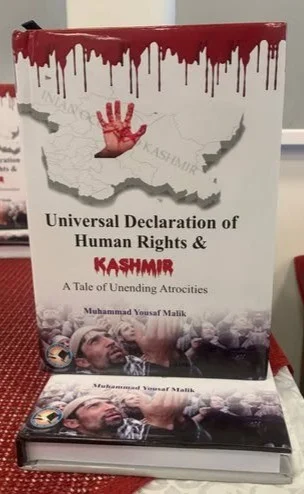
Universal Declaration of Human Rights and Kashmir: A Tale of Unending Atrocities, by Muhammad Yousaf Malik, provides a comprehensive, rights-based analysis of the Kashmir conflict, situating it within the frameworks of international human rights law and international humanitarian law (IHL). Muhammad Yousaf Malik critically examines the situation in Indian illegally occupied Jammu & Kashmir (IIOJK), where a series of developments constitute violations of internationally recognised legal standards. By grounding discussion in legal frameworks such as the Universal Declaration of Human Rights (UDHR), the author highlights the human rights dimension of the Kashmir dispute and its relevance to international Law.
The book is structured into four chapters that guide the reader through the historical, political, and legal context of the Kashmir conflict. It begins with an overview of Kashmir as the “Paradise on Earth,” followed by a discussion of the incomplete partition of the subcontinent and the genesis of the Kashmir dispute. The author traces the start of the freedom struggle in the region and explains how Kashmir gradually evolved into what many analysts describe as a nuclear flashpoint between India and Pakistan. The narrative also explores the stances of India and Pakistan on the Kashmir dispute and discusses the United Nations Security Council resolutions that have been passed for the resolution of the Kashmir conflict.
A significant portion of the book focuses on the socio-political claims of developments by the Indian government in Indian illegally occupied Jammu and Kashmir, particularly the abrogation of the autonomous status of the state, Articles 370 and 35A. The author discusses how the revocation of these provisions was followed by an extended internet blackout and reports of restrictions on civil liberties, suppression of dissent, arbitrary detentions, and the humanitarian consequences, including curfews, disruption of daily life, and the use of pellet guns that resulted in injuries to civilians. To exemplify these human rights violations, the author incorporates pictorial documentation and evidence that depict the lived experiences of affected communities.
Another notable feature of the book is its coverage of international responses to the human rights violations in Kashmir. It documents reactions from the international community, including statements and letters from presidents, prime ministers, and European Parliamentarians urging Indian authorities to address reported human rights concerns. The book also includes speeches delivered by leaders of various countries and highlights international media coverage of the human rights situation, particularly the issue of pellet gun victims.
The discussion is further strengthened through references to reports and documentaries from international organizations and media outlets. The author cites the reports and commentary from Amnesty International, Human Rights Watch, Al Jazeera, and The Wire to highlight international concerns regarding the human rights situation in Indian Illegally occupied Jammu and Kashmir. The book also lists resolutions adopted by the United Nations Security Council to resolve the Kashmir conflict and compiles articles, columns, and publications that have contributed to broader international discussion of the issue.
A distinctive aspect of the book is its comparative perspective. The author draws parallels between Kashmir and Palestine, situating the conflict within broader global debates on human rights violations, occupation, and the similar patterns of human rights abuses by Indian and Israeli forces. These comparisons are supported with textual analysis and pictorial representation, which help readers visualise patterns of human rights violations and humanitarian suffering in both regions.
The book’s other notable contribution is its article-by-article discussion of the Universal Declaration of Human Rights. The author examines how specific provisions of the Universal Declaration of Human Rights relate to human rights violations in Kashmir. Several fundamental rights have been violated in the region. This structured engagement with international legal instruments provides a strong academic orientation and enhances its appeal, particularly to readers interested in international law and human rights studies.
The inclusion of visual documentation throughout the book further enhances its accessibility. Pictorial representations of protests, civilian injuries, and other reported human rights violations effectively complement the textual narrative and provide readers with a more profound understanding of the situation described.
Overall, the book Universal Declaration of Human Rights and Kashmir: A Tale of Unending Atrocities provides a detailed and research-oriented account of the Kashmir conflict from a human rights perspective. By combining historical background, legal analysis, international documentation, and visual evidence, the book offers a multidimensional understanding of the issue. For scholars, policymakers, students of international law, and researchers interested in conflict studies and human rights, it presents a substantial body of material. Its extensive documentation, references to international organizations, and compilation of relevant writings make it a useful resource for those seeking to explore the Kashmir issue in greater depth. The author integrates multiple aspects of the Kashmir dispute into a unified analytical framework. Enabling readers to understand the issue from political, legal, and human rights perspectives.


![A view of Islamabad, as evolving regional dynamics reshape Pakistan’s security environment. [Image via Wikimedia].](https://southasiatimes.org/wp-content/uploads/2026/03/Islamabad_top_view.webp)