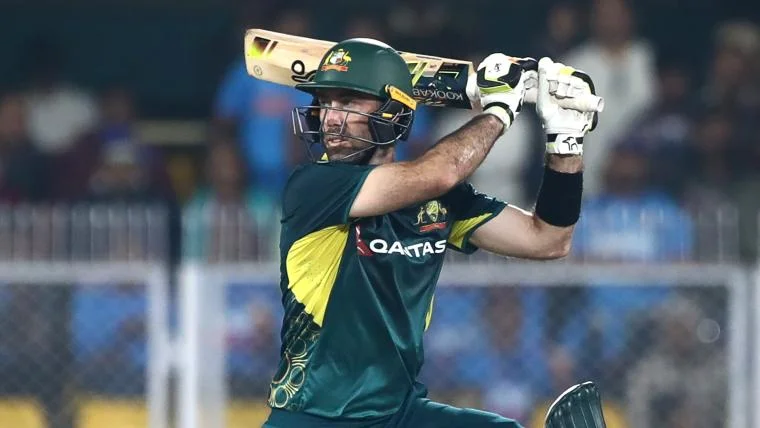
Australia T20I squad vs Pakistan announced

Australia announced its T20I squad for the series against Pakistan, with key players absent as they prepare for the Border Gavaskar Trophy.

On the morning of Monday, October 28, Australia announced its squad for the upcoming T20I series against Pakistan. The series will begin in early November. It will be part of a white-ball tour.

Key players like Pat Cummins, Travis Head, and Mitchell Starc are out of the Australia T20I squad. They are preparing for the crucial Border Gavaskar Trophy, which will start later in November, according to the press release.

Also See: History of Cricket Craze in South Asia

Australia’s squad for the T20I series against Pakistan

The official release states that any players from this squad who are also part of the Test side will join the Test team after their final game in Hobart. Xavier Bartlett, Nathan Ellis, and Spencer Johnson are among those named in the squad. They have returned to the team after recovering from injuries.

Australia squad for Pakistan T20Is: Sean Abbott, Xavier Bartlett, Cooper Connolly, Tim David, Nathan Ellis, Jake Fraser-McGurk, Aaron Hardie, Josh Inglis, Spencer Johnson, Glenn Maxwell, Matthew Short, Marcus Stoinis, Adam Zampa.

Chair of Selectors George Bailey said, “All players in this group have represented Australia in T20 cricket, so we look forward to seeing them continue to enhance their international experience throughout this series. The mix of seasoned players and those closer to the start of their international journeys excites us.”

Following the three ODIs from November 4 to November 10, Australia will host Pakistan for 3 T20Is on November 14, 16 and 18 at the Gabba, the SCG and Bellerive Oval respectively.

This news is sourced from Sporting News and is intended for informational purposes only.

News Desk

Your trusted source for insightful journalism. Stay informed with our compelling coverage of global affairs, business, technology, and more.

Recent

A fact-based rebuttal of claims about Pakistani troop deployment in Gaza, exposing disinformation and reaffirming Pakistan’s UN-mandated peacekeeping doctrine.

Debunking the Gaza Deployment Narrative

False claims of a Pakistani troop deployment to Gaza, amplified by disinformation networks, were firmly rejected by the Foreign Office, reaffirming that Pakistan’s military operates only under UN mandates and constitutional limits.

Read More »
The death of Sharif Osman Hadi marks the collapse of the 1971 Consensus, reshaping Bangladesh’s identity and triggering a strategic crisis for India.

The End of the 1971 Consensus

Sharif Osman Hadi’s death has become the symbolic burial of the 1971 Consensus that long structured India–Bangladesh relations. For a generation with no lived memory of the Liberation War, Hadi embodies a Second Independence, reframing 1971 as the start of Indian dominance rather than true sovereignty. His killing has accelerated Bangladesh’s rupture with India and exposed a deep strategic crisis across South Asia.

Read More »
Afghanistan’s Taliban uses pharmaceutical policy to assert autonomy, decouple from Pakistan, and expand strategic ties with India.

Afghan Taliban’s Biopolitics

The Taliban’s health diplomacy is reshaping Afghanistan’s geopolitical landscape. By phasing out Pakistani pharmaceuticals and inviting Indian partnerships, Kabul securitizes its healthcare infrastructure as a tool of strategic realignment. The shift highlights the intersection of sovereignty, economic statecraft, and regional influence, with Afghan patients bearing the immediate consequences.

Read More »
Islamophobia after violent attacks fuels polarization, legitimizes collective blame, and undermines security while strengthening extremist narratives.

Who Benefits from Islamophobia?

In the wake of global violence, political actors often replace evidence-based analysis with collective blame. Islamophobia, when elevated from fringe rhetoric to state discourse, fractures society and weakens security.

Read More »