
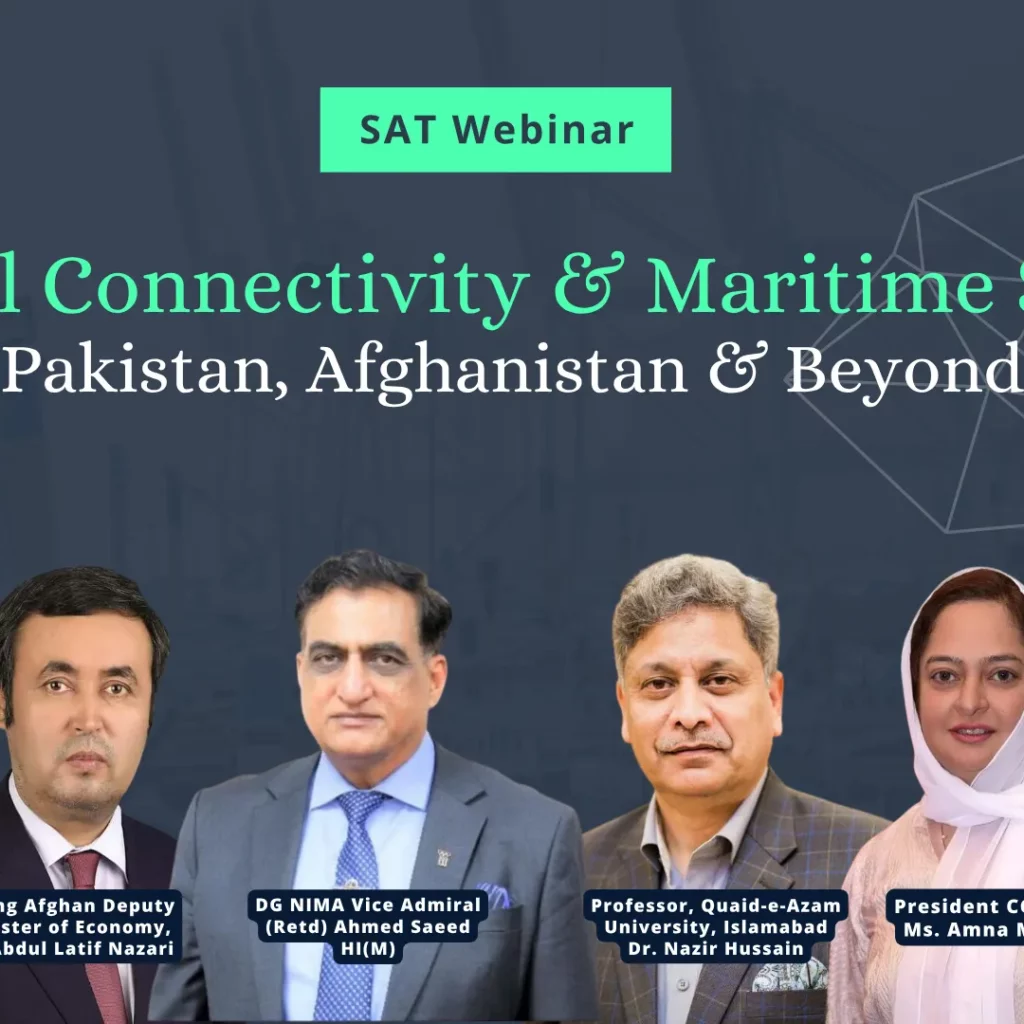
Regional Connectivity and Maritime Security: Pakistan, Afghanistan, and Beyond

South Asia Times (SAT) hosted its debut webinar to discuss the themes of regional connectivity and maritime security that have far-reaching implications for South Asia and beyond. Experts from Pakistan, Afghanistan and Iran participated in the discussion.

The webinar served as a robust platform for thought leaders to exchange insights, address challenges, and propose innovative solutions concerning regional connectivity and maritime security, with a focus on Pakistan and Afghanistan. Pakistan’s pivotal role in regional connectivity projects and the Maritime Silk Route, acting as a vital link for trade and energy flows, was a key highlight. Additionally, Afghanistan’s aspirations as a hub for regional trade were explored, emphasizing the potential for economic growth and stability through integration into these initiatives.

Distinguished panelists, including Dr. Abdul Latif Nazari, H.E. Mr. Fereydon Priloren, Dr. Nazir Hussain, and Ms. Amna Malik, enriched the discussions with their expertise and diverse perspectives. The keynote address by Vice Admiral (Retd) Ahmed Saeed delved into challenges, strategies, and shared prosperity in the realm of regional connectivity and maritime affairs.

WebDesk

Recent

Herat tragedy claims 30 lives, exposing Afghanistan’s governance failures, unsafe migration, and escalating humanitarian crisis.

Herat Border Tragedy: The Deadly Consequences of Afghanistan’s Governance Failures

The Herat border tragedy, is a stark illustration of the human cost of Afghanistan’s governance failures. With limited economic opportunities, widespread poverty, and insufficient social support, families are forced to undertake life-threatening journeys across freezing mountains. The incident underscores the urgent need for the Afghan government to provide stable livelihoods, establish safe migration routes, and strengthen healthcare and social services, as humanitarian risks continue to escalate across the country.

Read More »
A fact-based rebuttal of claims about Pakistani troop deployment in Gaza, exposing disinformation and reaffirming Pakistan’s UN-mandated peacekeeping doctrine.

Debunking the Gaza Deployment Narrative

False claims of a Pakistani troop deployment to Gaza, amplified by disinformation networks, were firmly rejected by the Foreign Office, reaffirming that Pakistan’s military operates only under UN mandates and constitutional limits.

Read More »
The death of Sharif Osman Hadi marks the collapse of the 1971 Consensus, reshaping Bangladesh’s identity and triggering a strategic crisis for India.

The End of the 1971 Consensus

Sharif Osman Hadi’s death has become the symbolic burial of the 1971 Consensus that long structured India–Bangladesh relations. For a generation with no lived memory of the Liberation War, Hadi embodies a Second Independence, reframing 1971 as the start of Indian dominance rather than true sovereignty. His killing has accelerated Bangladesh’s rupture with India and exposed a deep strategic crisis across South Asia.

Read More »
Afghanistan’s Taliban uses pharmaceutical policy to assert autonomy, decouple from Pakistan, and expand strategic ties with India.

Afghan Taliban’s Biopolitics

The Taliban’s health diplomacy is reshaping Afghanistan’s geopolitical landscape. By phasing out Pakistani pharmaceuticals and inviting Indian partnerships, Kabul securitizes its healthcare infrastructure as a tool of strategic realignment. The shift highlights the intersection of sovereignty, economic statecraft, and regional influence, with Afghan patients bearing the immediate consequences.

Read More »
Islamophobia after violent attacks fuels polarization, legitimizes collective blame, and undermines security while strengthening extremist narratives.

Who Benefits from Islamophobia?

In the wake of global violence, political actors often replace evidence-based analysis with collective blame. Islamophobia, when elevated from fringe rhetoric to state discourse, fractures society and weakens security.

Read More »