
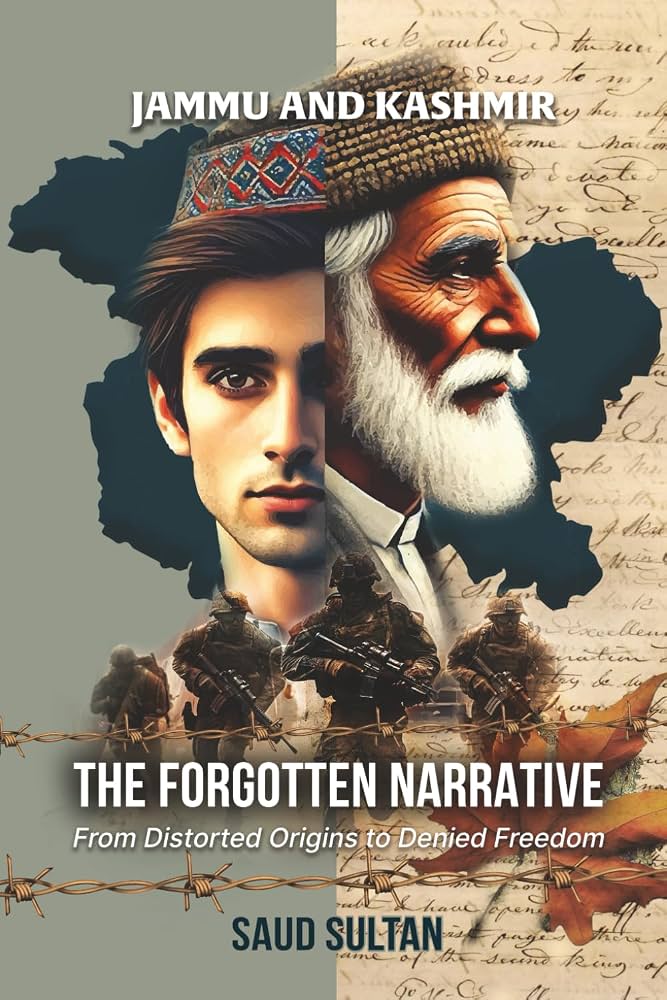
Jammu and Kashmir: The Forgotten Narrative from Distorted Origins to Denied Freedom, written by Saud Sultan, provides a comprehensive analysis of the partition of the sub-continent and its consequences, and the Jammu and Kashmir conflict.
The book places a dispute within a historical framework by presenting the facts and perspectives that have received little to no attention, which are mostly least discussed and, according to the author, misinterpreted, and also about those facts that are deliberately hidden by India.
The book is structured into eleven chapters divided into two parts. Part one consists of chapters one to seven, and part two of chapters eight to eleven, providing the reader with knowledge of the historical and political dimensions of Jammu and Kashmir and about the Kashmiri refugees of 1990 settled in Azad Kashmir.
One of the book’s noteworthy contributions is a detailed account of the struggles and sacrifices made by the people of Azad Jammu and Kashmir during the war of 1947-48; this aspect is often not highlighted.
The first part opens with a discussion of the forgotten bloodshed, “Jammu Genocide 1947,” and its reverberations, which India deliberately hides from the world; this Genocide is three times greater than the Holocaust. The author gives detail analysis about the Jammu Genocide and the killings of Muslims for demographic shift. Many authors believe that Jammu was a Hindu-majority region, but the author presented detailed evidence showing authentic demographic statistics of the Jammu region before and after the Jammu genocide.
The author also discussed two causes of this genocide: first, the Maharaja of Jammu and Kashmir was Hindu and wanted to change the demography of the region by reducing the Muslim majority, and second, to maintain his control over the state of Jammu and Kashmir, the Maharaja’s preference was that either Jammu and Kashmir become independent or accede to India.
A significant portion of the book focuses on India’s claim that Jammu Genocide of 1947 was the result of Pashtun tribesmen whose involvement forced Dogra Maharaja hari Singh to accede with India, by ignoring and hiding the facts that the indigenous people of the state of the Jammu and Kashmir were fighting prior before tribesmen against the brutal policies of the Dogra Maharaja and poonchis rebellion is the main evidence of that revolt against Maharaja.
The author discusses that in this way the Jammu Genocide was omitted from the Indian official narrative and hides from the world, by only highlighting the false narrative that tribesmen were responsible for the Jammu Genocide. The fact is that the people of Jammu and Kashmir called the tribesmen for help. In the United Nations Security Council on 1st January 1948, India, without mentioning what happened in Jammu, only complained about tribesmen by blaming Pakistan. Since then, the involvement of Pashtuns has continued to command academic and mainstream attention.
In addition, the book also highlights that the violence and mass deportations in Punjab were the center of attention in 1947. The author argued a direct link between the violence in Punjab and what occurred in Jammu.
Another notable feature of the book is that the author discusses the struggle of the inhabitants of Jammu and Kashmir, particularly in the area of Azad Jammu and Kashmir, which has been almost ignored in the academic discourse. The author highlights their revolt against the Maharaja and resistance against the Indian Army to liberate what is now called AJK in1947. This is the significant part, and it demonstrates the role and ambitions of the indigenous people during partition. By ignoring them and their sacrifices, the narratives become misleading.
The author also highlights the intervention of the Indian Deputy Prime Minister (Sardar Vallabhbhai Patel) in Jammu and Kashmir, whose foundations had been laid in October 1947. And when the people of the state, especially from Poonch, know about these developments, then they call Pashtun tribesmen for help. This argument of the author overturns the narrative by India, which portrays the tribesmen as the instigators.
A distinctive aspect of the book is the legality of the instrument of accession of 1947 with India by the Maharaja Hari Singh. The author argued that the instrument of accession is disputed and false; he also gives references to it by quotations of several prominent historians, such as Alastair Lamb, Victoria Schofield, and Andrew Whitehead.
The author also presented another new perspective about the origin of the conflict by opposing the claim of India which is also international accepted narrative that Pakistan invaded Kashmir first, he argues that before tribesmen came, there were external actors including Akali Sikhs who independently entered into J&K to kill the Muslims of the Jammu as an extension of the mayhem prevailing in Punjab and Patiala forces entered J&K as part of Sardar Patel’s plan of military intervention.
The second part of the book, in which the author discusses the Kashmiri refugees of 1990 and living in AJK. The author briefly explains the status and socio-political and economic conditions of the refugees. Since the 35 years of migration from Indian occupied Jammu and Kashmir several number of Refugees are still living in Refugee camps.
He also analyses the major problems, such as housing, employment, education, and their status in AJK. The book also presented the Pictorial representations of the refugees living in the camps and also about the status of the Refugee cards and allowances. He also discusses the reason why the AJK government has not been able to rehabilitate the refugees properly, which is due to a lack of or less financial resources.
In the last, the author highlighted in detail the current situation in Indian occupied Jammu and Kashmir and the policies of India to bring socio-political, cultural, demographic, and religious transformation in the Muslim-majority region.
Overall, the book Jammu and Kashmir: The Forgotten Narrative from Distorted Origins to Denied Freedom provides a comprehensive research-oriented account of historical facts about the state of Jammu and Kashmir, the partition of the sub-continent, the Jammu and Kashmir conflict, and the struggle and sacrifices of the liberated part of the state known as Azad Jammu and Kashmir.
By combining historical background, legal analysis, and international documentation, the book provides a multidimensional understand about the complex issue of Jammu and Kashmir.

The author is a Research Officer at the Center for International Strategic Studies, Azad Jammu & Kashmir (CISS-AJK), holds an M.Phil. in Kashmir Studies from the University of Azad Jammu and Kashmir, and is also an alumna of the Near East South Asia (NESA) Center for Strategic Studies and the Nuraa Women’s Institute, Indonesia (NWI).