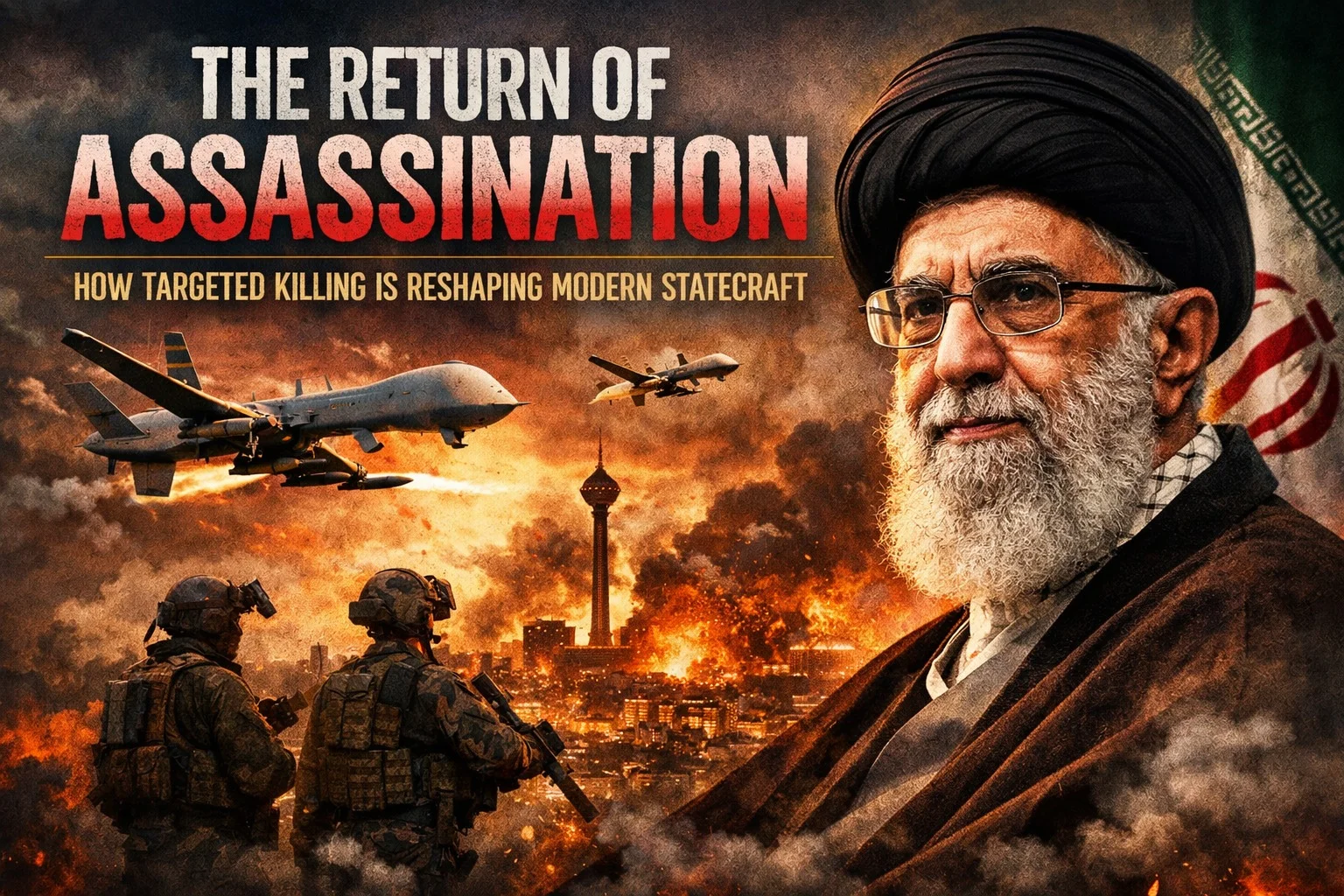
On 28 February 2026, Iran’s Supreme Leader, Ayatollah Ali Khamenei, was assassinated in a coordinated U.S.–Israeli strike on Tehran, which was carried out as part of a broader operation targeting senior Iranian leadership. Reports indicate that the mission relied on extensive intelligence and was designed to decapitate Iran’s leadership structure through precision strikes. The attack resulted in the deaths of several high-ranking officials and aides, marking one of the most consequential instances in recent history of a targeted killing that involve a sitting head of state.
It is worth mentioing that the assassination of Khamenei is not an isolated event, rather it is the manifestation of a wider trend in which states are increasingly using targeted killing, often via drones, special forces, or intelligence operatives, as a routine tool of national security policy. Some of the examples of this trend include the 2020 United States drone strike that killed Iranian General Qassem Soleimani in Baghdad, an operation widely debated under international law regarding its legality.
Once an exceptional practice largely confined to covert intelligence operations during the Cold War, targeted killing now appears to be moving toward normalization in contemporary conflict. In recent years, its use has expanded beyond traditional state adversaries to include non-state actors. Israel’s repeated attempts to target leaders of Hamas and Hezbollah across successive conflicts in Gaza and Lebanon illustrate this shift. Similarly, in 2024, Sudanese military leader Abdel Fattah al-Burhan survived a drone attack directed against him amid the country’s ongoing civil war. These instances collectively suggest that targeted killing is no longer restricted to clandestine intelligence activities but has evolved into a more routine instrument of modern military strategy.
States claim such actions to be legally permissible acts of self-defence or military actions. This article seeks to set out that target killing has gone from an extraordinary practice to a normal tool of statecraft. States increasingly invoke self-defence and counter-terrorism frameworks to justify lethal operations beyond traditional battlefields. Targeted killing, when it occurs, may sometimes constitute the lesser evil to address an imminent threat. However, normalising it risks eroding international legal norms and diffusing the practice of deescalation.
Defining Target Killing in the Context of International Politics
According to Nils Melzer, targeted killing means the intentional and premeditated use of lethal force against a specific person not in the physical custody of the attacking party. The definition sets out the three key features. First, targeted killings are deliberate, planned acts, not spontaneous acts of battle. Second, they target specific individuals at particular times, as opposed to generalized attacks against military units. Third, the targets are usually based outside the territorial control of the attacking state, which kills without any form of arrest or trial.
While the two are often conflated in the public sphere, the term is typically used in opposition to assassination. Assassination, in historical terms, refers to the politically-motivated killing of a prominent person. However as noted by Ronen Bergmen, governments generally tend to steer away from this term owing to its strong normative condemnation. International Humanitarian Law (IHL) allows the use of lethal force only when it is strictly necessary to protect life. Force must only be used as a last resort after lesser options like arrest or incapacitation have failed.
Targeted killing is not the same as battlefield killing under IHL. When there is armed conflict, combatants may lawfully target enemy fighters or individuals directly participating in hostilities. Under these circumstances, the killing of enemy combatants is permissible under the laws of war and is not a crime. The challenge arises because most targeted killings occur in spaces that do not fit these legal boxes. States justify this kind of action as consistent with existing armed conflict with non-state actors or opposing governments, even if it takes place outside a traditional battlefield. The lack of clarity enables governments to choose their preferred legal framework.
Competing Frameworks
Debates over the legality of targeted killings often turn on a more fundamental question: which body of law governs the operation in the first place. In this regard, three distinct, yet sometimes overlapping, legal frameworks are typically invoked, which are—the law on the use of force (jus ad bellum), international human rights law, and international humanitarian law. Each offers a different lens through which the permissibility of such actions is assessed, and the choice of framework can significantly shape the legal and moral evaluation of a given strike.
Jus ad Bellum: When Can States Use Force?
The first legal question asks whether a state can use force on another state’s territory at all. According to Article 2(4) of the United Nations Charter, no state shall use or threaten to use force against the territorial integrity or political independence of any state. This is the basic norm of a new international system whose foundation was laid after the Second World War. According to Article 51 of the Charter, states may use force in self-defence if it has been attacked. This is the provision upon which governments that conduct targeted killings abroad often rely.
In the case of the assassination of General Qassem Soleimani, the US invoked self-defence as justification. US officials defended the state’s actions by arguing that Soleimani was planning imminent attacks against American personnel in the Middle East. The assassination of Ali Khamenei in 2026 raises similar concerns. The killing of another state’s leader is one of the most extreme forms of targeted killing. According to some analysts, unless there is clear evidence of an imminent armed attack, such a strike might be construed as an act of war and aggression.
In this context, there is a serious concern regarding the expanding scope with which states are interpreting the right of self-defence. When governments unilaterally determine whether a threat is sufficient to justify the use of force beyond their borders, it risks undermining the prohibition on the use of force, thereby weakening one of the fundamental principles of the international legal order.
The Right to Life
The legality of targeted killings in situations other than armed conflicts is mainly determined by International Human Rights Law. Article 6 of the International Covenant on Civil and Political Rights (ICCPR) guarantees the inherent right to life and prohibits the arbitrary deprivation of life. According to the UN Human Rights Committee, this right applies not only within a state’s territory but also to situations where a state exercises power or control abroad.
The clarifications of General Comment No 36 state that lethal force must always be strictly necessary and proportionate. In this regard, states must show that killing was the only option left available. In practice, this creates a strict legal barrier. Authorities should assess whether capture or arrest was feasible before employing lethal force. Critics contend that there are many targeted killing operations that do not fulfil these requirements because they are carried out in contexts where arrest could have been possible. However, the critiques argued that in areas controlled by rival forces, the attempt to capture suspects could amount to an unacceptable risk to soldiers or civilians.
Laws For International Armed Conflict
The legality of targeted killings during armed conflict is governed by International Humanitarian Law. According to the Law, combatants and non-combatants actively involved in the belligerent acts could be legitimately targeted. However, the challenge arises in the determination of legitimate targets. The International Committee of the Red Cross has released guidance on direct participation in hostilities, indicating that civilians lose protection from attack only for the time of their participation in hostile acts.
Determining whether a suspected militant satisfies this threshold is often fraught with difficulty, particularly when the underlying intelligence remains classified and inaccessible to external scrutiny. This lack of transparency complicates any objective assessment of whether an individual is, at a given moment, directly participating in hostilities. A further issue concerns the geographical scope of armed conflict. Some states adopt an expansive view, arguing that hostilities against transnational terrorist groups extend to any location in which such groups operate. This interpretive flexibility allows governments to situate targeted killings within differing legal frameworks, depending on the context, thereby shaping the applicable legal justification for the use of force.
The Issue of Accountability
Targeted killings may be justified under International Law, yet this raises a major accountability issue. Philip Alston was the United Nations Special Rapporteur on extrajudicial executions. Alston warned that targeted killing programs usually function with a lack of transparency. Governments reveal little about the intelligence used to identify targets or the legal reasoning behind strikes.
The secrecy creates several accountability issues. Legislative oversight is often limited because the information is classified. Additionally, investigations into civilian casualties may not be independent. Often, victims and their families lack legal remedies. Devoid of meaningful oversight, it becomes difficult to ascertain whether such operations comply with international law.
Why States Use Targeted Killing
From a strategic perspective, targeted killing offers several perceived advantages to states. Foremost among these is its capacity to reduce the need for large-scale troop deployments. The use of drone strikes and covert operations enables states to neutralize specific threats without engaging in prolonged military campaigns.
In addition, such operations are often more manageable in political terms. Governments frequently emphasise the precision of advanced weapons systems, presenting targeted strikes as capable of minimising collateral damage and thereby making them easier to justify domestically and internationally. Furthermore, these operations provide a degree of plausible deniability, as they are typically conducted by intelligence agencies or specialised military units with limited public disclosure, allowing states to control the narrative and manage political fallout.
However, the risks are involved are often overshadowed by the advantages. One such risk is the erosion of the norms. When powerful states openly adopt targeted killing, other states may copy their methods. Countries that have fewer checks could use similar reasoning to remove opponents abroad. Another risk is backlash and intensification. The assassination of prominent leaders can spark tit-for-tat responses by states or groups. In essence, targeting certain individuals or groups will encourage other states to follow this practice in the longer term.
Conclusion
The growing use of targeted killings marks an important change in the practice of statecraft. What was considered an extraordinary practice has become an accepted feature of statecraft in the modern era. States are increasingly resorting to targeted killings of officials and political leaders, in addition to their use against terrorist groups. Although the use of targeted killings has been justified on the basis of self-defence and the laws of war, the question of legality and morality remains up in the air. The growing use of targeted killings is symptomatic of the beginning of the end of the international legal framework and its enforcement and the real challenge is to strike a delicate balance between security and the rule of law.

The author is a final year law student at the University of London. He has previously published for MinuteMirror and The Friday Times. He may be reached at walikharal10@gmail.com.