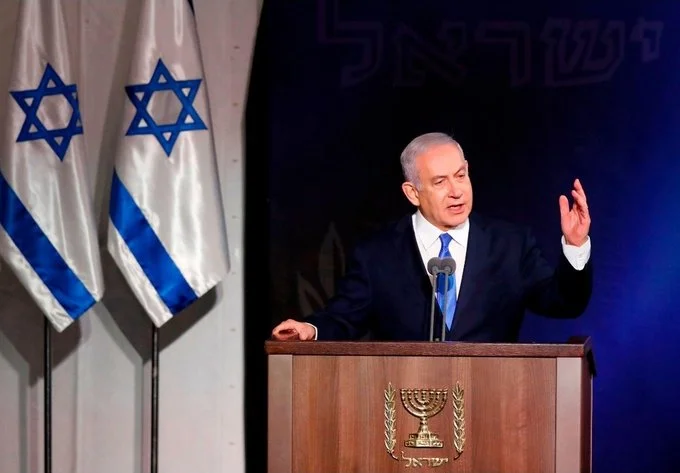
On the 13th day of Iran-Israel war, Israeli Prime Minister Benjamin Netanyahu held his first Press conference since the outbreak of the war. Netanyahu’s press conference was filled with grandiose claims about Israel. He insisted that Israel and the United States had struck Iran with a series of heavy blows that were directed at the military apparatus of the country. Ballistic missile sites were also attacked, as well as underground nuclear sites and Iranian nuclear scientists. These claims were pompous and a lot of them cannot be verified independently. Nonetheless, they served a clear objective, to portray Israel not merely as a regional military power but as a power that is actively reshaping the Middle East itself. The extent of the cooperation with the United States was also emphasized by Netanyahu, he stressed on the coordination with the U.S. President Donald Trump. The attacks on Iranian ballistic missile systems, he argued, were a collective effort to neutralize dangers which were facing both countries.
Netanyahu portrayed the conflict as the turning point: no longer the same Iran, no longer the same Israel, more potent and mightier than it has ever been. At the bottom of this rhetoric of military success is an even more dangerous agenda. Iran in this story is a simple diversion, a shroud to the promotion of the ideological needs of Israel. Military actions were explicitly associated by Netanyahu with messianic visions, the rebuilding of the Third Temple, and the coming of the Messiah, when he said: ” Israel will reach to the kingdom and will make it to the return of the Messiah” To get there, the temple must be rebuilt, which means destroying what currently stands. That is, of course, the Dome of the Rock and Al-Aqsa Mosque, and that is part of their broader plan.
Addressing Iranians, he stated that the day of your release is nearer and nearer and that the weakening of the Iranian security system could be a wake-up call to the Iranian masses to rise against the ruling regime, this statement of his confirms that Us-Israel joint military strikes can’t lead to collapse of the Iran’s clerical government. Netanyahu admitted that any uprising was still to depend upon Iranian people themselves, still, the implication was clear: military pressure was to destabilize the political structure in Tehran which will then precondition the ideological goals that may not be a mere question of national security.
Netanyahu also gave veiled threats to Iranian new Supreme Leader, Mojtaba Khamenei, and Hezbollah leader, Naim Qassem: “I would not issue a life insurance policy to any of the leaders of the terror groups, thus, indicating that it is going to carry out more covert operations and intimidate politically. Still, the ideological aspect of the press conference is more significant than individual leaders or proxies. Netanyahu depicted Islam, both Sunni and Shia, as a world threat, and so he says, we cannot say that it will sort itself out, and so he is connecting his military campaign with a religious one.
The rhetoric of Netanyahu indicates that the war to be waged against Iran is not just a tactic in a military offensive; but is an expansion of Zionism, which involves the rebuilding of Third Temple, and the eschatological arrival of the Messiah. The Israeli leadership is repositioning not just the states but whole communities as enemies by projecting the Islamic world as a threat on its own. This type of ideological expansion is what turns a geopolitical confrontation into a ideological confrontation, which threatens social, religious, and political life of the Muslims in the whole Middle East. It has become imperative to identify and examine the Israeli strategy as a driver by religious-ideological reasons, such as messianic and apocalyptic discourses, to prevent the dangers of heightened escalations, evasion of deception in the name of peace, and the vulnerability of the region to subservience to a Zionist ideology that jeopardizes common interests of Muslims.
Overall, the briefing delivered by Netanyahu on March 12 is much more than the empty rhetoric of the military. Iran is a smokescreen; the actual danger is an ideologically organized, messianic, expansionist, and explicitly antagonistic, ideologically informed ideological campaign which requires unified vigilant and ideologically aware reaction of the Muslim states.

Your go-to editorial hub for policy perspectives and informed analysis on pressing regional and global issues.