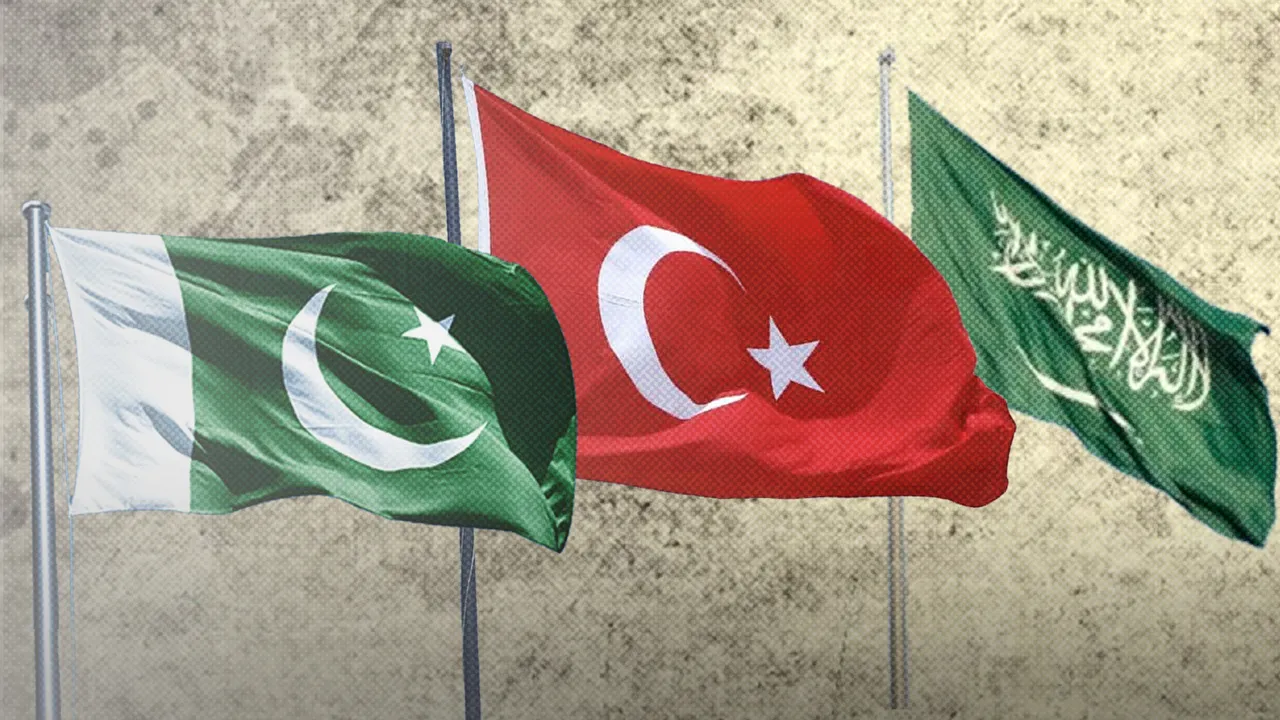
In early 2026, a series of high-level diplomatic reports, notably from Bloomberg and regional monitors, hinted that Turkey is in advanced talks to join a mutual defense pact already established between Pakistan and Saudi Arabia. This proposed alliance is often called an Islamic NATO. Following the signing of the Strategic Mutual Defence Agreement (SMDA) between Islamabad and Riyadh in September 2025, the addition of Ankara represents a massive development in regional security planning. This is in response to a global order currently being redesigned. As the post-Cold War era of a single dominant superpower fades, middle powers are seeking strategic autonomy. They want to protect their interests without being completely dependent on a volatile Washington or an assertive Beijing.
The current international system is defined by fluid multipolarity. Traditional security guarantees are being questioned. In the Middle East and South Asia, the United States is no longer seen as the guaranteed protector it once was. With global focus shifting toward the Indo-Pacific and shifts in American domestic policy, regional leaders have realized they can no longer leave their borders to be defended by outside superpowers.
As a result, states are hedging. They are diversifying their security partners to ensure they aren’t left alone. For Turkey, which fields the second-largest military in NATO with roughly 355,000 active personnel and 890,000 total, this trilateral pact is a way to be a part of a regional bloc. For Saudi Arabia, which has a massive defense budget of $78 billion, constituting 21% of its total government spending, it is a move away from total reliance on the US For Pakistan, consistently ranked as a top 10 global military power, it is a tactic to strengthen its defense in a hostile neighborhood.
The Foundation
The pact is built on two strong, pre-existing pillars. The Saudi-Pakistan relationship is a decades-long partnership of mutual need. Pakistan has historically provided the boots on the ground for the Kingdom, while Saudi Arabia has acted as Pakistan’s financial lender of last resort. According to official records, Pakistan has trained over 8,000 Saudi personnel since 1967.
Similarly, the Turkey-Pakistan bond is rooted in deep historical ties. Even before the modern states were formed, Muslims in the Indian subcontinent supported the Turkish War of Independence through the Khilafat Movement. In the 1970s, Turkey stood by Pakistan during the 1971 war, and Pakistan was the only country to fully back Turkey during the 1974 Cyprus crisis. Today, this has evolved into a high-tech partnership. According to SIPRI, Turkey is Pakistan’s one of the major arms suppliers. Major projects include the MILGEM corvette warships (Babur-class) and the mid-life upgrade of 42 Pakistani F-16s.
A major driver for this alliance is the widening rift between Saudi Arabia and the United Arab Emirates (UAE). Once inseparable allies, they are now competing for regional leadership. This is most obvious in Yemen, where Saudi Arabia supports the Presidential Leadership Council (PLC) for a unified state, while the UAE has backed the now defunct Southern Transitional Council (STC).
The tension reached a peak in late 2025 near the port of Mukalla, where Saudi military actions targeted UAE-linked shipments. As the UAE follows an independent path, focusing on maritime ports and normalization with Israel, Saudi Arabia is doubling down on traditional state-to-state alliances. Bringing Turkey and Pakistan into a formal pact allows Riyadh to balance against the UAE’s assertive and often unpredictable foreign policy.
Israel is also redrawing the regional map. Its recognition of Somaliland in December 2025 is a strategic move to gain a foothold near the Bab el-Mandeb Strait. Israel was also in talks with the STC in Yemen to create a Red Sea alliance aimed at countering Iran and the Houthis. This peripheral strategy tries to bypass traditional Arab rivals by making deals with breakaway territories.
The Anatomy of the Alliance
The practical logic of this alliance is founded on a sophisticated synergy of assets.
Turkey can be the technology provider. The flagship of this cooperation is the KAAN Fifth-Generation Fighter Jet program. Ankara has invited both Pakistan and Saudi Arabia to join as partners in this multi-billion dollar project, aiming to reduce dependence on Western jets. Furthermore, Turkish drone success is legendary, Saudi Arabia recently signed a multi-billion dollar deal for the Bayraktar Akıncı UCAV, which will be locally assembled in the Kingdom by 2026.
Pakistan has already made a decisive shift toward Turkish Unmanned Aerial Systems (UAS). Moving away from a historical reliance on Western platforms, the Pakistan Air Force (PAF) has integrated the Bayraktar TB2 and the high-altitude Akıncı into its frontline strike groups. This shift was put to the test during the Indo-Pak border clashes in May 2025. Reports indicate that Turkish-origin drones and loitering munitions played a pivotal role in neutralizing adversary positions with surgical precision. During this conflict, Turkey reportedly supplied Pakistan with drones and loitering munitions, providing real-time data and strike capabilities that fundamentally altered the tactical outcome on the ground.
With a $78 billion defense budget, Saudi Arabia can provide the capital for massive R&D. The Kingdom’s Vision 2030 aims to localize 50% of defense spending. By funding Turkish technology and Pakistani manufacturing, Riyadh is building an independent defense industry that is immune to Western sanctions.
Pakistan offers a battle-hardened military with over 650,000 active personnel. Its contribution can be centered on indigenous missile technology. The recently unveiled Fatah-5 guided rocket, with a range of nearly 1,000 km, allows for deep precision strikes. Furthermore, the creation of an Army Rocket Force separates conventional missile units from nuclear assets, adding a new layer to the escalation ladder.
The nuclear shadow remains the most sensitive element. Pakistan is the only nuclear-armed member. While official talks focus on conventional weapons, a defense pact with a nuclear power provides extended deterrence for Saudi Arabia. This remains a matter of strategic ambiguity, a powerful warning that changes the risk assessment for any aggressor.
Geopolitical Risks and Structural Shifts
The emergence of this trilateral axis represents a significant departure from the post-Cold War security architecture. By consolidating their strengths, Pakistan, Turkey, and Saudi Arabia are attempting to create a self-regulating regional security complex. This challenges the traditional hub-and-spoke model of the Middle East and South Asia, where the United States functioned as the central hub connecting various regional partners. Instead, we are seeing the rise of a horizontal web where middle powers bypass traditional mediators to manage their own security environment.
However, the ramifications go beyond simple defense. This alliance is intertwined with economic projects like the Middle Corridor (the Trans-Caspian International Transport Route), which Turkey and Saudi Arabia are increasingly eyeing as an alternative to Russian-controlled or purely Chinese-led routes. By securing the maritime space in the Arabian Sea (via Pakistan) and the Red Sea (via Saudi Arabia), the bloc can ensure its relevance in global trade, making it a connectivity hub that even the great powers must respect.
The challenges to this alliance are as significant as its potential. First, there is the NATO friction. Turkey’s commitment to a mutual defense pact outside the NATO framework raises serious legal and political questions in Brussels. If Ankara is obligated to defend Islamabad or Riyadh in a conflict that does not involve NATO, it could lead to a crisis of identity within the Western alliance. Second, the Iranian dilemma remains. While the bloc is Sunni-majority but it is not necessarily an anti-Iran coalition.
Turkey and Pakistan have long-standing, pragmatically stable relations with Iran, and Saudi Arabia recently normalized ties with its neighbor. The success of this pact depends on its ability to act as a bridge rather than a division. If the alliance is perceived as a tool for sectarian dominance, it could trigger a new arms race that destabilizes the very region it seeks to protect.
Finally, the impact on South Asia cannot be overstated. A Pakistan that is backed by Turkish high-tech weaponry and Saudi financial resilience is a vastly different strategic actor. This forces a total recalibration of Indian strategic planning, as the cost of conventional military engagement with Pakistan increases significantly. It also creates a new dynamic for China and Russia, who may see this bloc as a useful counter-weight to US influence.
In conclusion, while the Pakistan-Turkey-Saudi alliance is far from finalized and faces immense structural hurdles, the very fact that these talks have reached this stage signals a fundamental shift. The Middle East and South Asia are no longer separate strategic theaters; they have merged into a single map. This trilateral convergence is a bold declaration that the era of outside control over regional security is drawing to a close, replaced by a complex, multi-layered pursuit of strategic autonomy.

Your go-to editorial hub for policy perspectives and informed analysis on pressing regional and global issues.