In the second decade of the 21st century, the global geopolitical landscape is undergoing a violent and irreversible recalibration. As the Liberal International Order, a system once defined by Western security umbrellas, international law, and globalized trade, fragments into a multipolar reality, middle powers are discovering a primal and uncomfortable truth that sovereignty is only as strong as the industrial base that armors it. For Pakistan, a nation historically characterized as a security state reliant on the shifting whims of external patronage, the last few years have witnessed a radical pivot.
This is not merely a change in procurement, it is a fundamental shift in national identity. Pakistan has transitioned from a net consumer of defense hardware to a high-tech exporter. By leveraging a unique history of joint development with China and a battle-hardened internal requirement, Islamabad has created a sovereign industrial complex. This evolution is a statement of strategic autonomy in a world where guarantees have become increasingly hollow.
The Macroeconomics of Defense Exports
The shift in Pakistan’s defense trajectory is most visible in the sheer scale of its recent commercial successes. In late 2025, reports surfaced of a monumental $4.6 billion deal with the Libyan National Army (LNA), marking the single largest arms export in the country’s history. This was followed in early 2026 by a $1.5 billion agreement with Sudan, signaling a turn toward Africa as a primary market for Pakistani hardware.
These deals are comprehensive, high-tech systemic packages. The Sudan deal, for instance, encompasses ten Karakoram-8 (K-8) light attack aircraft, over 200 sophisticated loitering munitions (drones), and advanced air defense solutions.
From an economic perspective, this breakout is transformative. For an economy frequently navigating the choppy waters of IMF programs and foreign exchange crises, defense exports have emerged as a vital pillar for the balance of payments. Under the umbrella of the Special Investment Facilitation Council (SIFC), the Pakistani state has streamlined the Defense-Industrial-Complex model. This model ensures that defense profits are reinvested into domestic R&D, creating a trickle-down effect into civilian sectors like aerospace engineering, metallurgy, and software development. By diversifying its portfolio, from the super mushshak trainer aircraft (now a staple for air forces in Saudi Arabia, Turkey, and Qatar) to the Fatah-II guided multiple-launch rocket systems, Pakistan is proving that high-end manufacturing is the only sustainable path to national solvency in a fractured global market.
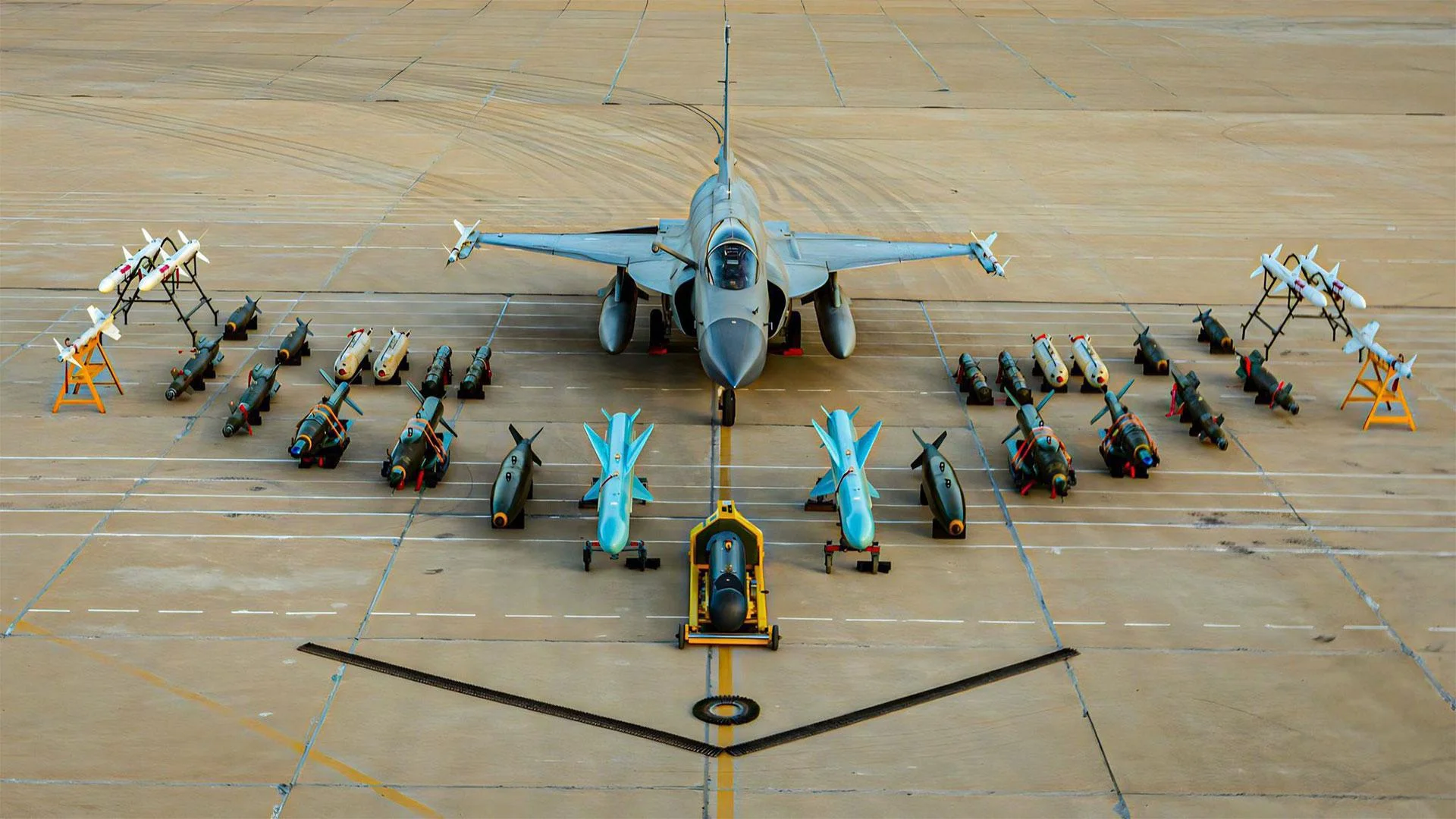
The centerpiece of this industrial renaissance is the JF-17 Thunder. For years, Western analysts dismissed the JF-17 as a budget fighter intended for nations that couldn’t afford F-16s. However, the emergence of the Block III variant has shattered this narrative. The Block III, which began deliveries to Azerbaijan in October 2025, represents a generational leap in cost-to-capability ratios.
What makes the Block III revolutionary is its integration of J-20 DNA. By utilizing the KLJ-7A Active Electronically Scanned Array (AESA) radar and a cockpit interface derived from China’s fifth-generation J-20, the JF-17 has transformed from a visual-range dogfighter into a Beyond-Visual-Range (BVR) predator. Its ability to fire the PL-15, a missile with a dual-pulse rocket motor and a range exceeding 200km, allows it to outrange almost every Western air-to-air missile currently in service, including the AIM-120C.
The synergy between the Pakistan Aeronautical Complex (PAC) and China’s Chengdu Aircraft Industry Group (CAC) has created a unique collaborative model. Unlike Western platforms that come with restrictive end use monitoring and political kill switches, the JF-17 offers 4.5-generation capabilities with total operational sovereignty. For nations like Azerbaijan or Iraq, this is a security insurance policy against Western sanctions.
Battlefield Validation
No amount of marketing can replace the validation provided by high-intensity combat. In May 2025, the Pakistan Air Force (PAF) provided the world with a masterclass in modern, network-centric warfare during a four-day escalation with India. Under Operation Bunyan-un-Marsoos, the PAF deployed a highly integrated package of JF-17 Block III and J-10CE fighters.
The results were geographically and technologically significant. According to reports by all international observers and media, the PAF utilized long-range stand-off weapons to neutralize high-value Indian assets, including French-made Rafale and Mirage-2000 jets, without ever entering the lethal range of Indian air defenses. The recovery of PL-15 debris within Indian territory served as a visceral confirmation that integrated Chinese-Pakistani tech had rendered traditional Indian air superiority doctrines obsolete.
The commercial fallout was immediate. Within weeks of the conflict, at least seven nations, including Egypt, Morocco, and Malaysia, formally initiated high-level discussions to evaluate the JF-17 Block III.
The necessity of a balanced, high-tech domestic industry is most starkly highlighted by a comparison with Iran. Throughout 2024 and 2025, Iran faced a series of humiliating Israeli incursions that targeted its nuclear and military infrastructure with near-total impunity. Despite Iran’s massive investment in asymmetric quantity by producing thousands of Shahed drones and ballistic missiles, coupled with a network of proxies in the region, it lacked the quality to defend its own airspace.
Iranian pilots were forced to fly 50-year-old F-14s and F-4s against fifth-generation Israeli F-35s. Drones are excellent for harassment, but they cannot contest air superiority. In contrast, Pakistan’s smart development focused on a balanced mix: high-end interceptors (J-10CE) paired with a versatile, domestic workhorse (JF-17). While Iran had the will to fight, it lacked the tools to protect its dignity. Pakistan’s ability to down Indian jets in May 2025 proved that in the 21st century, true deterrence requires a conventional edge, the ability to contest the air, sea, and land simultaneously with modern, integrated systems.
The Geopolitics of the Third Way
In this increasingly fractured world, the old Liberal Order is fading, and the risks of military dependency have never been clearer. Modern history provides a sobering cautionary tale in the form of the Ukraine conflict. Despite receiving tens of billions in support from the West, Kyiv has found its tactical options repeatedly constrained by the political whims of its backers.
Ukraine has been constantly snubbed and arm-twisted—denied the use of long-range weapons inside Russian territory and forced to wait months for critical ammunition while its soldiers died on the front lines. This dynamic forces a nation to compromise its strategic dignity. A nation that cannot produce its own bullets is not a sovereign state, it is a client state.
Recognizing this, Pakistan has utilized its defense exports to craft a third way.” The Strategic Mutual Defense Agreement with Saudi Arabia, signed in late 2025, is a prime example of this. It is not a buyer-seller relationship, it is a joint industrial venture. By achieving 90% indigenization in critical sectors, including the production of main battle tanks (Al-Khalid series) and sophisticated naval frigates (MILGEM project), Islamabad ensures that in a crisis, it is not waiting for a foreign shipment that may come with humiliating political conditions.
Looking toward the 2030s, Pakistan’s defense footprint is set to expand into Southeast Asia and South America and this is not just about weapons, it is about the sovereignty of supply. As global supply chains become weaponized, the ability to maintain, upgrade, and produce one’s own defense systems is the ultimate form of soft and hard power combined. Pakistan is now exporting this philosophy.
The Indispensable Logic of Sovereign Production
The evolution from 1947, when Pakistan inherited a handful of dysfunctional ordnance stores, to the independence of 2026 is one of the most significant industrial transformations in the developing world. However, the lesson here extends far beyond the borders of South Asia.
As the liberal international order continues to erode, the rule-based safety nets that smaller nations once relied upon are vanishing. We are entering a neo-realist era where only those with the capacity to arm themselves can truly claim to be free. The message for the coming decades is unmistakable that domestic defense production is not a luxury or a matter of prestige, it is the fundamental requirement for national survival.
Reliance on external powers for security is, at best, a gamble and, at worst, a surrender of sovereignty. By turning its chronic security challenges into a high-tech industrial engine, Pakistan has demonstrated that the only way to navigate a fractured world with dignity is to possess the means of your own defense. In the 21st century, if you do not build your own shield, someone else will always decide how you are allowed to use it, or worse, when they will take it away.

Your go-to editorial hub for policy perspectives and informed analysis on pressing regional and global issues.