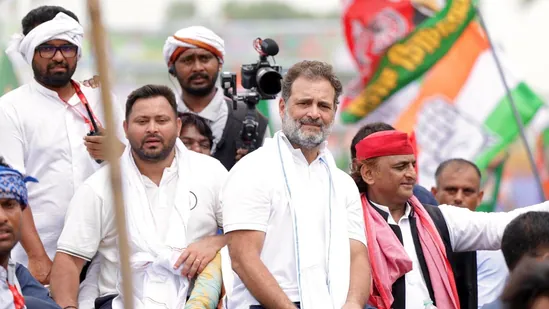
On 29 August, during a rally in Darbhanga, Bihar, Rahul Gandhi once again found himself at the receiving end of India’s weaponized state machinery. This time Bihar police registered a case against him, citing “abusive slogans” raised during the event. While, at first glance, this could be mistaken for a matter of law and order but the underlying political message is ever-since clear for any mind of little sanity and that is, dissent will be criminalized, and the most visible opposition leader in India will remain entangled in an endless cycle of legal harassment only for demanding truth for the people of his nation living under Modi’s regime for over a decade by now.
A Systematic Pattern of Political Persecution
Rahul Gandhi’s political journey over the past decade has been marked not just by electoral battles, but by a steady stream of legal challenges that critics say are designed to weaken his credibility. In March 2023, he was disqualified from the Indian Parliament following a controversial defamation verdict in Gujarat. The verdict was widely criticized as excessive, given that it resulted in stripping an elected representative of his parliamentary seat, a move that effectively silenced one of Modi’s most vocal critics within India’s legislative framework.
The Bihar case is not an isolated incident. Rahul Gandhi has faced dozens of FIRs filed across multiple Indian states, from Uttar Pradesh and Maharashtra to Assam and now Bihar. According to the Association Democracy Research Network (ADRN), since 2014 to 2023, 121 political leaders have been harassed, probed and raided by enforcement department alone, out of which 115 (95%) are from opposition, with Rahul Gandhi featuring prominently among them. What must be understood is the cumulative effect of this legal pressure, that is to keep him constantly embroiled in judicial proceedings, limiting his ability to focus on grassroots campaigning and connecting with voters every single time when public consent is required upon any matter of state interest.
Bihar as a Political Flashpoint
The choice of Bihar as the ground for this latest FIR is significant. Bihar, with its complex caste dynamics, restless youth population, and history of social mobilization, has often served as a bellwether in Indian politics where congress party dominated political ruling after independence for over four decades. Rahul Gandhi’s campaign in Bihar has been directed toward amplifying the voices of the unemployed, Dalits, and marginalized communities, groups that have increasingly expressed dissatisfaction with the BJP’s current economic and social policies there.
In this context, the FIR over “abusive slogans” appears less about maintaining public order and more about cutting into his campaign’s momentum. Political sloganeering is an inseparable part of India’s electoral culture, practiced explicitly by BJP yet when it comes from Modi’s opponents, it is criminalized. By deploying state police in Bihar, the BJP is signaling its determination to suppress narratives that challenge its dominance in a state where electoral margins can tilt national outcomes.
Weaponization of State Institutions Under BJP
The Darbhanga incident highlights a broader and deeply troubling trend in Indian governance: the weaponization of state institutions to serve partisan ends. Between 2005 to 2023, investigative agencies such as the Enforcement Directorate (ED) and the Central Bureau of Investigation (CBI) have disproportionately targeted opposition figures. According to MLA Rohit Pawar, who has been facing critical investigations, of ED cases conducted by Indian media found that 85% of its investigations since Modi came to power have been directed at opposition leaders.
This staggering statistic underscores how agencies meant to uphold accountability are increasingly being deployed to intimidate and neutralize dissent. Police forces across states, especially those ruled by the BJP, are part of this apparatus. By filing FIRs against Gandhi in far-flung jurisdictions, authorities not only burden him with legal hurdles but also send a clear message to other opposition figures, criticizing Modi comes at a cost.
Humanizing the Political Struggle
Numbers and statistics tell part of the story, but the human consequences are equally critical. For Rahul Gandhi, the relentless legal cases translate into fewer opportunities to engage directly with ordinary citizens, the farmers struggling under mounting debts, the youth demanding jobs, and the communities marginalized by rising social polarization.
For Congress workers and grassroots activists, each FIR against their leader is more than a bureaucratic inconvenience, it is a psychological blow. It creates an atmosphere of fear, discouraging mass mobilization and muting their willingness to challenge the BJP’s dominance. In effect, the state is not only targeting Gandhi but also strangling the lifeblood of India’s opposition politics.
Modi’s Insecurity and the Politics of Suppression
The persistence of such cases against Gandhi reveals something deeper about the BJP’s approach to power. Despite its overwhelming control over mainstream media, dominance in Parliament, and extensive grassroots machinery, the party remains deeply insecure about Rahul Gandhi’s ability to connect with the masses.
His Bharat Jodo Yatra (2022–23), which covered over 4,000 kilometers across 12 states, attracted millions of participants and rekindled the Congress party’s political energy. For many Indians, particularly the youth the yatra represented a rare moment of authentic political engagement, distinct from the hyper-nationalist rhetoric of the BJP. Rahul Gandhi’s growing resonance among these groups makes him a political threat that Modi cannot ignore. The Darbhanga FIR, therefore, is less about “abusive slogans” and more about preemptively crippling a rival’s ability to capitalize on his rising popularity.
Implications for Indian Democracy
What is at stake goes far beyond one leader’s legal troubles. The repeated targeting of Rahul Gandhi reflects a dangerous erosion of democratic norms in India. A democracy thrives on the existence of a strong opposition capable of holding the government accountable. When dissent is criminalized and opposition leaders are systematically silenced, what remains is not democracy but majoritarian rule.
India, often projected as the “world’s largest democracy,” now finds its internal contradictions on full display. Institutions once celebrated for their independence are increasingly pliant. Political discourse is narrowing, with critical voices branded as “anti-national.” The FIR in Bihar is symptomatic of this broader trend, a shrinking democratic space where power is preserved not through persuasion but through prosecution.
Conclusion: A Democracy on Trial
The booking of Rahul Gandhi in Bihar is not just another political skirmish. It represents the Modi government’s deliberate strategy of victimization through legal harassment. By turning routine political sloganeering into a criminal offense, the state demonstrates its intent to police not just speech, but opposition itself.
For the people of India, especially its 65% youth population, the implications are profound. They are being deprived of a genuine political contest where ideas clash freely, replaced instead with a spectacle of intimidation and suppression. For the international community, which often lauds India as a democratic counterweight in Asia, the events unfolding in Darbhanga and beyond raise urgent questions about whether India’s democracy can still accommodate dissent.
The Darbhanga case, therefore, is not about slogans. It is about the survival of opposition politics in a country of 1.4 billion people. It is about whether the promise of democracy in India will remain intact, or whether it will be hollowed out by a politics of victimization.