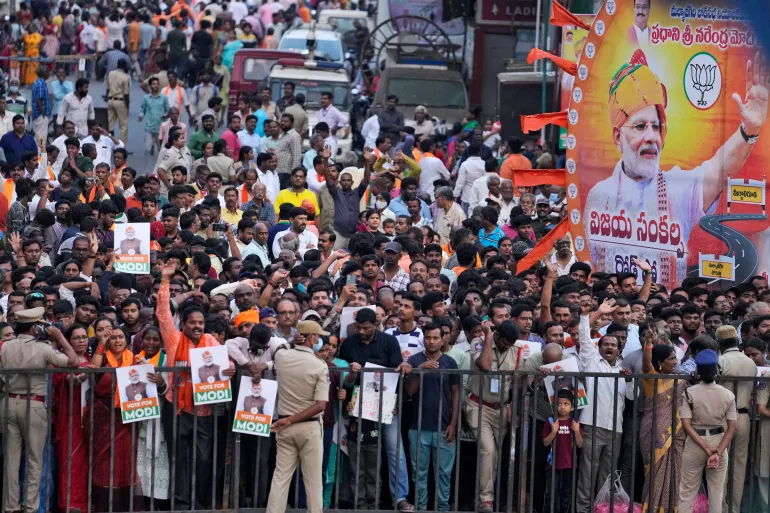
The seven-phased polling in Uttar Pradesh (UP), India’s most populous state, has concluded on March 7, 2022.
Uttar Pradesh is considered a stronghold of the Bharatiya Janata party where the incumbent Chief Minister Yogi Adityanath is seeking re-election for another five years. It is believed by many in India that the path towards Delhi comes through Lucknow (the capital city of UP). So, each political party in India seeks to have roots in the state, and implicitly or explicitly control the politics of UP. To retain UP could be crucial to the BJP’s hold in nationwide polls due by 2024.
UP: Leading Political Actors on the Stage of India’s Largest State
Uttar Pradesh, a state of about 200 million people in India’s north, has been widely regarded as the political heartland of India for geographical, social, cultural, political, and linguistic reasons. With mass nationalism gaining a foothold in the UP countryside, it emerged at the forefront of the freedom movement against British Rule. It also served as the power hub of Muslim political and cultural activity in pre-partition India. After independence, UP maintained its status of being the political heartland of India by sending the maximum number of parliamentarians in the Lok Sabha (80 out of 543) and providing more prime ministers (9 out of 15) than all other states combined.
Following is a short description of the most important political players in the UP arena.
Bhartiya Janata Party (BJP)
Leader: Yogi Adityanath
Seats won in last 2 elections: 312/403 (2017), 47/403 (2012)
Percentage of Votes secured in last 2 elections: 39.7% (2017), 15% (2012)
Brief overview (political ideology/vision)
The incumbent government of BJP, which has long been accused of invoking Hindu nationalist sentiment that has resulted in violence against minority groups, particularly Muslims, contested its first UP election in the 1980s and only secured 11 seats. Later its support base grew as it aligned itself with the Ram Janmabhoomi movement (which culminated in the destruction of Babri Mosque in Ayodhiya). The movement helped BJP improve its vote share from 11.8% in 1989 to 31.5% in 1991. The BJP, in the 2014 National Assembly elections and afterward, succeeded in breaking the core caste-based vote banks of the Samajwadi Party and the Bahujan Samaj Party, by promoting communal issues.
The BJP, being a far-right party, espouses the ideology of Hindutva and is practically the political arm of the extremist Hindu organization RSS, which itself was inspired by the Fascist organizations of Europe in the Post First World War period. The BJP and RSS aim to transform India into a pure Hindu Rashtra in which the non-Hindu minorities will be second-class citizens at best.
Samajwadi Party (SP)
Leader: Akhilesh Yadav
Seats won in last 2 elections: 47/403 (2017), 224/403 (2012)
Percentage of Votes secured in last 2 elections: 21.8% (2017), 29.1% (2012)
Brief overview (political ideology/vision)
Samajwadi Party is mostly a caste-based party that also has a significant pull for the sizable Muslim community of the UP. It can be described as a party with Social Democratic leanings. The Samajwadi Party’s core support base consists of Other Backward Classes (OBC). It traces its roots to the political ruffle following the BJP-led Ram Janmabhoomi Movement and Mandal Commission. The Mandal Commission’s findings, which favored a 27% reservation for the OBCs, helped in the electoral consolidation of OBC voters and created a need for representation that led to the formation of political parties for backward classes. Banking on the OBC vote bank, the SP has become a force to reckon with in the politics of UP and it has controlled UP in the past (most recently after winning the 2012 elections).
SP saw a major Setback In the 2017 assembly polls, when in alliance with Congress. It could only win 47 seats and lost on 177 seats that it had won in the 2012 assembly polls.
Bahujan Samaj Party (BSP)
Leader: Mayavati
Seats won in last 2 elections: 19/403 (2017), 80/403 (2012)
Percentage of Votes secured in last 2 elections: 22.2% (2017), 25.9% (2012)
Brief overview (political ideology/vision)
The Bahujan Samaj Party (BSP) was formed to represent the Scheduled Castes, Scheduled Tribes, and Other Backward Classes (OBC), along with religious minorities. The BSP identifies closely with the political ideology and views of the famous Dalit leader Dr. B. R. Ambedkar. As more than 21% of the population of UP belongs to the Dalit community, the BSP commands a huge following here. Apart from Dalits, BSP has also attracted a significant number of Muslim votes in the past elections.
In the last thirty years, BSP has formed four governments in the UP, including one full majority government. The party was also part of the SP-led government in 1993.
Indian National Congress (INC)
Leader: Priyanka Gandhi
Seats won in last 2 elections: 7/403 (2017), 28/403 (2012)
Percentage of Votes secured in last 2 elections: 6.3% (2017), 11.6% (2012)
Brief overview (political ideology/vision)
A party with a somewhat ambiguous socialist and secular ideology, the Indian National Congress is considered the founding political party of the Republic of India. It is still dominated by the family of India’s first Prime Minister Mr. Jawaharlal Nehru and has a national appeal like the BJP (in contrast to the BSP and SP).
If we look at the political and electoral history of UP, we can say that in the initial years after independence, Indian National Congress completely dominated the Uttar Pradesh political arena. But, after the 1980s, the Congress has ceased to be a leading political force in the UP. Where BJP started to trump Congress due to the rising tide of Hindutva nationalism after 1991 as far as the higher castes like Brahmins and Rajputs were concerned, Congress was also repeatedly, and decisively, bested by the SP and BSP in the battle for the lower caste and Muslim vote.
Predictions Based on Exit Polls
While the result of the 2022 election will be, in a way, a referendum on the incumbent Chief Minister Yogi Adityanath’s performance, the others like the Samajwadi Party, the Bahujan Samaj Party, and the Indian National Congress have fought hard to win popular support.
Almost all exit polls indicate the BJP’s Yogi Adityanath is likely to stay in power. It has been predicted via exit polls that the BJP might secure about 35-40% votes and more than 230 seats. The Samajwadi Party is expected to be the runners-up with about 25% votes whereas the BSP and the Indian National Congress appear to reprise their dismal showing in the 2017 elections.
If the exit polls are to be believed, BJP’s Yogi Adityanath is set to return as UP’s first Chief Minister in 37 years to return to power for a second consecutive term, an achievement that will signify the continuing rise of Godse’s Hindutva in Gandhi’s India!
The views expressed in this article are the author’s own and do not necessarily reflect the editorial policy of the South Asia Times.