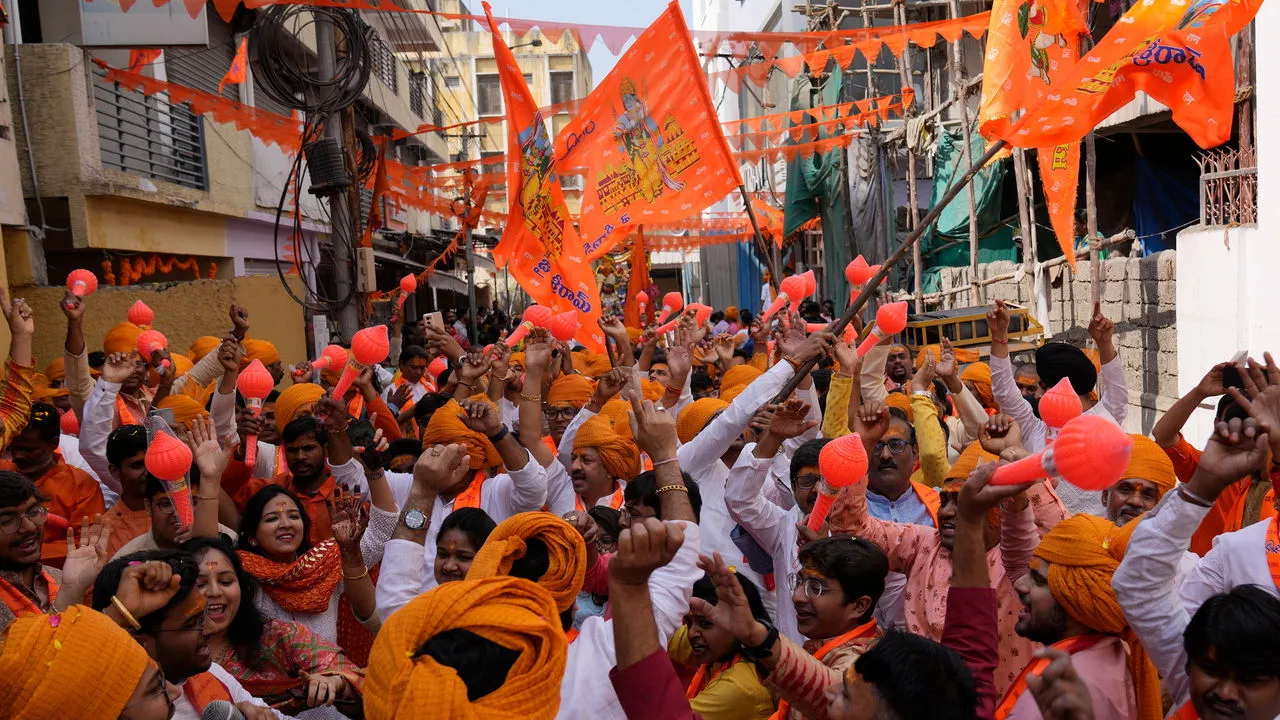
The political landscape of India has undergone a tectonic shift over the last nine years, moving away from its foundational project of secular pluralism toward a governing logic rooted in a specific ideological framework. This transformation is not merely an outcome of electoral success, it represents a fundamental reframing of Indian identity. Historians often note that the modern form of Hinduism we recognize today was largely shaped during the colonial period. This syndicated or unified version of the faith emerged partly as a response to, and a mirror of, the unified religious structures of Christianity and Islam. By consolidating a vast array of diverse, localized practices into a more centralized narrative, it sought to create a cohesive social block. However, it was V.D. Savarkar who, in 1923, transformed this burgeoning sense of unity into a rigid political ideology known as Hindutva.
While Hinduism remains a pluralistic conglomeration of sects, Savarkar’s Hindutva sought to equate nationhood with a singular ethnic and cultural identity. This worldview was institutionalized in 1925 with the formation of the Rashtriya Swayamsevak Sangh (RSS), which operates on the equation that Nation equals Culture equals Religion. Under this logic, the true Indian is defined as one who views the subcontinent as both a fatherland and a holy land, an outlook that inherently positions Muslims and Christians, whose holy lands lie outside India, as perpetual others whose primary allegiances are forever under suspicion.
The shift of Hindutva from a peripheral cultural movement to the primary instrument of state power has been marked by a transition from social influence to legislative dominance. This ideological reframing has been most aggressively pursued through the manipulation of citizenship. The Citizenship Amendment Act (CAA) of 2019, when viewed alongside the proposed National Register of Citizens (NRC), introduced a religious test for belonging for the first time in independent India. As of 2025, estimates suggest that the total number of minorities in India has reached approximately 28.2 crore (282 million) people, making up 19.3% of the total population. This is not just an abstract percentage, it is a population larger than that of most sovereign nations. This scale makes any project of alienation a massive undertaking with profound consequences. The majoritarian project is further complicated by the fact that even within the Hindu fold, the construction of a monolithic identity often ignores the diverse traditions of Dalit, Adivasi, and Bahujan communities. By weaponizing an upper-caste Vedic narrative, the state effectively excludes the vast diversity of intra-Hindu minorities who resist this forced homogenization.
Cultural Majoritarianism
The process of social polarisation is maintained through state-sanctioned cultural majoritarianism and the systematic targeting of specific communities. For the Sikh community, this takes the form of a persistent denial of their distinct identity. Hindutva ideologues frequently assert that Sikhism is merely a sect of Hinduism or its sword arm, a claim that Sikhs vehemently deny. When Sikhs assert their political rights, as seen during the 2020-21 Farmers’ Protest, they are often met with the Khalistani label, forcing an entire community to constantly prove its loyalty to a state that seeks to absorb its unique identity.
Similarly, the Christian community has faced a staggering 550% increase in attacks over the last decade, with incidents rising from 127 in 2014 to 834 in 2024. Christians are frequently maligned with the rice bag slur, a derogatory term that reduces their faith to a transaction for material gain. In states like Uttar Pradesh and Chhattisgarh, which account for the majority of these incidents, the disruption of prayer meetings and physical assaults on pastors have become a frequent reality under the watch of an indifferent or complicit administration.
For the Muslim community, the pressure is even more systemic, characterized by legislative efforts like the 2024 Waqf Amendment Bill. This bill is viewed as a direct attempt to seize communal property by granting government appointees, specifically District Collectors, the power to override traditional religious endowments. This is particularly significant given that India has over 4.9 lakh registered Waqf properties covering approximately 6 lakh acres of land. Figures like Yogi Adityanath have mastered a rhetoric of division that translates into real-world violence; according to the India Hate Lab Report 2024, Adityanath was linked to 86 documented instances of hate speech in that year alone.
This rhetoric has contributed to an environment where events like the 2020 Delhi Riots, which claimed 53 lives, or the ethnic violence in Manipur, which left hundreds dead and thousands displaced, can occur with minimal institutional accountability. This polarisation has proven electorally efficient, allowing the ruling party to consolidate a diverse Hindu vote bank by manufacturing a sense of civilizational threat. In this political math, the marginalisation of over 28 crore people is treated as an acceptable cost for maintaining power.
The Long-Term Cost of Social Re-engineering
The current cleavage in Indian society is not a temporary electoral rift, it is a deep structural wound that will have lasting impacts. You cannot alienate a population of 28 crore and expect them to accept hegemony lying down. History shows that pushing large, significant minorities to the margins leads to deep inter-communal mistrust and the forced ghettoisation of communities who no longer feel safe in mixed neighborhoods. We are witnessing the generational normalization of hate, where a new demographic is growing up in an environment where bigoted rhetoric is rewarded with high office. This environment is also driving a significant brain drain, as the country’s best minds increasingly look for futures elsewhere, leading to a loss of the very pluralism that was once India’s greatest soft power asset.
Furthermore, the decay of institutions, where the police, judiciary, and media are seen as partisan actors in a religious war, undermines the rule of law for every citizen. A nation of 1.4 billion cannot thrive while in a state of constant internal conflict. The governing logic of Hindutva may secure electoral victories, but it is fundamentally damaging the social fabric of the republic. Even if the BJP were to lose power, the social re-engineering it has overseen may outlast its tenure, leaving India more fragmented and less governable. The seeds of division have been sown deep into the administrative and social landscape, and the task of uprooting them will require more than just an electoral change.