In war, truth is often the first thing buried. But sometimes it does not even get buried properly. Sometimes it is rushed out too early, dressed up too neatly, and pushed so hard that the cracks begin to show almost at once.
That is what appears to be happening with the Taliban’s claim that Pakistan targeted a hospital in Kabul.
The allegation carries weight. It is designed to be. A hospital. Drug addicts. Hundreds dead. Civilians caught in the fire. It is the kind of story that travels fast because it comes preloaded with outrage. But the problem is that once the noise settles, the pieces do not fit together the way they should.
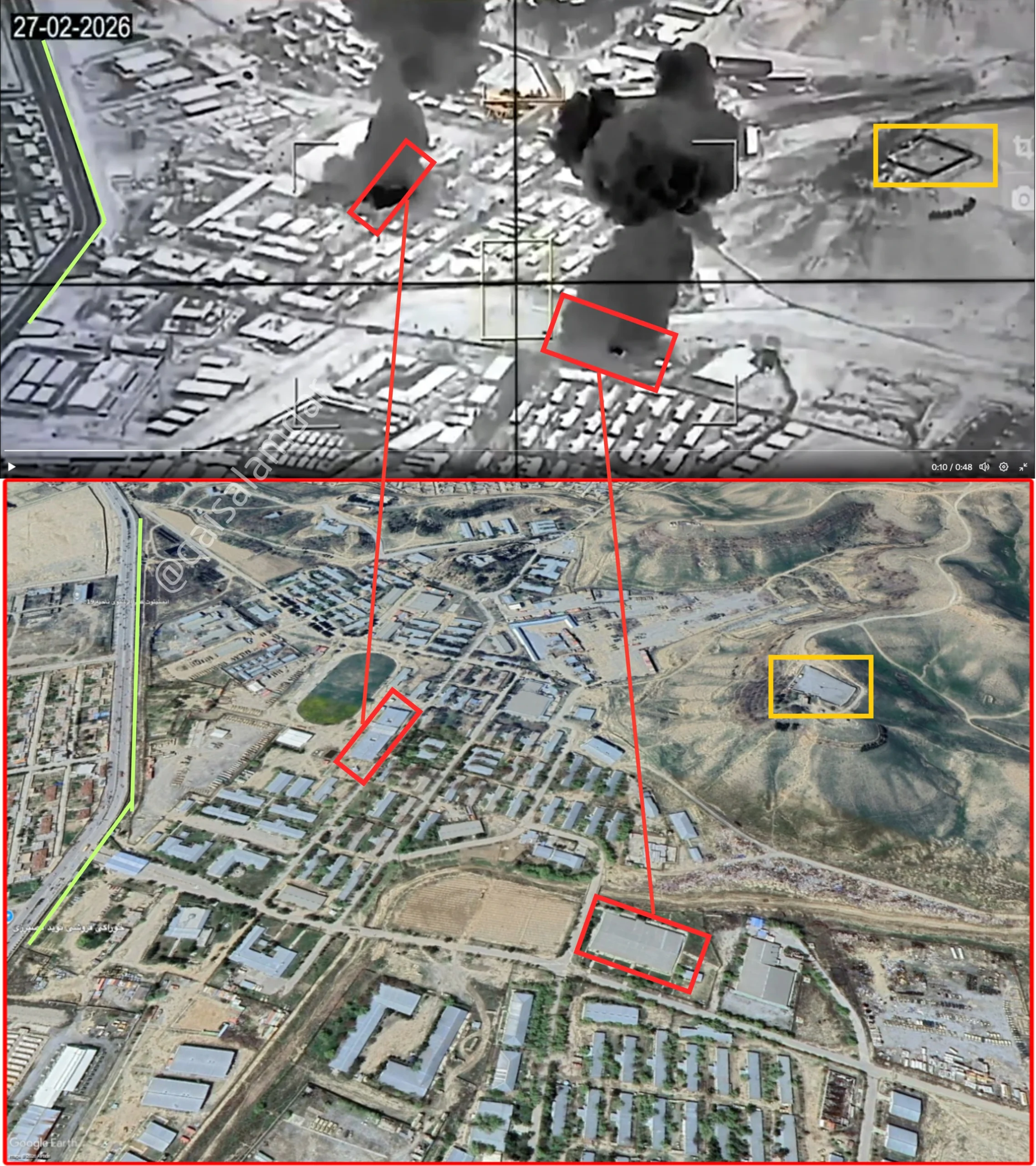
Pakistan says the strikes carried out on the night of 16 March under Operation Ghazab Lil Haq were precise and aimed at military and terrorist-linked infrastructure in Kabul and Nangarhar. The stated targets were not vague. They included ammunition storage sites, technical support infrastructure, and installations linked to hostile activity against Pakistan. In Kabul, one of the strike locations was described as a sensitive office tied to the Taliban’s Ministry of Defense in the Sarak-e-Naw area. A hospital was nearby. Even Taliban-linked reporting, by its own wording, suggested that a building close to the office was damaged. That is not the same thing as saying the hospital itself was the target.
Pakistan’s Information Minister Attaullah Tarar also said in his X post that all six strikes were “precise, deliberate, and professional,” targeting only military and terrorist infrastructure, with video evidence released showing ammunition sites and secondary detonations, explicitly stating that “no hospital, no drug rehabilitation centre, and no civilian facility was targeted.”
And that difference matters.
Because once a regime shifts from explaining what was hit to emotionally branding what was nearby, it is usually trying to win the argument before the facts catch up.
What makes the Taliban’s story harder to accept is not just Pakistan’s denial. It is the Taliban’s own narrative, which keeps wobbling under its own weight.
Start with the basics: location. One version of the story pointed to a drug addiction hospital in Pul-e-Charkhi. But the strike Pakistan described was in Kartay Now / Sarak-e-Naw. These are not two names for the same patch of road. They do not casually blur into one another. If the central accusation is that a specific civilian site was deliberately targeted, then the location should be the easiest part to establish. Instead, it is one of the first things that turns slippery.
Then there are the numbers, and this is where the story really begins to smell wrong.
The Taliban side pushed claims of 400 dead and 250 injured. That is not a minor discrepancy or a fog-of-war mismatch. That is a huge alleged massacre in the middle of a capital city. Numbers like that leave a trail. They create hospital chaos, family searches, funeral preparations, names, neighborhoods, faces, witnesses, records. But what has come out so far looks nothing like the aftermath of 400 dead.
TOLO TV’s own field reporting contradicted early claims. While a family member suggested 20–25 injured, the reporter on ground stated only 10–15 injured were actually present at Kabul Emergency Hospital. The same report mentioned around 40 bodies being brought in and later transferred elsewhere.
Elsewhere is doing a lot of work here.
Where exactly were the bodies taken?
Which hospitals received them?
Who identified them?
Where are the families?
Where are the names?
If there were 400 dead, then where is the public evidence that normally follows loss on that scale?
That absence is not a detail. It is the story.
Then comes the most awkward part for the Taliban’s version that is the nature of the strike itself.
Reports from the scene spoke of secondary explosions after the initial blast. That is a familiar sign in war zones. It usually suggests stored ammunition, explosives, or military material cooking off after impact. Hospitals do not usually erupt like weapons depots. Rehabilitation wards do not produce prolonged secondary detonations. Ammunition sites do.
So, the Taliban are effectively asking the world to believe two things at once: that this was a civilian medical target, and that the strike also produced signs consistent with munitions storage. That is not impossible in the abstract, but it is a very difficult case to make without hard proof. So far, that proof has not arrived.
And this is where memory matters.
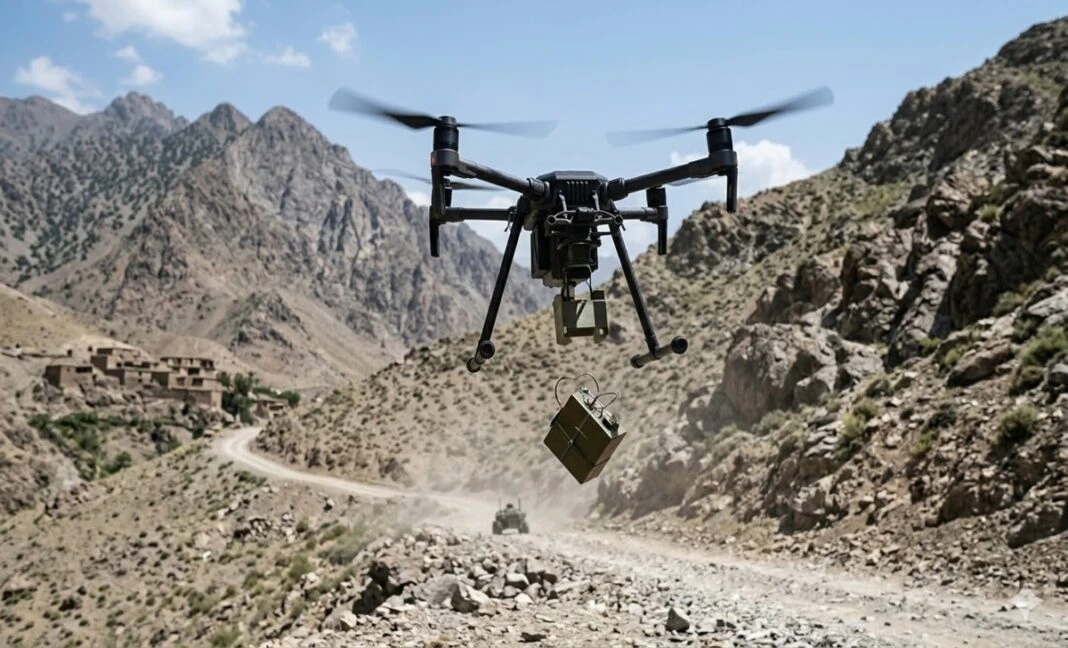
Independent reporting has already pointed to the presence of military-linked infrastructure in and around Kabul. A March 2026 report in The Diplomat noted that the Taliban have been developing indigenous drone capabilities, with assembly reportedly taking place at Camp Phoenix near Kabul, a former United States military base. Earlier reporting by the Daily Mail (June 2025) also described how abandoned military infrastructure and hardware at such bases were repurposed by Taliban engineers.
Hence, it is noteworthy that the Taliban did not invent propaganda yesterday. They know exactly which images move an international audience and which words trigger sympathy. The language of victimhood has long been one of their most useful political assets.
Moreover, notably Taliban officials had already pushed a “drug addict rehabilitation” narrative in earlier instances, including claims just days before this strike, suggesting a pattern where such framing is deployed quickly to shape international perception.
The “drug addict” angle in particular is not random. It is emotionally disarming. It conjures helpless people, abandonment, moral urgency. It reframes a strike on a sensitive site as cruelty against society’s most vulnerable. It is a sharp narrative weapon.
Which is precisely why it deserves scrutiny.
There is also something deeply convenient about how quickly this framing appeared. Before the dust had settled, the civilian story was already standing at the microphone. That speed is not proof of fabrication on its own, but in a conflict where information is weaponized as deliberately as drones and rockets, speed itself becomes suspicious. When a regime already under pressure is hit at sensitive sites and immediately answers with an accusation crafted for international consumption, skepticism is not cruelty. It is discipline.
None of this means civilian harm should be brushed aside. If civilians were harmed, that matters. If nearby structures were damaged, that matters too. No serious person should pretend otherwise. But civilian proximity is not the same as civilian targeting. Damage near a sensitive defense-linked site is not proof that the strike was aimed at a hospital. And if the Taliban want the world to accept their version, then they need to offer more than emotion, inflated casualty claims, and shifting geography.
Because the truth here is one they would rather avoid.
Pakistan did not wake up and discover Afghanistan on a map. These strikes come after years of Pakistani warnings that groups hostile to Pakistan have found room, cover, infrastructure, and protection on Afghan soil.
Pakistan has repeatedly stated that such facilities are being used to “plan, facilitate, shelter, and train” elements linked to cross-border terrorism, including groups like Tehreek-e-Taliban Pakistan (TTP), which continue to target Pakistanis.
That is the real issue in dispute. Not just one night’s strike, but the ecosystem behind it. That is the conversation the Taliban keep trying to escape.
So they reach, once again, for a familiar script, that is civilian tragedy, moral outrage, inflated numbers, blurred facts, and a rush to seize sympathy before verification catches up. It is a script that has worked for them before. But this time the seams are showing.
The location does not line up cleanly. The casualty figures do not line up cleanly. The hospital reporting does not line up cleanly. The physical signs from the strike do not line up with the story being sold. Even the movement of bodies, as described, raises more questions than answers.
And when a story of this scale keeps generating questions faster than evidence, the responsible conclusion is not blind belief. It is doubt.
Pakistan’s position, whether one likes its tone or not, is internally more coherent. It says military and terrorist-linked infrastructure was struck. It says no hospital was targeted. It points to video evidence, precision targeting, and secondary detonations consistent with ammunition sites. That version may still require scrutiny, as all state claims do in wartime. But at the very least, it hangs together better than the Taliban’s current narrative.
That is the uncomfortable reality.
The Taliban want the world to look at a hospital story. The facts available so far point instead toward a strike on sensitive military infrastructure with nearby damage that is now being repackaged for political effect.
And that is why their claim does not hold.
In the end, this is not only about what happened in Kabul on one March night. It is about credibility. A regime that shelters violent networks, manipulates narratives, and repeatedly wraps itself in civilian suffering whenever pressure lands on its infrastructure cannot expect automatic trust. Not anymore.
The burden is now on the Taliban to prove what they are claiming.
So far, they have produced outrage.
What they have not produced is a convincing case.