Regional Connectivity and Maritime Security: Pakistan, Afghanistan, and Beyond

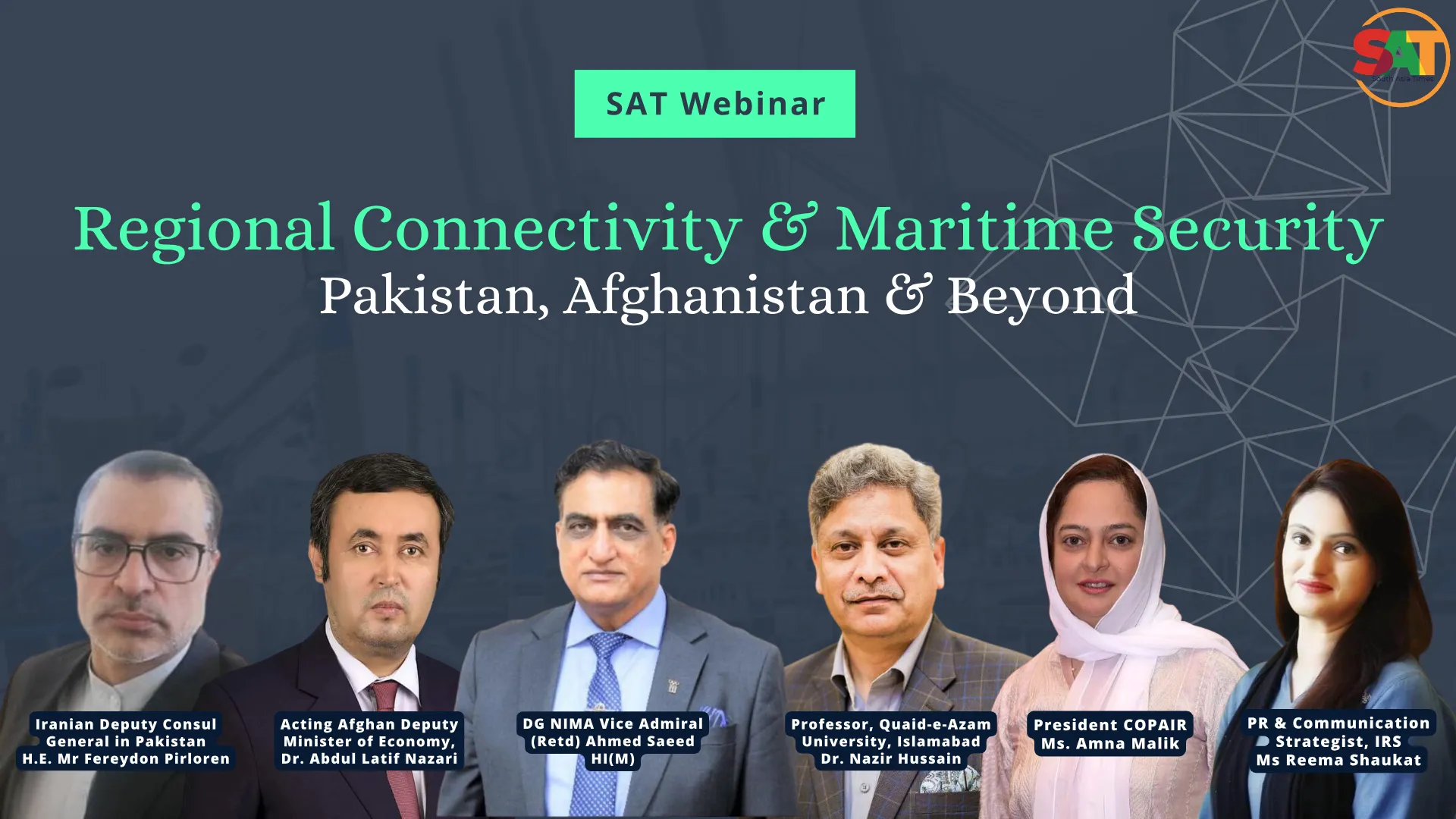
South Asia Times (SAT) hosted its debut webinar to discuss the themes of regional connectivity and maritime security that have far-reaching implications for South Asia and beyond. Experts from Pakistan, Afghanistan and Iran participated in the discussion.

The webinar served as a robust platform for thought leaders to exchange insights, address challenges, and propose innovative solutions concerning regional connectivity and maritime security, with a focus on Pakistan and Afghanistan. Pakistan’s pivotal role in regional connectivity projects and the Maritime Silk Route, acting as a vital link for trade and energy flows, was a key highlight. Additionally, Afghanistan’s aspirations as a hub for regional trade were explored, emphasizing the potential for economic growth and stability through integration into these initiatives.

Distinguished panelists, including Dr. Abdul Latif Nazari, H.E. Mr. Fereydon Priloren, Dr. Nazir Hussain, and Ms. Amna Malik, enriched the discussions with their expertise and diverse perspectives. The keynote address by Vice Admiral (Retd) Ahmed Saeed delved into challenges, strategies, and shared prosperity in the realm of regional connectivity and maritime affairs.


WebDesk

WebDesk

Recent

Iran war is exposing world order that is shifting away from US economic dominance

The Islamabad Bridge: Navigating the Ruins of a Unipolar Order

The 2026 US-Iran conflict serves as a “Suez Moment” for American hegemony, exposing the terminal decline of the post-1945 rules-based order. As US security guarantees fracture, global allies are shifting toward “major hedging” and regional autonomy to protect their own energy and economic interests. In this vacuum, Pakistan has transitioned from a frontline state to a pivotal mediator, leveraging the Islamabad Talks to define a new era of transactional multipolarity. This shift prioritizes terrestrial connectivity and local stabilization over the unilateral dictates of a distant hegemon.

Read More »
The flag of the International Atomic Energy Agency IAEA waves in front of the IAEA

The Mirage of “Nuclear Islamism”: Why the Pakistan-Iran Comparison Fails

This commentary critiques Brahma Chellaney’s “nuclear Islamism” narrative, arguing that grouping Pakistan and Iran ignores critical legal and strategic realities. It highlights the disparity in non-proliferation enforcement, specifically contrasting the treatment of NPT signatories with the strategic exceptions granted to India. By deconstructing ideological framing, the text advocates for a foreign policy analysis rooted in treaty architecture rather than religious identity.

Read More »