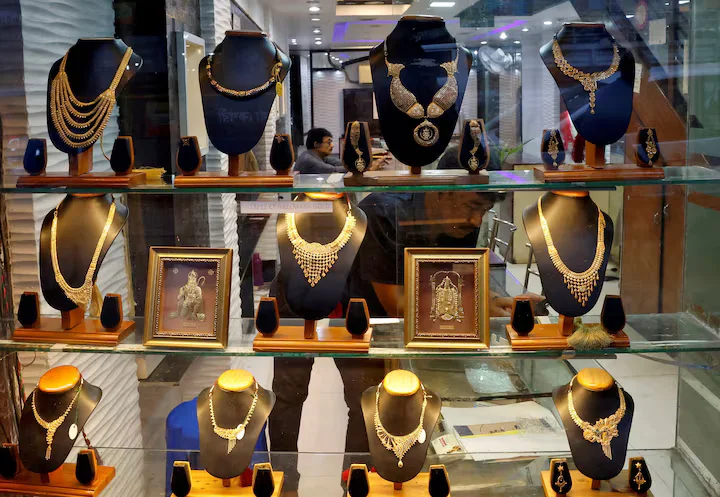
Record High Prices Dampened India Gold Demand Ahead of Key Festival

High prices dampened gold demand in India and China, forcing dealers to offer discounts ahead of the upcoming Diwali festival.

This week, physical gold dealers in India had to offer discounts as record high prices dampened demand ahead of a key festival, while top consumer China narrowed its discounts.

In India, domestic prices hit a record high of 77,641 rupees ($923.85) per 10 grams. This represents an increase of more than 15% from a four-month low of 67,400 rupees recorded in July.

“The ongoing price rally is slowing down the demand. Consumers are buying less volume because they need to allocate far more money if they want to buy the same volume they planned with the rising prices,” said Bachhraj Bamalwa, partner at Indian jewellery retailer Nemichand Bamalwa & Sons.

Indian dealers offered a discount of up to $8 an ounce over official domestic prices, – inclusive of 6% import and 3% sales levies, versus last week’s $3 premium.

“Jewellers aren’t feeling too confident about Diwali sales this year due to rising gold prices. To keep customers interested, many are offering discounts on jewellery making charges to help boost their sales during the festive season,” a Mumbai-based bullion dealer with a private bank said.

Indians will celebrate Diwali in late October, when buying gold is consider auspicious. However, high prices dampened demand of buying gold this season, leading to increased discount offers from dealers.

Also See: India Struggles over Financially Inclusive Economy without Generating Fresh Bad Loans

China’s Gold Demand Faces Challenges

Chinese dealers narrowed discounts to $3-$14 below international spot prices , from $15-$31 discounts quoted last week. In Hong Kong, dealers sold gold at prices ranging from a $2 discount to a $1.20 premium.

Recently, China has sharply ramped up policy stimulus, but markets are waiting for a clearer road map on economic recovery.

Retail gold demand in China has taken a hit this year amid sky-high prices and economic slowdown.

Chinese demand unlikely to recover in the next three months as prices will rise further, said Peter Fung, head of dealing at Wing Fung Precious Metals, Hong Kong.

Hong Kong leader John Lee on Wednesday pledged to promote the development of world-class gold storage facilities in the region.

In Singapore, gold was sold between discount $0.80 to $2.20 premium.

This news is sourced from Reuters and is intended for informational purposes only.

News Desk

Your trusted source for insightful journalism. Stay informed with our compelling coverage of global affairs, business, technology, and more.

Recent

An analysis of Qatar’s neutrality, Al Jazeera’s framing of Pakistan, and how narrative diplomacy shapes mediation and regional security in South Asia.

Qatar’s Dubious Neutrality and the Narrative Campaign Against Pakistan

Qatar’s role in South Asia illustrates how mediation and media narratives can quietly converge into instruments of influence. Through Al Jazeera’s selective framing of Pakistan’s security challenges and Doha’s unbalanced facilitation with the Taliban, neutrality risks becoming a performative posture rather than a principled practice. Mediation that avoids accountability does not resolve conflict, it entrenches it.

Read More »
An analysis of how Qatar’s mediation shifted from dialogue to patronage, legitimizing the Taliban and Hamas while eroding global counterterrorism norms.

From Dialogue to Patronage: How Qatar Mainstreamed Radical Movements Under the Banner of Mediation

Qatar’s diplomacy has long been framed as pragmatic engagement, but its mediation model has increasingly blurred into political patronage. By hosting and legitimizing groups such as the Taliban and Hamas without enforceable conditions, Doha has helped normalize armed movements in international politics, weakening counterterrorism norms and reshaping regional stability.

Read More »
AI, Extremism, and the Weaponization of Hate: Islamophobia in India

AI, Extremism, and the Weaponization of Hate: Islamophobia in India

AI is no longer a neutral tool in India’s digital space. A growing body of research shows how artificial intelligence is being deliberately weaponized to mass-produce Islamophobic narratives, normalize harassment, and amplify Hindutva extremism. As online hate increasingly spills into real-world violence, India’s AI-driven propaganda ecosystem raises urgent questions about accountability, democracy, and the future of pluralism.

Read More »
AQAP’s Threat to China: Pathways Through Al-Qaeda’s Global Network

AQAP’s Threat to China: Pathways Through Al-Qaeda’s Global Network

AQAP’s threat against China marks a shift from rhetoric to execution, rooted in Al-Qaeda’s decentralized global architecture. By using Afghanistan as a coordination hub and relying on AQIS, TTP, and Uyghur militants of the Turkistan Islamic Party as local enablers, the threat is designed to be carried out far beyond Yemen. From CPEC projects in Pakistan to Chinese interests in Central Asia and Africa, the networked nature of Al-Qaeda allows a geographically dispersed yet strategically aligned campaign against Beijing.

Read More »