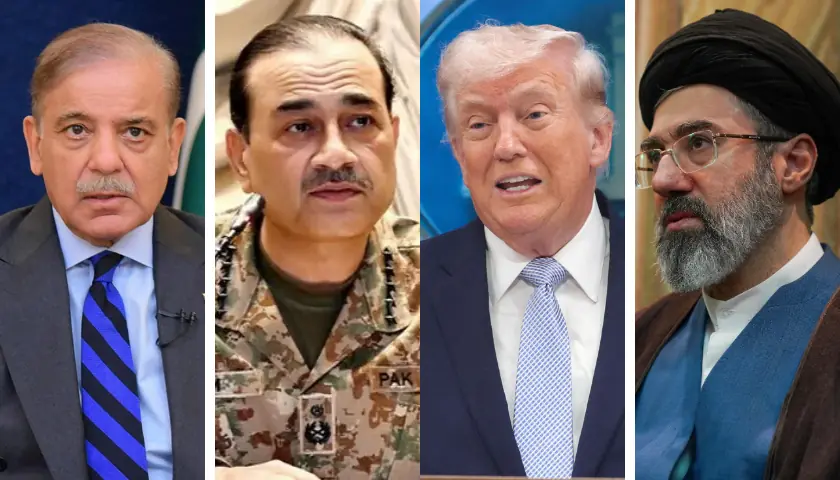
![Pakistani President and Prime Minister urge global action for right of Kashmiri people to self-determination on Kashmir Solidarity Day. [Image via AP]](https://southasiatimes.org/wp-content/uploads/2025/02/APP08-030225Islamabad.webp)
President Asif Ali Zardari and Prime Minister Muhammad Shehbaz Sharif have urged upon the international community to put pressure on India to allow the Kashmiri people to freely determine their own future for lasting peace in South Asia, Pakistan’s state-run Radio Pakistan reported.
In his message on Kashmir Solidarity Day being observed on Wednesday, February 5, 2025, President Asif Ali Zardari said this day reminds the international community of its responsibility towards the oppressed Kashmiri people.
He said the United Nations should honor the promises made to the Kashmiris 78 years ago and support their struggle for their right to self-determination.
Prime Minister Shehbaz Sharif, in his message, said the right to self-determination is a fundamental principle of international law but the Kashmiri people have not been able to exercise this right even after the passage of last seventy-eight years.
He said Pakistan will continue to offer its unwavering moral, diplomatic and political support to the Kashmiri people till the realization of their right to self-determination.
“The right to self-determination is a fundamental principle of international law. Every year, the UN General Assembly adopts a resolution that stresses the legal right of people to decide their own destiny,” Pakistan’s Prime Minister said, as per the statement from his office.
Expressing regret, the Prime Minister noted that even after 78 years, the Kashmiri people have yet to exercise their inalienable right to self-determination. He highlighted that Indian Illegally Occupied Jammu and Kashmir (IIOJK) remains one of the most militarized regions in the world, where residents continue to live under a climate of fear and intimidation.
The recent developments in the Middle East demonstrate that long-standing disputes should not be allowed to fester, the Pakistani prime minister said in a message on Kashmir Solidarity Day being observed today (Feb 5), APP reported.
Meanwhile, during a daylong visit to the Azad Jammu and Kashmir (AJK) capital on Wednesday (today), PM Shehbaz will reaffirm Pakistan’s unwavering commitment and support for the people of occupied Jammu and Kashmir, reported Pakistan’s Dawn.
The prime minister’s main engagement in Muzaffarabad will be an address to the AJK Legislative Assembly, Speaker Chaudhry Latif Akbar confirmed to Dawn. He added that before the prime minister’s address, the AJK premier and parliamentary leaders of various political parties would also speak.
Dawn citing the official sources, reports that upon arrival in Muzaffarabad, the prime minister will first visit the grand Monument to Martyrs at Chattar Chowk, where he will lay a floral wreath in tribute to those who sacrificed their lives in the struggle against India.
Chief of the Army Staff Gen Asim Munir would also join the prime minister in laying the wreath and offering Fateha for the fallen heroes of Kashmir, reports Dawn citing sources.
Meanwhile, Chairman Joint Chiefs of Staff Committee, General Sahir Shamshad Mirza, the Service Chiefs, and the Pakistan Armed Forces have reaffirmed their unwavering support for the resilient people of Indian Illegally Occupied Jammu and Kashmir in their just struggle for self-determination.
In a statement, the Inter-Services Public Relations (ISPR) said armed forces of Pakistan strongly condemn the ongoing grave violations of human rights in IIOJK.
These transgressions stand as a stark indictment of India’s blatant disregard for international law, humanitarian principles, and fundamental human rights.
Also See: Kashmir, An Unending Story of Resistance
AJK Leaders Reaffirm Support for Kashmiris on Solidarity Day
Azad Jammu and Kashmir (AJK) President Barrister Sultan Mehmood Chaudhry and Prime Minister Chaudhary Anwar ul Haq have stated that Kashmir Solidarity Day, observed for several decades, serves as a clear testament to the enduring social, cultural, and religious ties between the people of Kashmir and Pakistan.
In their separate messages released on Tuesday ahead of February 5 Kashmir Day, they reiterated that the government and people of AJK remain steadfast in their unwavering support for the legitimate struggle of Kashmiris until they attain freedom from India.
Highlighting Pakistan’s consistent backing of the Kashmiri cause, both leaders emphasized, “Pakistan and its people have supported the Kashmiri people through every thick and thin.”
The AJK president, in his message, strongly condemned India’s ongoing suppression of political and human rights in occupied Kashmir and called on the United Nations to intervene and put an end to the violence in the conflict-ridden region. He urged the UN to exert pressure on India to implement the UNSC resolutions mandating a plebiscite in Kashmir.
Commending the resilience and determination of the Kashmiri people, Barrister Chaudhry stated that they have remained steadfast in their struggle and did not move back even an inch from their motto. He reiterated that Kashmiris consider Jammu and Kashmir an indivisible entity and underscored the need for resolving the dispute in accordance with UNSC resolutions and the aspirations of the Kashmiri people.
Meanwhile, AJK Prime Minister Anwaar ul Haq stressed that the observance of Kashmir Day reflects the unwavering commitment of Pakistanis and Kashmiris to standing in solidarity with their oppressed brethren in their freedom struggle.
He further stated that while Pakistan desires peace in the region, India continues to undermine stability through its actions. “The extremist actions of the Indian government have threatened the peace of the region,” he added.
Torch Rally Held in Muzaffarabad to Honor Kashmiri Resistance
A torch rally and a separate candlelight vigil were held in Muzaffarabad on Tuesday evening to pay tribute to Kashmiris resisting Indian oppression, ahead of Kashmir Solidarity Day.
Organized at Burhan Wani Chowk—a symbolic site for pro-Kashmir demonstrations—the rally took place shortly after sunset under the banner of Pasban-i-Hurriyat Jammu Kashmir (PHJK), an organization representing post-1989 migrants from Indian-occupied Jammu and Kashmir.
Holding flaming torches high, participants marched through the city’s main thoroughfare from Burhan Wani Chowk to Garhi Pan Chowk, aiming to draw international attention to the deteriorating situation in occupied Kashmir.
Many attendees carried the flags of Azad Jammu and Kashmir (AJK) and Pakistan, while others held a banner reading: “All Eyes on Jammu & Kashmir.”
Addressing the rally, PHJK chief Uzair Ahmad Ghazali emphasized that the Kashmir issue remains a persistent point of tension between India and Pakistan, adding that millions worldwide continue to demand its fair resolution.
GB Assembly Adopts Resolution Condemning Indian Occupation
The Gilgit-Baltistan Assembly on Tuesday unanimously passed a resolution condemning India’s illegal occupation of Jammu and Kashmir while reaffirming unwavering support for the Kashmiri people’s right to self-determination.
The resolution, jointly moved by ministers and members from both the government and opposition, was read out by Minister Ghulam Muhammad. It denounced India’s aggression and occupation of Kashmir on October 27, 1947, as a “black day” in history, asserting that Kashmiris have never accepted Indian rule.
With inputs from Radio Pakistan, APP and Dawn.