Background and Context:
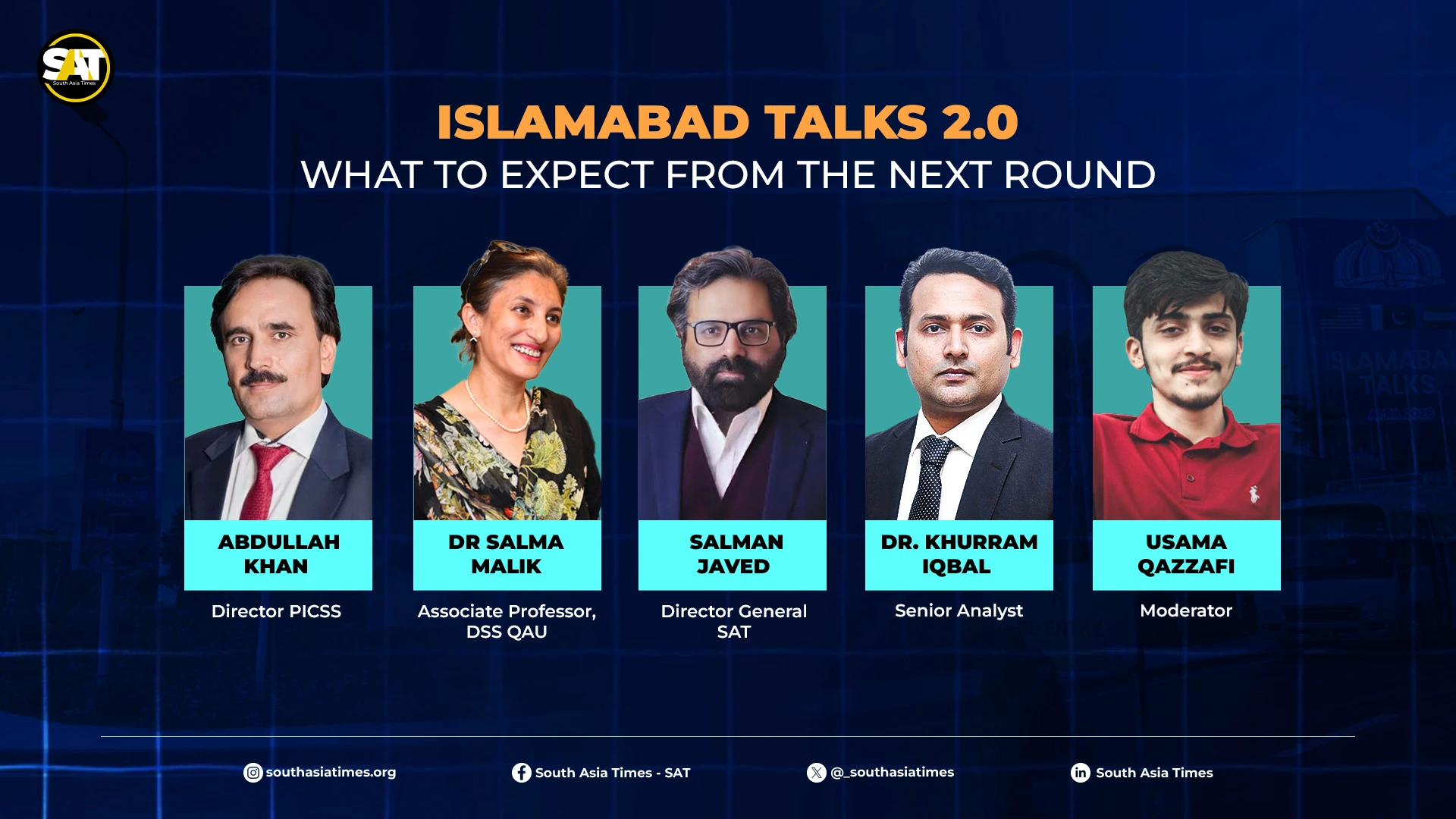
On April 17th, 2026, South Asia Times (SAT) hosted an X Space session titled “Islamabad Talks 2.0: What to Expect from the Next Round.” Moderated by Usama Qazafi, the session featured Salman Javed (Director, South Asia Times) and Abdullah Khan (Director, PICS), Dr. Salma Malik (Associate Professor, DSS QAU) and Dr. Khurram Iqbal (Senior Analyst) with contributions from other strategic experts. The discussion analyzed Pakistan’s pivotal role as the sole mediator in the ongoing rapprochement between the United States and Iran, the potential for a final agreement, and the regional “spoilers” threatening the peace process.
The “Islamabad Process”: Continuation, Not Failure
The panel clarified that the conclusion of the first round of talks was neither a breakdown nor a total breakthrough, but a strategic “pause.” Dubbed the Islamabad Process, the negotiations have already seen heavy lifting, with agreements reached on most bilateral issues except for specific technicalities regarding nuclear protocols. The upcoming second round in Islamabad (or Rawalpindi) is seen as an acceleration toward a potential signing.
Pakistan as the “Sole Mediator”
A central theme was the unique trust both Washington and Tehran have placed in Pakistan. While other regional players like Qatar and Turkey remain involved, the White House and the Iranian government have formally acknowledged Pakistan as the primary bridge. This role is bolstered by active “shuttle diplomacy,” with Prime Minister Shehbaz Sharif engaging Saudi Arabia, Qatar, and Turkey, while military leadership coordinates directly with Tehran.
The Trump Factor and the “Credit” Game
The experts examined President Trump’s contradictory personality, his desire for historic “wins” versus his unpredictable statements. While a physical visit by Trump to Pakistan for the talks is unlikely due to his upcoming May 15th visit to China, the panel noted he is keen to take full credit for the deal. His engagement may manifest through high-level video messages or digital presence to signal a “Trump-led” peace era.
The Lebanon Condition and Regional Spoilers
A major revelation from the session was that Pakistan’s primary condition for the first round of talks was the inclusion of Lebanon in the ceasefire. While the US and Iran initially agreed, the panel identified Israel as the primary “spoiler.” Experts argued that the “Deep State” in the US often operates under Israeli influence, and the subsequent escalations in Lebanon were seen as an attempt to undermine the Islamabad-mediated progress.
The Mirage of the Israel-Lebanon Ceasefire
A critical point of the discussion was the warning that the recently brokered 10-day ceasefire between Israel and Lebanon should not be celebrated as a definitive deal. The panel noted that the agreement was made with the Lebanese government, whereas Israel’s actual war is with Hezbollah. Since Hezbollah—the primary combatant, is not a formal party to this deal, the “peace” is technically flawed and serves more as a temporary pause than a resolution to the conflict.
The Emerging Security and Economic Block
Beyond the US-Iran duo, the talks have broader implications for a rising regional security block involving Egypt, Turkey, Pakistan, and Saudi Arabia. The panel noted that the US is increasingly weary of being “dragged” into regional wars by Israel and is looking for an exit strategy that prioritizes economic connectivity over military conflict.