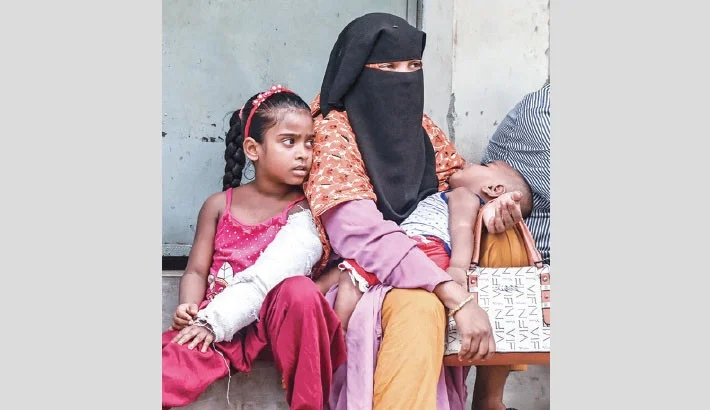
On Sunday, a doctors’ strike at public and private hospitals across the country brought the health service to a halt. Thousands of patients and their relatives endured severe hardship as a result.
Medical personnel abstained from work following a series of attacks on them. As a result, hospitals struggled to provide even the most basic services. Emergency departments locked and outpatient services suspended, leaving many patients in critical condition unattended.
Later in the day, physicians partially postponed their “complete shutdown” for 24 hours. The Health and Family Welfare Adviser assured them that authorities would arrest all individuals involved in the attacks and address their other demands.
Health Adviser Nurjhan Begum announced the decision in the evening. She made the announcement after meeting with doctors, interns, nurses, and medical staff at Dhaka Medical College Hospital (DMCH).
DMCH Director Brigadier General Md Asaduzzaman subsequently announced that the doctors had decided to call off their strike.
“Doctors will return to work immediately. They will first resume emergency services. Later, all staff will return to work in other departments,” he said.
Our correspondent observed that physicians at DMCH began providing medical care at 8:30pm. They did so in the presence of Army and BGB personnel. However, by 9:30pm, services in most other departments, except the ICU and HDU, had not yet resumed.
Abdul Ahad, a resident physician in the neurosurgery department at DMCH, stated that the strike had been suspended. However, the emergency department would continue to provide medical services.
“Outpatient and routine services will remain closed for the next seven days. If the perpetrators are not arrested and the safety of doctors is not ensured, we will announce further action,” he said.
Doctors’ Strike leave Thousands Stranded
Earlier, physicians announced an indefinite strike at all public and private hospitals across the country. This strike crippled the entire health service system. It followed several incidents of attacks on medical personnel.
As a result, thousands of patients and their relatives, who rushed to hospitals seeking treatment for their loved ones, experienced severe difficulties.
Two sisters, Shilpi and Taslima, brought their father from Madaripur. Upon arriving at DMCH, they found that the hospital had suspended medical services. The sisters burst into tears due to their father’s suffering.
“We went to two other hospitals, but no one is treating the ailing patients. This is inhumane. Where should we go now?” Shilpi said standing at the gate of the emergency department.
Our correspondent reported from Chattogram that Md Arman, from Anwara, brought his pregnant wife, Sumaiya, to Chittagong Medical College Hospital with labour pains but could not find a doctor to admit and treat her.
“The emergency department of the hospital is locked. I cannot enter with my wife. There are no doctors here. I don’t know how to get treatment or where to go with my wife,” he said.
Numerous individuals seeking medical care faced similar situations as doctors and interns locked the emergency and other departments of most hospitals that day.
Earlier on Sunday morning, Abdul Ahad announced the strike, demanding adequate security and the prosecution of those involved in the attacks.
The strike began when all 200 intern physicians at DMCH refused to attend their duties, and later, other physicians joined them in solidarity.
Multiple Attacks on Medical Staff
They subsequently presented several demands, including the immediate arrest and exemplary punishment of those involved in the attacks on doctors, the appointment of armed law enforcement officers to protect doctors in all hospitals nationwide within 24 hours, the appointment of a health police force under the Directorate General of Health Services within a week, and the reform and implementation of the health protection law.
Several incidents of attacks at DMCH on Saturday prompted the doctors’ strike. In the first incident, someone assaulted a physician over alleged negligence in treating Ahsanul Haque Dipto, a student from the Bangladesh University of Business and Technology (BUBT), who later succumbed to his injuries.
Following his death, a group of BUBT students allegedly dragged a resident doctor out of the operating theatre and took him to the director’s room, beating him. They also stormed the emergency department.
Doctors protested the incident, demanding the arrest of the perpetrators and guarantees of their safety. Although DMCH authorities and law enforcement agencies assured them of safety and the arrest of the attackers, further incidents of attacks occurred.
When a kidney patient died while undergoing treatment in the urology department, his relatives also attacked the interns.
Two rival groups clashed in the Khilgaon area on Saturday night. Some of the injured went to DMCH for treatment, but the opposing group attacked them inside the emergency ward, leading to a fierce clash between the two groups.
Following the strike announcement, DMCH Director Brigadier General Md Asaduzzaman and two coordinators of the Anti-discrimination Student Movement, Sarjis Alam and Hasnat Abdullah, met with doctors and medical staff but were unable to convince them to resume services.
Investigations Underway
Meanwhile, an office assistant at DMCH, Amir Hossain, filed a case with Shahbagh Police Station, accusing four named and 50 unnamed individuals.
The case statement names Shahrier Anrab, a teacher at the Bangladesh University of Business and Technology (BUBT), as the prime accused.
Authorities formed two separate investigative bodies to examine the incidents and allegations of negligence in treatment.
This news is sourced from Daily Sun and is intended for informational purposes only.