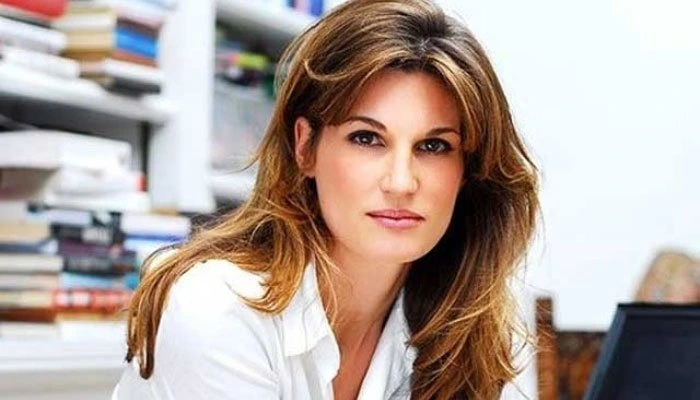
Stressing that Grooming Gangs crisis was a broader issue of men abusing power and not specific to any community, British screenwriter Jemima Goldsmith, ex-wife of jailed ex-prime minister Imran Khan, issued a stark warning on Wednesday over rampant child sexual abuse also known as grooming in the UK.
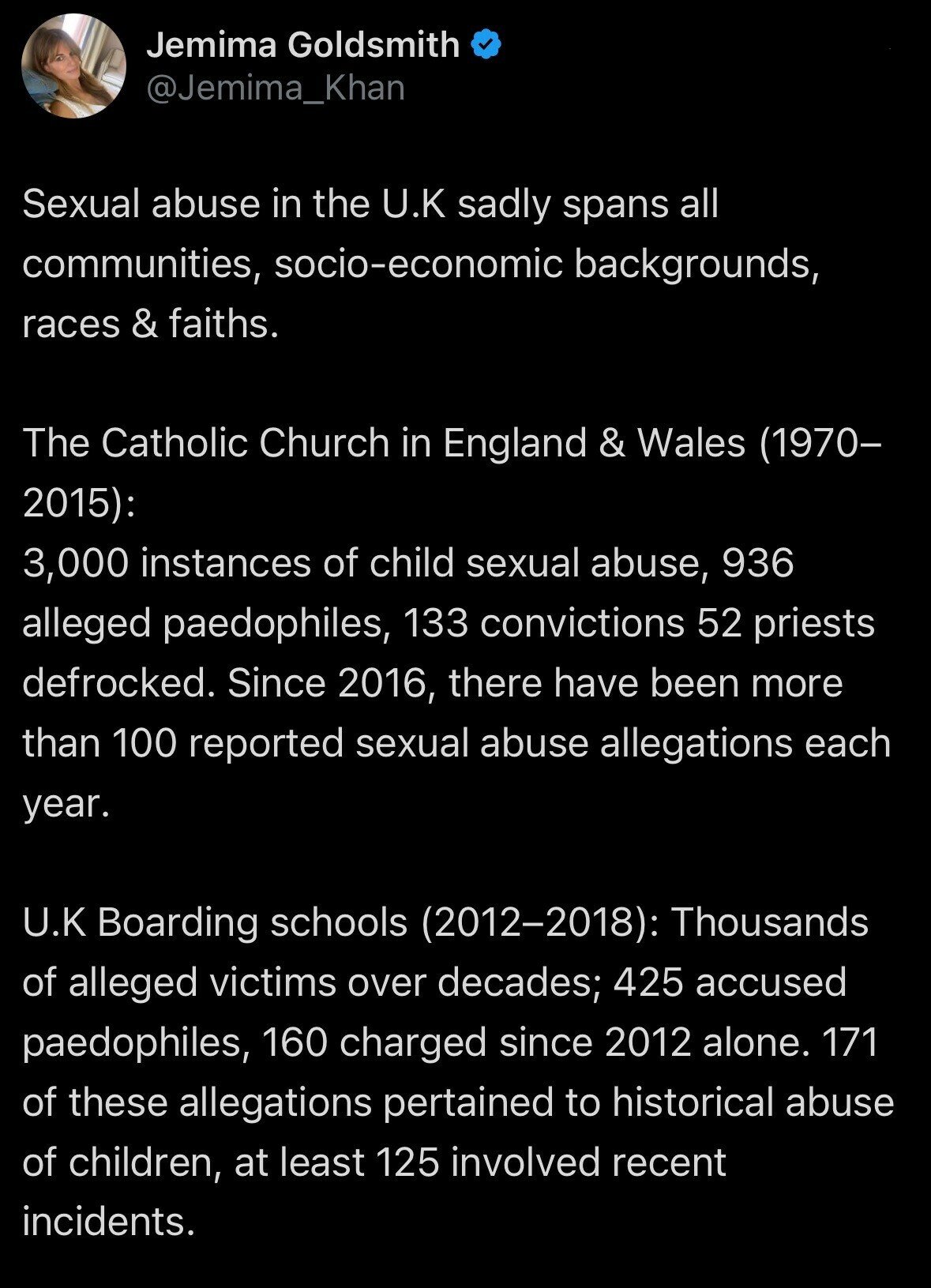
In a recent post on X, Goldsmith, said, “Sexual abuse in the UK sadly spans all communities, socioeconomic backgrounds, races and faiths.”
Jemima’s remarks on one of the most pressing issues affecting young girls and boys came a day after the Foreign Office of Pakistan categorically condemned grooming allegations levelled against the Pakistani diaspora in the UK.
Responding to a recent spate of “xenophobic remarks”, the FO on Monday expressed deep concern over the increasingly racist and Islamophobic political and media commentary towards the Pakistani community in the UK.
“Pakistan-UK friendship is characterised by warmth, cordiality, robust cooperation and trust. Nurtured over decades this relationship remains an important priority of Pakistan’s foreign policy,” the FO said in a statement.
The statement came after tech billionaire Elon Musk, who owns microblogging website X, waded into the debate surrounding the term “Asian grooming gangs,” which sparked fears of reinforcing negative stereotypes about Pakistanis.
Also See: Elon Musk’s Grooming Gangs Debate: Is There More Than Meets the Eye
She also shared statistics on abuse cases involving the Catholic Church in England and Wales, British boarding schools, and British Asian grooming gangs.
“The Catholic Church in England and Wales (1970–2015): 3,000 instances of child sexual abuse, 936 alleged paedophiles, 133 convictions 52 priests defrocked. Since 2016, there have been more than 100 reported sexual abuse allegations each year,” the ex-spouse of the cricketer-turned-politician wrote in the X post.
“UK Boarding schools (2012–2018): Thousands of alleged victims over decades; 425 accused paedophiles, 160 charged since 2012 alone. 171 of these allegations pertained to historical abuse of children, and at least 125 involved recent incidents.
“UK Asian grooming gangs (1997–2013): at least 1,400 victims, 60 child rapists convicted so far.
“The exact number of victims for all the above is unclear, as cases so often go unreported for years.
“And there have been multiple failures to prosecute perpetrators & protect victims),” Jemina wrote in a footnote at the bottom of the post.
Replying to an X-user, she said, “The common thread here is men, (often from closed, hierarchical, gender-segregated communities), abusing their power.”
The provocative posts from Musk also prompted a response from the National Police Chiefs’ Council (NPCC) earlier this month, stating that the vast majority of sexual grooming gang offences are carried out by white men.
Richard Fewkes, the director of the NPCC’s Hydrant programme targeting child sexual abuse, said: “There is no significant issue with any particular ethnicity or setting.”
Fewkes’s comments come after Musk used his social media platform X to wage an online campaign against the UK government over the grooming gangs crisis, making hideously false allegations against Prime Minister Keir Starmer, who had ensured that the grooming gangs are prosecuted and punished for their crimes when he was the head of Crown Prosecution Service (CPS) at the height of this scandal involving Pakistanis, Asians, and White men.
Previously, the billionaire also falsely accused the British prime minister of being “complicit in the rape of Britain” over his record as a former director of public prosecutions, and called safeguarding minister Jess Phillips a “witch” and a “rape genocide apologist”.
Source: Geo News, Pakistan.



![A view of Islamabad, as evolving regional dynamics reshape Pakistan’s security environment. [Image via Wikimedia].](https://southasiatimes.org/wp-content/uploads/2026/03/Islamabad_top_view.webp)