Joseph Nye once said,
“ In the information age, it is not just whose army wins but whose story wins.”
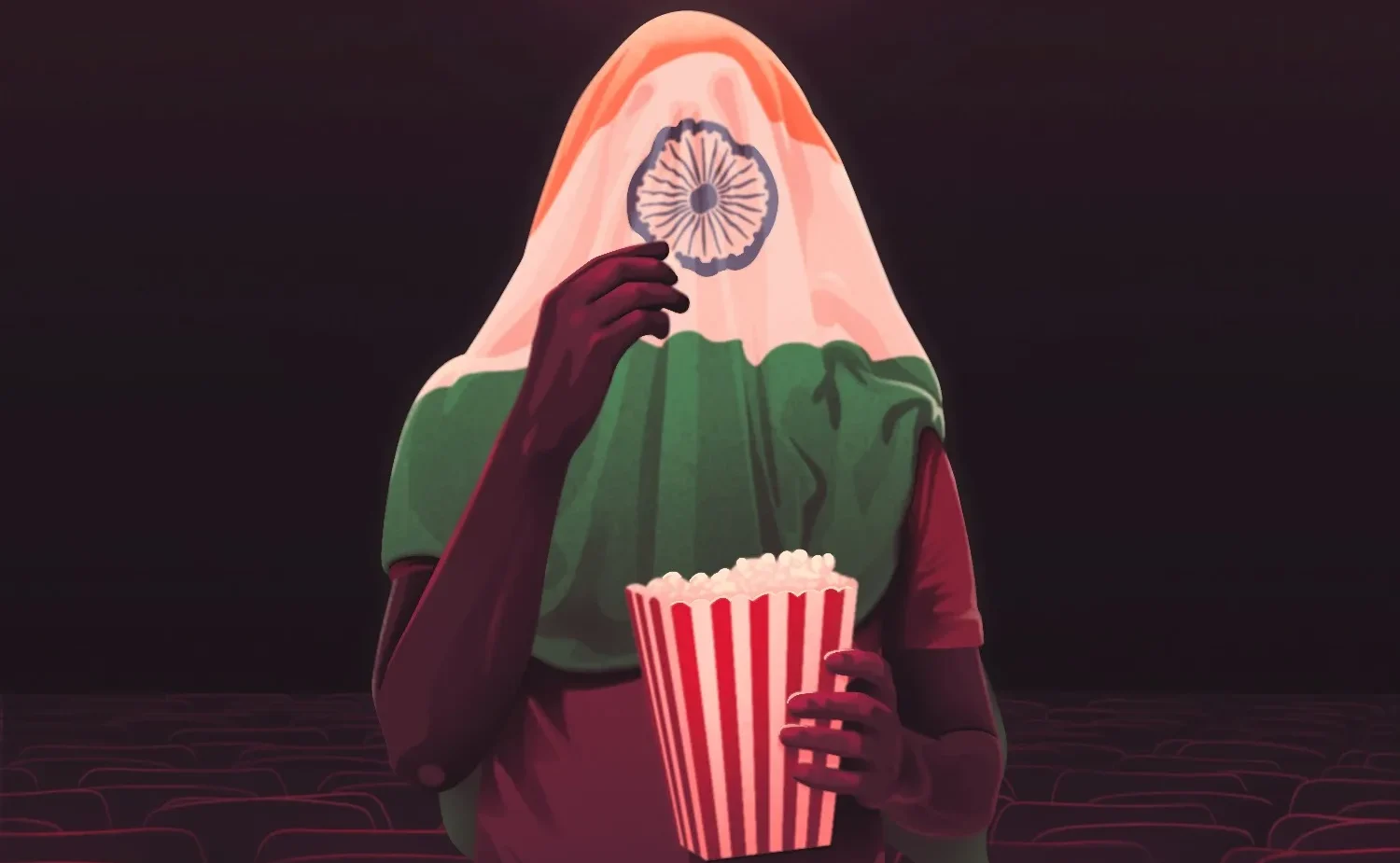
The Indian government appears well on its way to winning the lost wars in the imaginary world of movies. Since 2019, multiple blockbuster films have been released that were intrinsically based on propaganda disseminated with beautiful direction and captivating dialogues, much to the public’s appeal. From Uri – The Surgical Strike to Mission Majnu, India appears to have won the wars lost in actual combat. In addition, the Kashmir dispute and Islam are portrayed inaccurately with twisted facts. This appears to be part of a systematized information warfare, aiming at engineering the minds of the masses. The entertainment industry of India has now become the new textbook of history, depicting the contours of the subcontinent and Indo-Pak relations through the Hindutva lens of BJP and RSS.
When looking at Bollywood movies with business exceeding INR 100 crore since 2019, it appears that many of them have served this propaganda movement. Indian cinema, through these movies, has been used as a tool to create a narrative that serves to appease the radical vote bank against Pakistan and Kashmir. Movies like Uri: The Surgical Strike, Fighter, Sam Manekshaw, and Gadar 2 are a manifestation of how India is rewriting war history with Pakistan. Pakistan and its armed forces are portrayed as ignorant, rogue, and jingoistic warmongers aiming at destabilizing India by sponsoring and orchestrating terrorism.
Additionally, during the BJP era, Bollywood has also attempted to portray the Kashmir dispute differently. They are trying to shift the focus of the Kashmir issue towards Azad Jammu & Kashmir (AJK), redefining it as the sole area of dispute. In films like Uri, Fighter, and Article 370, the term “POK” (Pakistan Occupied Kashmir) has been repeatedly used when referring to AJK. In Article 370, the revocation of special status was justified as “an act taken according to the law, in the benefit of the Kashmiris, to reform the administrative structure so that the Kashmiris can have the same development as the rest of India.” However, the UN Human Rights Commission’s 2019 report presents a different reality. Moreover, the struggle for freedom was portrayed as terrorism sponsored by Pakistan. The resistance, as depicted in the movie, was said to have its roots among the Kashmiri youth due to the unwillingness and inefficiency of Kashmiri leadership in Indian-administered Kashmir in serving the people. In other words, facts were twisted very tactfully to gather support for the BJP and justify Indian moves taken on August 5, 2019, among the masses, as well as to redefine the Kashmir dispute.
But it does not end here. Movies are being produced to redefine the image of Islam. The Kerala Story, for instance, is a significant addition to Islamophobic content. The storyline of the movie portrays Indian Muslims as perpetrators and recruiters of terrorism, sponsoring the menace in India and worldwide. Muslim men were portrayed using women as puppets to secure their personal needs and ideological goals. The fact that these movies were endorsed by BJP officials highlights the government’s support for creating such content. In various cases, such as The Kerala Story and Article 370, tax exemptions were given in some states, and BJP representatives were found appreciating such movies, which in turn motivates the masses, resulting in them becoming blockbusters with massive public support. In sharp contrast, movies with a nuanced and balanced approach, like Raazi and Haider, did not receive such support from the government.
This highlights the use of cinema for propaganda, which could have serious repercussions not only for Pak-India relations but also for regional stability. Entertainment and art, once intended to connect masses and facilitate diplomacy, have, on the contrary, become an arsenal for ideological warfare. With India having access to OTT platforms such as Disney+, Amazon Prime, and Netflix, such content maligns Pakistan’s reputation among public and political audiences internationally. India has managed to equate Pakistani and Indian Muslims with terrorists, which will harden public discourse on both sides. Moreover, Pakistanis are exposed to ideological bombardment, questioning their ideals and nationalism, placing them in a defensive position. The artist community, on the other hand, is forced to take sides during conflicts instead of becoming a bridge. In a single line, the BJP government, through its entertainment industry, has managed to disseminate the idea of India being a survivor against a terrorist state with whom no dialogue, only war, is possible, making peace an elusive idea in South Asia. Such an approach will, sooner or later, bring the entire region to the brink of a catastrophe as it creates an environment where war, not dialogue, is supported. India, through its entertainment industry, has succeeded in dehumanizing an entire nation, equating patriotism and nationalism with aggression, jingoism, and anti-Pakistan sentiment.
The Pakistani cinema and drama industry, on the other hand, is trying to catch up, projecting our side of the story. Various movies such as Ghazi, Parwaaz Hai Junoon, and War have been released. Interestingly, Pakistan has also ventured into re-opening the chapter of the 1971 Indo-Pak War and Fall of Dhaka with well-received projects like Jo Bichar Gaye, Khab Toot Jate Hain, and Khel Khel Mein, providing a nuanced and realistic view.
Is it enough? No, simply banning Indian content is no longer a solution, as it can be bypassed through proxy servers and illegal websites. Pakistan needs to actively engage in battling India’s informational and ideological cold war. The government must invest in the entertainment industry to produce high-quality, fact-based content that is not solely driven by ratings, in order to win this war of narratives. Public-private partnerships and collaborations with entertainment industries and production houses in other countries can help disseminate content about Pakistan’s history, ideology, and cultural diversity.
In the post-2025 war period, Pakistan has found an opportunity to remove the tag of “terror-sponsoring state” imposed by India and project its true image, propagating a message of peace, diplomacy, and negotiation towards India and the world. However, the entertainment industry must also shoulder the weight of these peace-building efforts. It can become an ambassador of peace, helping to project soft power. The quality content produced in recent years has garnered attention from audiences in India as well. This gives Pakistan the chance and market to counter the BJP’s narrative warfare against its core interests. Creative and neutral voices in the Indian entertainment industry should also come forward and present nuanced and balanced perspectives, focusing more on shared issues on both sides. It is high time the entertainment industry takes initiatives to bridge the gaps created by the polarizing policies of the Indian government. Otherwise, Modi’s India, while trying to win lost socio-cultural wars through its digital weapons, will impact the broader geopolitical environment of the region at the cost of stability.
The views expressed in this article are the author’s own. They do not necessarily reflect the editorial policy of the South Asia Times.