![Canada's PM Carney says US relationship is over, vows retaliation for auto tariffs, and urges a reimagined economy. [Image via The Canadian Press via AP]](https://southasiatimes.org/wp-content/uploads/2025/03/canadapm.webp)
Canadian Prime Minister Mark Carney said that Canada’s old relationship with the United States (US), “based on deepening integration of our economies and tight security and military cooperation, is over”.
Speaking to reporters in Ottawa after a cabinet meeting, Carney said Canadians must “fundamentally reimagine our economy” in the face of US President Donald Trump’s tariffs.
He said Canada would respond with retaliatory tariffs that will have “maximum impact” on the US.
Trump announced on Wednesday he would target imported vehicles and vehicle parts with a 25% tax, stating: “This is permanent.”
Carney, the Liberal Party leader, called the original Canada-US Automotive Products Agreement signed in 1965 the most important deal in his lifetime.
“That’s finished with these tariffs,” he said in French.
He continued that Canada can sustain an auto industry with the US tariffs provided the government and business community work to “reimagine” and “retool” the industry.
Canada needs to build an economy Canadians can control, he said, and that would include rethinking it’s trade relationship with other partners.
It remains to be seen whether Canadians can have a strong trading relationship with the United States going forward, he added.
Carney has switched his campaign plans ahead of next month’s general election to confront the latest import duties.
The US has already partially imposed a blanket 25% tariff on Canadian goods, along with a 25% duty on all aluminium and steel imports. Canada has so far retaliated with about C$60bn ($42bn; £32bn) of tariffs on US goods.
The new car tariffs will come into effect on 2 April, with charges on businesses importing vehicles starting the next day, the White House said. Taxes on parts are set to start in May or later.
Early on Thursday morning, Trump warned Canada and the EU against joining forces versus the US in the trade war.
“If the European Union works with Canada in order to do economic harm to the USA, large scale Tariffs, far larger than currently planned, will be placed on them both,” he posted on his Truth Social platform.
Carney met his ministers in Ottawa on Thursday morning to “discuss trade options”. He had originally been scheduled to campaign in Quebec.
He said during his press conference that President Trump had reached out to him last night to schedule a call, and that it would take place in the “next day or two”.
If it takes place, this would be the first call between the pair.
Also See: Trump Threatens Further Tariffs as EU, Canada Retaliate
Pierre Poilievre, leader of the Conservatives, the main opposition party, called the tariffs “unjustified and unprovoked”.
The NDP, a left-wing party that previously helped prop up the minority Liberal government of ex-PM Justin Trudeau, also switched its campaign plans on Thursday.
Jagmeet Singh, the NDP leader, spent the day meeting union leaders and car workers in Windsor, Ontario, an auto manufacturing hub across from Detroit, Michigan.
He said the US tariffs are a “betrayal” against a close ally, saying that “Donald Trump has started an illegal trade war with Canada” for “absolutely no reason”.
He said any auto company that moves their operations out of Canada because of the tariffs should be blocked from selling cars in the country.
Canadians go to the polls on 28 April.
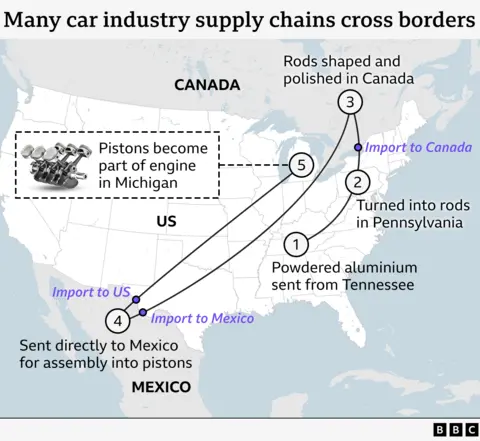
The US imported about eight million cars last year – accounting for about $240bn in trade and roughly half of overall sales.
Earlier this month, after he became Liberal leader and before he was sworn in as prime minister, Carney gave a victory speech in which he lambasted the US president.
“A person who worships at the altar of Donald Trump will kneel before him, not stand up to him,” he said, while assailing his main rival, Poilievre.
Mexico is the top supplier of cars to the US, followed by South Korea, Japan, Canada and Germany.
Mexican President Claudia Sheinbaum, in a news conference on Thursday morning, declined to comment directly on the new auto tariffs.
She vowed her government would “always defend Mexico”, and fight to maintain job creation and protect Mexican companies affected by import taxes.
She said Mexico would provide an “integral response” to the Trump administration’s tariffs on 3 April, the day after many are due to come into effect.
Sheinbaum has repeatedly noted that many US car companies have operations in both Mexico and Canada, which are bound by a North American free trade agreement that Trump himself negotiated during his first term in the White House.
“Of course, there shouldn’t be tariffs,” she said on Thursday. “That’s the essence of the free trade agreement.”
This news is sourced from BBC and is intended for informational purposes only.