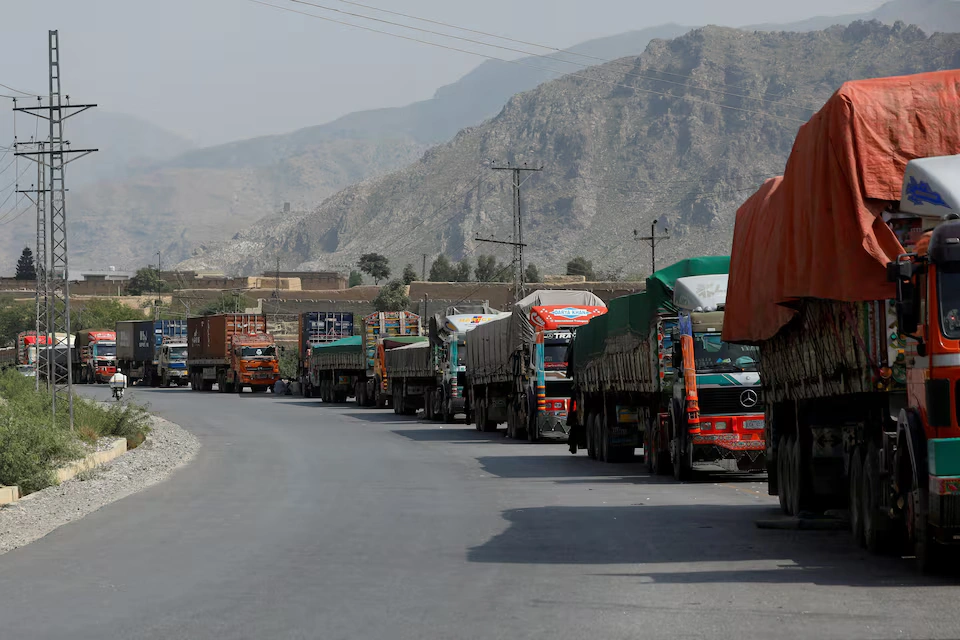
In October 2025, the Taliban leadership in Kabul directed Afghan traders to halt business dealings with Pakistan, framing the decision as an assertion of economic sovereignty. While presented as a strategic step toward trade diversification, the measure exposes a fundamental misjudgment: Afghanistan’s economy is heavily dependent on Pakistan’s trade corridors, both structurally and operationally. Attempts to bypass Islamabad risk far greater economic and logistical consequences for Kabul than for Pakistan.
Pakistan: Afghanistan’s Primary Trade Gateway
Since 1947, Pakistan has served as Afghanistan’s primary conduit for international trade. Two principal routes, the Chaman–Karachi and Torkham–Karachi corridors, account for over half of Afghanistan’s imports and exports. In FY 2024–25, bilateral trade reached approximately US $1.5 billion, with Pakistan’s exports alone valued at $1.14 billion. These corridors are not simple transport routes; they reflect decades of operational development, infrastructure investment, and institutional knowledge.
Over the past 50 to 70 years, border towns along these corridors, Chaman, Spin Boldak, Torkham, Jalalabad, and Ghulam Khan, have evolved into commercial hubs. Afghan business communities rely on established networks of customs officials, bonded carriers, warehouses, and cold-storage facilities. The depth and maturity of this ecosystem cannot be replicated rapidly through alternative routes.
Limitations of Alternative Trade Routes
Afghanistan’s attempts to shift trade toward Iran, Central Asia, and northern corridors face significant operational and financial constraints. The Lapis Lazuli Corridor, connecting Afghanistan to Europe via Turkmenistan and the Caucasus, is only partially operational. Transporting goods through this corridor increases costs by approximately 40% and doubles delivery times, rendering it impractical for perishable goods such as fruits, vegetables, and dried nuts.
The Chabahar Port question cannot be separated from the wider U.S. sanctions architecture on Iran. Historically, Washington has enforced secondary sanctions, penalties that target not just Iranian entities but any foreign company, bank, or government that engages in significant transactions with them. These measures have previously been applied to international financial institutions, shipping companies, and even state-linked enterprises in Europe and Asia. This framework means that any country operating through Iranian banks or sanctioned entities risks being cut off from the U.S. financial system, losing access to dollar-clearing, or facing trade restrictions. Afghanistan is no exception. If the Taliban choose to route major trade flows through Chabahar and rely on Iranian banking channels already under U.S. sanctions, they expose themselves to the same penalties.
Northern trade routes through Uzbekistan, Turkmenistan, and Kazakhstan involve long distances, multiple border crossings, and bureaucratic processes. Security risks, variable tariffs, and seasonal disruptions further complicate these pathways. In short, while alternative corridors exist on paper, they remain slower, costlier, and operationally less reliable than Pakistan’s historic routes.
Fiscal Impact on Kabul
The economic consequences of bypassing Pakistan are immediate and substantial. Pakistan’s border trade generates approximately PKR 50 million daily in customs revenue. Afghanistan relies on these crossings for more than 50% of its state revenue. World Bank estimates indicate that Afghan customs collected AFN 41.4 billion (≈ US $1.6 billion) in the first eight months of FY 2024–25. Extended border closures or trade boycotts directly reduce revenue, foreign-exchange inflows, and the availability of essential goods.
The October 2025 closures at Torkham and Chaman reportedly caused monthly losses exceeding US $200 million for Afghan exporters. Hundreds of trucks were stranded, perishable goods spoiled, and traders incurred significant demurrage costs. Border communities suffered immediate income loss, rising unemployment, and economic uncertainty.
Labour Mobility and Remittances
Trade dependency is only one dimension of Afghanistan’s reliance on Pakistan. Labour mobility represents another critical channel of economic support. Pakistan permits Afghan workers to earn livelihoods and remit cash home, sustaining families and local economies. By contrast, neighboring countries, including Iran, Turkmenistan, Uzbekistan, and Tajikistan, require work visas and restrict cash remittance. Central Asian employers must prove the absence of qualified local labor, limiting opportunities for Afghan workers. Cash transfers are also heavily regulated, reducing the economic benefit to Afghan households. By bypassing Pakistan, Kabul risks severing a vital source of household income. Reduced labour mobility directly affects remittances, increases poverty, and heightens social vulnerability.
Strategic and Operational Constraints
Afghanistan’s efforts to reduce reliance on Pakistan overlook several operational realities. Northern corridors suffer from insufficient infrastructure, poor road quality, limited cold-chain facilities, and inadequate rail networks. Transporting goods through Chabahar or northern routes adds 20–40% in logistics costs for sensitive commodities and introduces unpredictable delays.
Geography further limits alternatives. Pakistan’s contiguous land access and deep-sea ports are unmatched by India or Central Asian neighbors. While India can provide political support or financing, it cannot replicate Pakistan’s logistical efficiency, capacity, or speed. Therefore, alternative routes cannot substitute for Pakistan’s structural advantages.
Broader Regional Implications
Afghanistan’s trade boycott carries broader geopolitical consequences. Diversion from Pakistan threatens to reduce Islamabad’s role as a regional logistics hub and undermines the strategic framework of the China-Pakistan Economic Corridor (CPEC). Afghanistan faces additional challenges, including navigating sanctions on Iranian-linked routes, ensuring northern corridor reliability, and maintaining predictable market access. While alternative trade channels may offer incremental gains, they do so at the cost of efficiency, revenue, and operational reliability.
Conclusion
Afghanistan’s decision to halt trade with Pakistan reflects frustration over border closures and security concerns. However, Pakistan remains the only country capable of handling Afghanistan’s commercial needs at scale, speed, and cost-effectiveness. Alternative corridors, while operationally viable in limited scenarios, cannot replace the established trade ecosystem.
Economic sovereignty is important, but it cannot come at the expense of fiscal stability, infrastructure efficiency, or livelihoods. For Kabul, pragmatic engagement with Pakistan, rather than symbolic economic nationalism, is essential. Until Afghan policymakers fully account for the structural, logistical, and operational realities of their trade network, attempts at diversion risk significant self-inflicted economic and social harm.



![US Embassy in Riyadh, Saudi Arabia, amid heightened regional tensions following the Iran crisis. [Image via AFP].](https://southasiatimes.org/wp-content/uploads/2026/03/image-3-3-scaled-1.webp)