![The Afghan Taliban-ISKP spiral is spiraling out of control, threatening stability—Akora Khattak’s tragedy is just the tip of the iceberg. [Image via SAT Creatives]](https://southasiatimes.org/wp-content/uploads/2025/03/SAT-Web-Banners-33.webp)
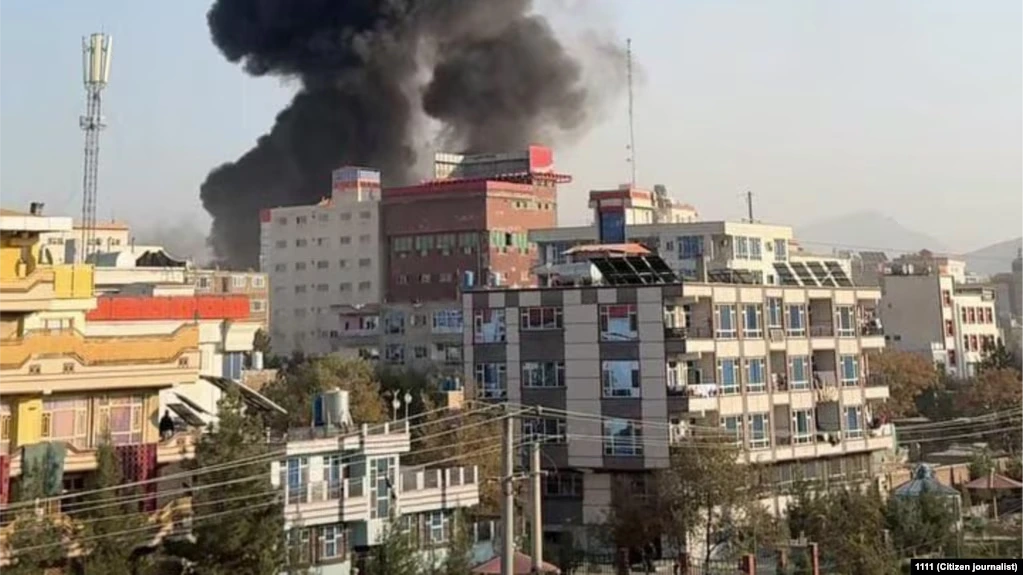
As of March 3, 2025, tensions have escalated at the volatile Pakistan-Afghanistan border, with Pakistani and Afghan forces exchanging fire at the Torkham crossing, now closed for over a week due to disputes over Afghan border post construction. While no casualties were reported, the skirmish is emblematic of the broader instability gripping Afghanistan and its inevitable spillover into Pakistan and beyond.
Akora Khattak: A Town Steeped in History and Tragedy
In Akora Khattak, a town steeped in religious and political history, the grim consequences of this chaos became tragically evident. The assassination of Moulana Hamid ul Haq, son of Moulana Sami ul Haq, in a suicide bombing at the Jamia Haqqania seminary is yet another stark reminder that Afghan Taliban-ISKP spiral is not contained within Afghanistan’s borders. Thousands of mourners gathered to pay their respects, highlighting the profound impact of this loss.
The Islamic State Khorasan Province (ISKP), suspected in this attack, has followed this modus operandi before—targeting high-profile figures to sow fear and assert its presence.
This is not an isolated incident but a symptom of a deeper malaise. Analysts view this not just as a high-profile killing but as a manifestation of the growing anarchy taking root in Afghanistan under the Taliban regime.
The Afghan Taliban-ISKP Spiral: A Growing Threat and Deepening Crisis
ISKP’s persistent attacks—from the assassination of Sheikh Rahimullah Haqqani in 2022 to the recent killing of Haji Khalil Haqqani and now Moulana Hamid ul Haq—underscore the group’s expanding reach and its ability to strike at will. Even within Afghanistan, ISKP’s campaign has been relentless, with last month’s massacre of 40 Taliban officials in Kunduz serving as a testament to the Taliban’s failure to neutralize the threat.
ISKP’s campaign now appears to be a dual-front assault: targeting Afghanistan’s religious leadership, as seen in Akora Khattak, and strategically positioning itself around key economic corridors. These include the Turkmenistan-Afghanistan-Pakistan-India (TAPI) pipeline, Trans Afghan railway, and the Chitral-Badakhshan Highway, which links Afghanistan to Pakistan and the China-Pakistan Economic Corridor (CPEC). ISKP’s presence around these strategic corridors, including areas like Kunduz, Nangarhar, and Helmand, poses a direct threat not only to the security of Afghanistan but to the broader regional economic stability, with China, Pakistan, and other neighboring countries feeling the reverberations.
Internal Divisions Within the Taliban: The Path to Civil War?
Pakistan has taken a proactive stance, recently dismantling an ISKP network in Balochistan. But the challenge remains formidable. The Taliban’s internal fissures—particularly the growing rift between the Kandahar faction and the Haqqani network— has created a vacuum, allowing ISKP to thrive. These fissures, coupled with the Taliban’s failure to neutralize the threat, are intensifying the Afghan Taliban-ISKP spiral, driving Afghanistan toward greater anarchy and undermining its already fragile governance. Mullah Haibatullah’s hardline approach has alienated many within the ranks, and the preferential treatment of the Noorzai tribe has further exacerbated tensions. These divisions have not only weakened the Taliban’s grip on Afghanistan but have also allowed ISKP to recruit disillusioned fighters, particularly from northern Afghanistan, further destabilizing the region.
The Taliban’s internal fractures are being exploited by external actors. Some analysts suggest that India, Iran, and other nations may be quietly supporting factions opposed to both the Taliban and ISKP. With exiled Afghan politicians, disillusioned commanders, and armed opposition groups growing, could Afghanistan be on the verge of another civil war? The possibility of a new resistance—akin to the Northern Alliance of the early 2000s—is no longer far-fetched.
Also See: The Spillover of Chaos: Afghanistan’s Instability and Its Regional Fallout
The Strategic Importance of Akora Khattak: A Symbol of Ideological and Economic Warfare
Akora Khattak, historically a breeding ground for ideological movements, now finds itself at the crossroads of a strategic and ideological battle. The town, home to the Darul Uloom Haqqania madrasa—alma mater to many of the Taliban’s leadership—has long played a pivotal role in shaping the region’s political-religious discourse. Its significance in the Pakistan-Afghanistan dynamic cannot be overstated.
Today, its prominence is not just ideological but also strategic; the ISKP’s ability to strike here signals its intent to deepen the rift between Pakistan and Afghanistan while consolidating its influence near crucial economic connectivity projects, including the China-Pakistan Economic Corridor (CPEC), the Turkmenistan-Afghanistan-Pakistan-India (TAPI) pipeline, and the Chitral-Badakhshan Highway. The group’s expanding presence in these corridors signals a dual assault on both ideological and economic fronts, aiming to disrupt regional commerce and investment, particularly Chinese interests in Pakistan and Afghanistan.
The growing insecurity along these trade routes not only threatens Pakistan’s stability but also jeopardizes key infrastructure projects and regional economic initiatives. ISKP’s focus on such areas demonstrates its evolving strategy—targeting Afghanistan’s religious establishment while simultaneously undermining critical connectivity projects that bind the region’s economies together. The attack on Akora Khattak serves as a stark reminder that ISKP is no longer just waging an ideological war but is actively engaging in economic sabotage, with long-term consequences for regional stability.
Taliban’s Governance Crisis: From Insurgency to Economic Monopolization
The Taliban’s failure to transition from an insurgency into a functional government has fueled this crisis. Three years into their rule, their governance is defined more by economic monopolization and repressive policies than by stability or progress. Figures like Haji Bashir Noorzai control Afghanistan’s mineral wealth, while heavy taxation and economic mismanagement push ordinary Afghans further into despair. Despite the Taliban’s claims of control, ISKP’s ability to recruit from impoverished Afghan communities and former security forces suggests otherwise. The Taliban’s economic mismanagement and monopolization of resources have not only deepened public resentment but also created a fertile ground for ISKP’s recruitment, as disillusioned Afghans—particularly former security personnel and marginalized communities—seek alternatives amid growing instability. Hence, the economic despair in Afghanistan is not just a crisis—it is an incubator for militancy.
As The Cipher’s Matin Bek outlines in his recent analysis, the Taliban’s internal fractures are deepening, and their days as an unchallenged force may be numbered. The emerging consensus among analysts is that external pressure—diplomatic, economic, and legal—could accelerate this decline. The International Criminal Court’s (ICC) potential arrest warrants against Taliban leaders could further fracture their ranks, pushing moderate elements to defect or seek alternative power structures. The question remains: can international diplomacy leverage this moment to force a more inclusive political transition in Afghanistan?
The Ripple Effect: The Afghan Taliban-ISKP Spiral and its Threat to Regional Stability
For Pakistan, the security landscape is worsening. Over the past four years, groups like Tehreek-e-Taliban Pakistan (TTP), Balochistan Liberation Army (BLA), and ISKP have carried out over 600 attacks, according to a recent UN Security Council report. The ISKP’s strategic shift towards targeting Pakistani religious figures, such as Moulana Hamid ul Haq, suggests a deeper game: an attempt to fracture Pakistan’s religious establishment, which has historically influenced Taliban politics. If unchecked, this could trigger ideological schisms within Pakistan itself.
So, what next? The international community must recognize that the Taliban’s internal strife presents both a challenge and an opportunity. The growing resistance within Afghanistan—whether from internal Taliban factions or external opposition groups—must be studied closely. If an alternative political structure begins to take shape, external actors will have to decide whether to engage with the Taliban or pivot towards a new leadership. Legal and diplomatic pressure, such as the ICC’s arrest warrants for Taliban leaders, could further fracture their ranks. Meanwhile, regional trade and security frameworks must adapt to the reality that ISKP’s presence near strategic corridors is no longer just a security issue—it is an economic liability for Pakistan, China, Russia and Afghanistan’s neighbors.
Pakistan, too, must recalibrate its approach. The reality of an unstable Afghanistan is one that Islamabad cannot afford to ignore. While some still cling to the hope that the Taliban will mitigate these challenges, the trajectory suggests otherwise. Pakistan’s counterterrorism strategy must evolve beyond kinetic operations to include ideological counter-narratives, economic incentives for tribal regions, and diplomatic efforts to stabilize Afghanistan’s political landscape.
If history—and Akora Khattak’s role in it—teaches us anything, it is that ideological battles never remain confined to one geography. And as the fault lines in Afghanistan widen, the tremors will be felt far beyond its borders.