Indian attempts to Change Jammu & Kashmir’s demography

Navin Choudhary, a senior Indian Administrative Service Officer from Bihar, became the first Domicile holder of Jammu and Kashmir from among the Indian bureaucracy running JK. 

India has introduced new domicile law in the Indian occupied State of Jammu and Kashmir. This new law has sparked a new wave of anger in native Kashmiri people. They are seeing this law as a continuation of Indian state acts to change the demography of the area. 

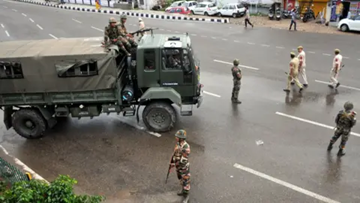
Jammu and Kashmir had a special status in the Indian constitution, this special status was guarded by article 370. In August 2019 BJP led government abrogated this article and changed the status of Jammu and Kashmir to a union territory along with Ladakh. After this abrogation, protests erupted in the valley and Indian security forces enforced curfew there. These security arrangements are still there along with the suspension of high-speed mobile internet. In March 2020 BJP government went further and changed citizenship laws of Indian occupied Jammu and Kashmir.

The new rules allow such Indian citizens who have lived in Jammu and Kashmir for 15 years to claim a domicile certificate to attain residency benefits, before this no one outside of the Jammu and Kashmir was able to buy land here. The period for a student who has studied here is 7 year and children of the central government officials are 10 years. This law has been introduced by central government without taking politicians of the valley into confidence. 

People across Jammu and Kashmir are worried that this law will change the demography of the region, people from all over India will start pouring into the valley and hence they would snub the rights of the indigenous people.

This law will also help BJP lead the Indian government to change the demography of the valley and turn this Muslim majority area into a Hindu majority area, as it did with Jammu which was a Muslim majority area but now Muslims are in minority there. This grave situation also creates severe security concerns; the majority of the Muslim population do not view India as their country that’s why separation movements in the valley are always so strong. By changing the demography of this area India can then secure this area, which has engaged a vast proportion of its army and security budget.

China and Pakistan both constantly condemning these changes. After the clashes in Ladakh, China has presented itself as a party in the Kashmir issue, however without a strong input from the international community, the plight of the local Kashmiri people often falls to deaf ears.


\"kashmir

News Desk

Your trusted source for insightful journalism. Stay informed with our compelling coverage of global affairs, business, technology, and more.

Recent

An analysis of Qatar’s neutrality, Al Jazeera’s framing of Pakistan, and how narrative diplomacy shapes mediation and regional security in South Asia.

Qatar’s Dubious Neutrality and the Narrative Campaign Against Pakistan

Qatar’s role in South Asia illustrates how mediation and media narratives can quietly converge into instruments of influence. Through Al Jazeera’s selective framing of Pakistan’s security challenges and Doha’s unbalanced facilitation with the Taliban, neutrality risks becoming a performative posture rather than a principled practice. Mediation that avoids accountability does not resolve conflict, it entrenches it.

Read More »
An analysis of how Qatar’s mediation shifted from dialogue to patronage, legitimizing the Taliban and Hamas while eroding global counterterrorism norms.

From Dialogue to Patronage: How Qatar Mainstreamed Radical Movements Under the Banner of Mediation

Qatar’s diplomacy has long been framed as pragmatic engagement, but its mediation model has increasingly blurred into political patronage. By hosting and legitimizing groups such as the Taliban and Hamas without enforceable conditions, Doha has helped normalize armed movements in international politics, weakening counterterrorism norms and reshaping regional stability.

Read More »
AI, Extremism, and the Weaponization of Hate: Islamophobia in India

AI, Extremism, and the Weaponization of Hate: Islamophobia in India

AI is no longer a neutral tool in India’s digital space. A growing body of research shows how artificial intelligence is being deliberately weaponized to mass-produce Islamophobic narratives, normalize harassment, and amplify Hindutva extremism. As online hate increasingly spills into real-world violence, India’s AI-driven propaganda ecosystem raises urgent questions about accountability, democracy, and the future of pluralism.

Read More »
AQAP’s Threat to China: Pathways Through Al-Qaeda’s Global Network

AQAP’s Threat to China: Pathways Through Al-Qaeda’s Global Network

AQAP’s threat against China marks a shift from rhetoric to execution, rooted in Al-Qaeda’s decentralized global architecture. By using Afghanistan as a coordination hub and relying on AQIS, TTP, and Uyghur militants of the Turkistan Islamic Party as local enablers, the threat is designed to be carried out far beyond Yemen. From CPEC projects in Pakistan to Chinese interests in Central Asia and Africa, the networked nature of Al-Qaeda allows a geographically dispersed yet strategically aligned campaign against Beijing.

Read More »
The Enduring Consequences of America’s Exit from Afghanistan

The Enduring Consequences of America’s Exit from Afghanistan

The 2021 US withdrawal from Afghanistan was more than the end of a long war, it was a poorly executed exit that triggered the rapid collapse of the Afghan state. The fall of Kabul, the Abbey Gate attack, and the return of militant groups exposed serious gaps in planning and coordination.

Read More »