There are decades where nothing happens, and there are weeks where decades happen” – Vladimir Ilyich Lenin
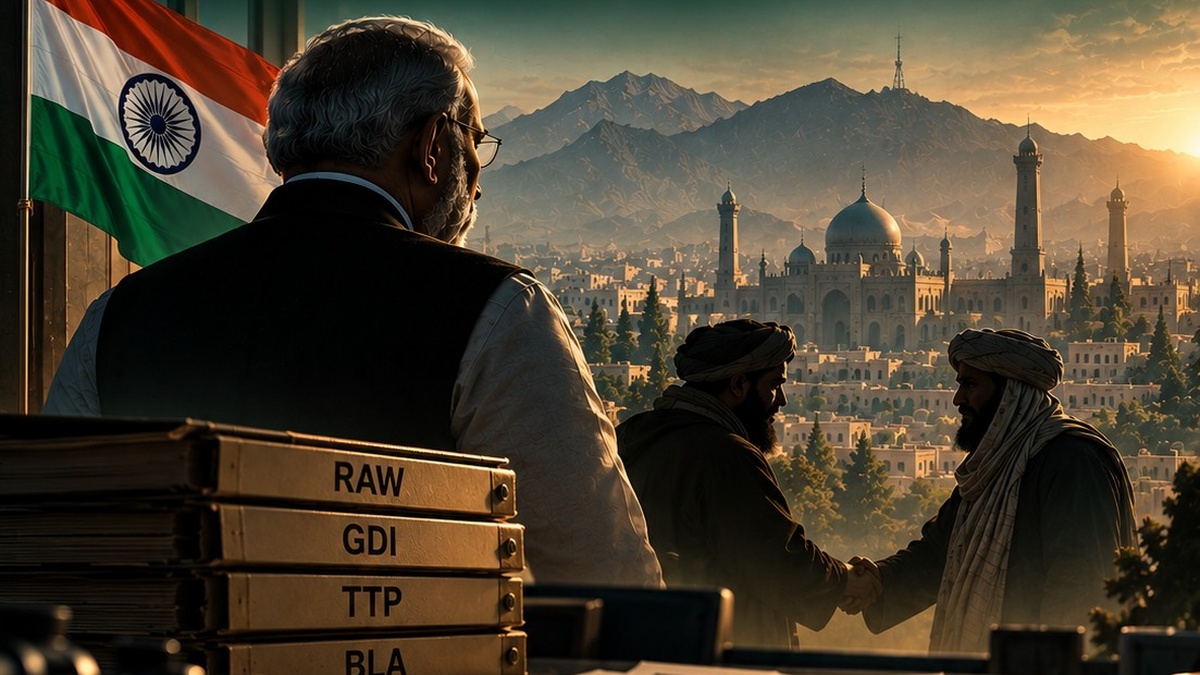
In an interview with the Indian news outlet, Mullah Yaqoob, the defense minister of the Afghan interim government, left many startled when the minister nodded yes to the possibility of sending Afghan soldiers to India for training. The announcement was particularly frowned upon among the circle of policymakers in Pakistan. The issue was further compounded by the Afghan interim government’s cold response to the issue of Blasphemous remarks by the BJP spokesperson. The aforesaid developments led many to speculate that something is brewing inside between India and Afghanistan. This in turn begets the question:
Should Pakistan worry about this new dynamic of the relationship unfolding between Afghanistan and India?
To answer the question, we shall recourse to the history.
Evidence from History
India since long has developed hegemonic ambitions in the South Asian region. The said hegemonic ambitions are reflected in their respective foreign policy doctrines. Since its inception, India under the leadership of the secular and progressive Jawaharlal Nehru has developed its own Monroe Doctrine. Apparently, the doctrine was aimed to keep the external powers out of South Asia, however, embedded in the doctrine was India’s hegemonic ambitions to pull the neighboring countries under its influence. However,
it is pertinent to mention that the term ‘hegemonic ambitions’ should be understood as a euphemistic word for the project ‘Akhand Bharat’
The said doctrine was reinforced by the subsequent governments irrespective of their party affiliations and ultimately institutionalized as a key principle of Indian foreign policy during the tenure of Indira Gandhi in the form of the Indira Doctrine. Since then, to quote from the Indian ministry of external affairs’ official website, “the principle has been a matter of faith for Indian foreign policymakers.” What is noteworthy here is that contrary to the mainstream discourse which laid particular emphasis on the Bharatiya Janata Party (BJP) as a pioneer of the Hindutva project it was the leadership of the so-called secular, progressive Indian National Congress that laid the foundations of Hindutva project disguised under the hegemonic ambitions.
In line with its hegemonic ambitions and its foreign policy goals, India has hauled a number of countries in the region into its own sphere of influence which includes Nepal, Bhutan, Sri Lanka, and Bangladesh. Attempts have also been made on Afghanistan to put it in under its influence. These attempts carry strategic importance for Pakistan_ the country which has resisted Indian hegemonic ambitions. The point needs further illustration.
The Triad and Strategic Responses
Afghanistan has remained a center of regional powers’ rivalry with competing interests. Of all these regional powers, the two countries, whose rivalry has greatly influenced the stability of Afghanistan are Pakistan and India.
There is no exaggeration in the assertion that Afghanistan is the epicenter of the Pak-India Cold war, where both the countries are entangled in a zero-sum game.
To put it bluntly, in the context of Afghanistan, Pakistan’s gain is perceived by India as its loss and vice versa.
But it should be kept in mind that Pakistan is merely responding to the Indian maneuvers in Afghanistan to preserve its sovereignty and territorial integrity. For a long, India is trying to make inroads in Afghanistan through soft power projection. All of its endeavors, whether it is economic or military assistance to Afghanistan are mainly aimed against Pakistan. Pakistan fears, that the central objective of Indian endeavors in Afghanistan is to turn the latter into a focal point for the pincer movement against Pakistan. However, in retrospect, these fears are aptly placed, as India’s relations with Afghanistan are mainly dictated by the Pakistan factor. Jawaharlal Nehru’s remarks on India-Afghanistan relations could serve as an eyeopener in this regard. When asked about the relations between the countries, Nehru did not mince his words:
“Ever since India’s independence, we have grown closer to each other, for a variety of reasons. The long memory of our past was there, and the moment it was possible to renew them, we renewed them. And then came mutual interest, (our common hostility towards Pakistan) which a powerful factor.”
Thus, it can be inferred from the whole debate that Indian maneuvers in Afghanistan are mainly dictated by the Pakistan factor.
Given the futility of their historic support to the Northern Alliance in the wake of the Taliban’s ascendance to power, India has finally recognized the Taliban as a force to be reckoned with.
After recognizing the Taliban as a de facto power, India now seems desperate to forge ties with the Taliban interim government. Pakistan, by virtue of its close proximity to Afghanistan, cannot turn a blind eye to these new developments and should pursue a proactive, and effective strategy to counter Indian influence in Afghanistan. After all, we cannot afford a second India on our Western border.
The article is originally published by Daily Times. The views expressed in this article are the author’s own and do not necessarily reflect the editorial policy of the South Asia Times.
Azhar Zeeshan is a researcher at the Centre for Aerospace and Security Studies (CASS) Lahore, Pakistan. He can be reached at info@casslhr.com