
Background and Context:
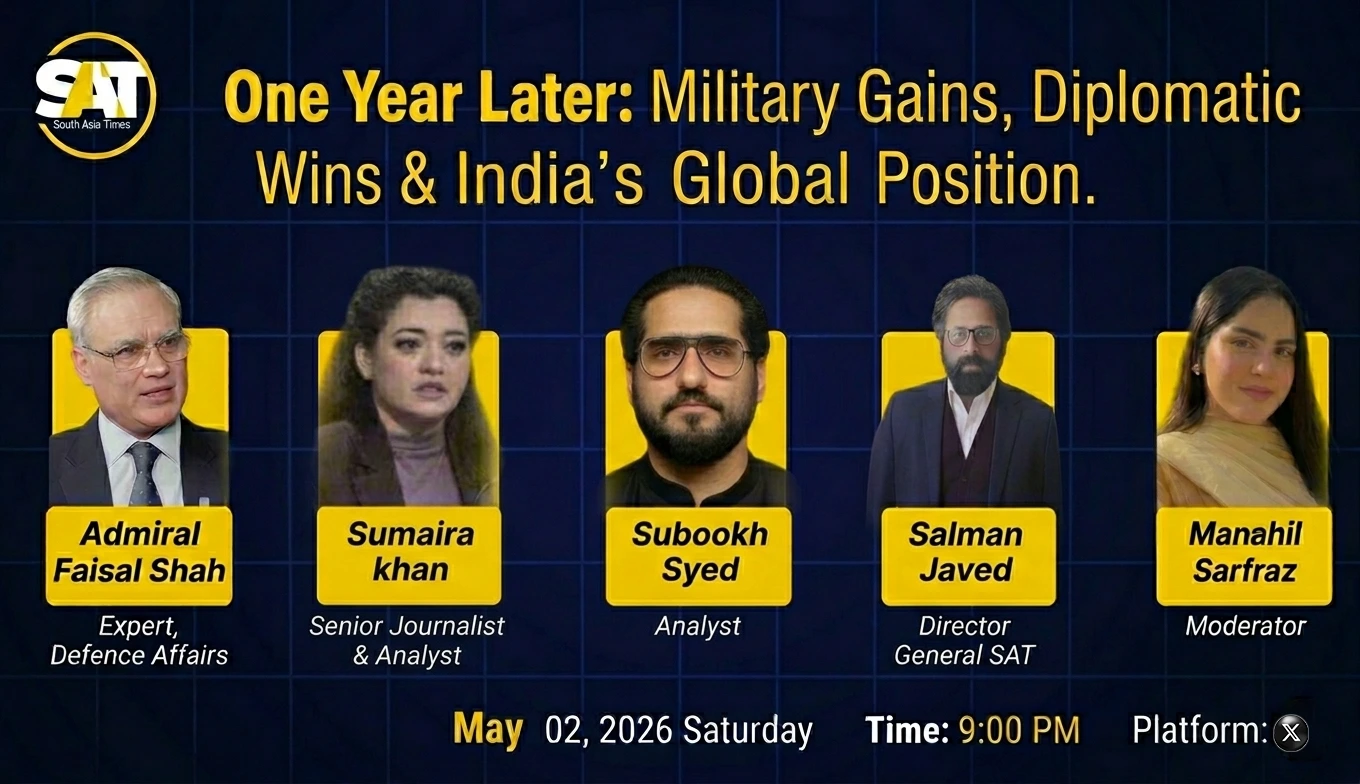
On May 2, 2026, an X Space session was held under the title “One Year Later: Military Gains, Diplomatic Wins and Pakistan’s Position.” The discussion assessed Pakistan’s evolving strategic posture in the aftermath of developments following May 2025, with a focus on shifts in military credibility, diplomatic positioning, and international perception.
The conversation situated Pakistan’s trajectory within broader regional and global power realignments, examining how internal coordination and external geopolitical developments collectively influenced its current standing.
Post–May 2025 Perception Shift
The discussion highlighted that Pakistan’s global image has undergone a noticeable shift since May 2025. While traditional narratives around Afghanistan and Indian-administered Kashmir persist, they no longer singularly define Pakistan’s external perception in the same way as before.
Military Credibility and Strategic Signaling
A central argument was the improvement in Pakistan’s military credibility, particularly the role of air force performance in reshaping external assessments. This was framed not merely as operational strength, but as an enhancement of strategic signaling capacity, influencing how deterrence is perceived internationally.
Emerging Stabilizing Role in Regional Politic
Pakistan was increasingly described as a stabilizing actor within a volatile geopolitical environment, including tensions between the United States and Iran. This reflects a gradual shift in how Pakistan is positioned within regional security calculations.
Multi-Vector Foreign Policy and Diplomatic Balance
A consistent theme was Pakistan’s sustained multi-vector foreign policy, maintaining calibrated relations with China, Russia, Saudi Arabia, and Iran. This balancing strategy was identified as a key factor in strengthening diplomatic relevance and preserving strategic flexibility.
Defence Preparedness and Security Priorities
The discussion emphasized renewed focus on defence preparedness and resource allocation, driven by evolving internal security challenges and external threat perceptions. This was framed as part of a broader adjustment in strategic priorities.
From Constraint to Strategic Autonomy
A major analytical point was Pakistan’s transition from being perceived as diplomatically constrained to demonstrating greater strategic autonomy and global engagement over the past year.
Reassessment of Earlier Narratives (2016–2019)
Earlier external narratives were recalled, where Pakistan was frequently described as diplomatically weak, economically vulnerable, and strategically dependent. These perceptions were also reinforced by assumptions of internal instability under external pressure.
Decline of Isolation Narrative
Pakistan’s earlier image of diplomatic isolation, shaped by propaganda pressures and regional tensions—particularly with India—was noted as significantly weakened in the post-2025 environment.
May 2025 as a Turning Point
The events of May 2025 were identified as a defining inflection point that altered both domestic morale and international perception. However, this shift was attributed not to a single incident, but to a convergence of sustained policy evolution and geopolitical developments.
Multidimensional Nature of Gains
Pakistan’s recent improvements were characterized as multidimensional, involving military effectiveness, diplomatic maturity, narrative management, and coordinated institutional response across state structures.
Civil–Military and Institutional Coordination
The discussion highlighted the importance of synchronized responses across military, diplomatic, and informational domains, reflecting improved institutional coordination during high-pressure periods.
Leadership Response and Strategic Outcomes
The leadership response during critical moments was described as coordinated and strategically aligned, contributing to enhanced international confidence in Pakistan’s stability and decision-making capacity.
The complete Recording of the Session can be accessed here.
