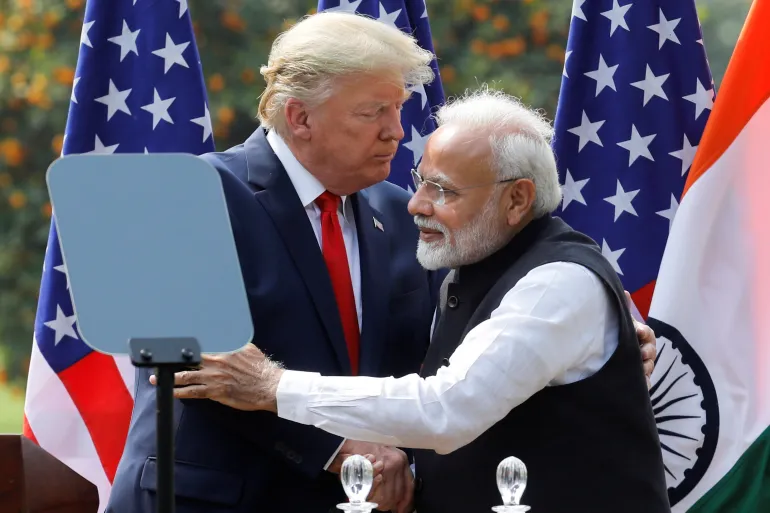
The National Security Strategy released by the United States on Dec 4, 2025 under Trump administration is transactional in nature under the banner of America First. The previous NSS focused on China and Russia as a strategic competitor while the competition repositioned in 2025 where China treated more as an economic competitor, criticizing previous American policies for opening market to China as enabler of China’s strategy. Meanwhile, with Russia US prioritize to re-establish the strategic stability. NSS 2017 prioritized strategic investment on partners and allies, while the recent one redefined the alliance policy, from strategic investment to strategic extraction as the Trump expect from its partners and allies to deliver returns. India is an important case study in this regard; it was seen as a “high potential asset.” The official defence cooperation between the US and India began with the signing of “Ten years of Defence Framework Agreement” in 2005. Washington believed that a powerful India would be a crucial counterweight to Chinese influence in the region. Previous National Security Strategies also defined India as a strategic partner to counter balance China. The US invested in India through variety of agreements across various domains such as defence, trade, economy, space, AI and critical emerging technologies. The National Security Strategy 2025 signals towards an end to the era of strategic altruism and the beginning of return on investment. The US invested in India under its strategic partnership and now it is time for India to deliver strategic returns.
Economic Coercion as a Tool of Strategic Alignment
The Trump’s NSS is interest driven and conditional. The NSS highlights that how Trump aims to discipline its allies and partners. It stated, “We will also work to align the actions of our allies and partners with our joint interest in preventing domination by any single competitor nation.” It shows the abrupt change in nature of alliances and partnerships that would be behavior contingent not trust based. Trump’s coercive economic diplomacy is a test case where India’s purchase of Russian oil halted by imposition of 50 percent tariff on India and levied direct sanctions on Russia’s largest oil companies. Under the guise of strategic autonomy, India previously kept purchasing Russian oil that has spiked from 0.2 percent to 40 percent despite economic sanctions imposed by the US. The US Trade Advisor Peter Navarro gone even so far to refer Russo-Ukrainian conflict as “Modi’s war” and said that the “road to peace runs, in part, through New Delhi.” India’s strategic inflexibility gave a clear message to the US that when it counts most it would be autonomous. NSS implies that India can no longer act autonomously against the US interests. This transition is evident in recent press talk by the Trump where he openly claimed that how to make him happy India cut down the oil purchase from Russia following the imposition of 50% tariff on Indian exports.
The NSS signals the US strategy of constraining states whom it defined as competitor through economic war. The tariffs, market access and supply chain would be a weapons of alignment to limit policies that undermine the US objective. The strategic partners and allies are expected to align with US led economic sanctions otherwise; they will face punitive trade measures including higher tariffs.
Erosion of India’s Strategic Autonomy under Trump 2.O
To reduce tariff imposed by the US Modi agreed to stop purchasing Russian oil, it has lost the strategic room to maneuver. Iran that was defined as an irritant in previous NSS is termed as a “Chief Destabilizing Force” in NSS 2025. Washington recently announced 25 percent tariff on countries trading with Iran. While New Delhi is a top export destination for Tehran, the total value of export in 2024 was 1.05 billion dollar. It was also investing in Chabahar port deal secured in 2024 giving India ten years of access to the port. While, the recent sanctions has left India with no choice but to exit the Chabahar port. India is constraint under Trump 2.O where the US would be defining the trajectory of its multi-alignment policy.
The US still needs India in Indo-Pacific region to secure sea-lanes, logistics, and QUAD. The US has invested in India’s role as a key Indo-Pacific logistic hub through Master Ship Repair Agreement, concluded in 2023. The NSS requires from India and other allies to not only expand its naval capabilities but also contribute to regional security through QUAD. The US expects from its partners and allies to address the security challenges and share burden. The strategic partners are subjected to compliance enforcement. The US is investing on India since last two decades; it has now reclassified its partnership from long-term investment to transactional asset as the era of strategic altruism is over and the transactional alignment has commenced.

Syeda Tahreem Bukhari is an Associate Director at the Center for International Strategic Studies-AJK, where she works on strategic stability, South Asian security and emerging regional security dynamics. She has also served as a lecturer at the University of Azad Jammu & Kashmir and is an alumna of the Near East South Asia Center for Strategic Studies (NESA), National Defense University, Washington, DC.