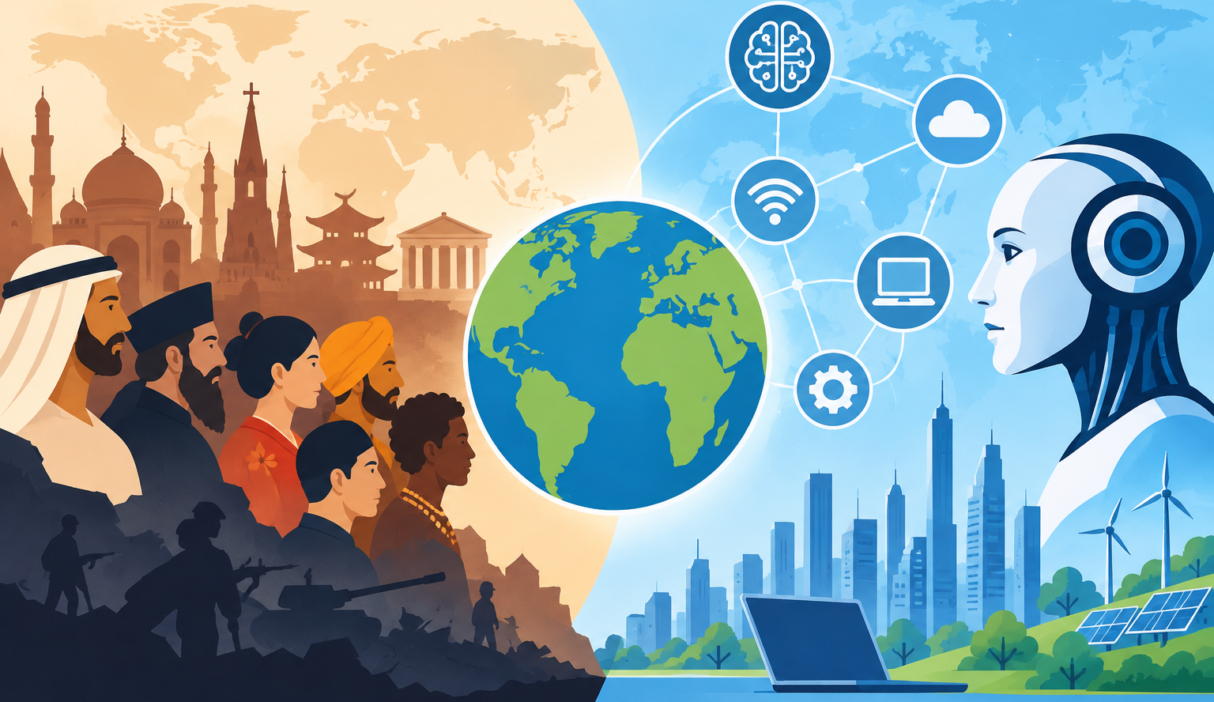
We are repeatedly told that the future is digital, efficient, inclusive, and safe. Digital IDs, cashless economies, smart governance, and global development plans are marketed as progress. But history teaches us a painful lesson: every system of control is first introduced as convenience.
Digital ID is not merely a technological upgrade. It is a shift in power. It is the transformation of human beings into data points profiles that can be tracked, evaluated, approved, or restricted. When your identity, finances, health, travel, education, and online presence are merged into one centralized digital system, freedom no longer belongs to the individual. It belongs to whoever controls the system.
Agenda 2030, promoted through the United Nations’ Sustainable Development Goals, appears compassionate on the surface: climate action, equality, health monitoring, digital governance, and economic restructuring. Yet many of these goals require centralized data control, mass surveillance, and behavioral monitoring. Digital identity systems are not optional add-ons; they are the infrastructure.
Surveillance does not only observe behavior, it reshapes it. When people know they are being watched, they self-censor. They comply more, question less, and eventually normalize control. Freedom does not disappear overnight; it erodes quietly.
Now imagine this system fully integrated: your money is digital, your speech is digital, your health records are digital and access to all of it is conditional. Compliance means continuity. Resistance means restriction. No prisons are required. No violence is necessary. Access itself becomes the weapon.
Economic Control: Interest, IMF, and a System We Accepted
This is not new. Economic control has always been the backbone of domination. Islam clearly warns us about riba (interest). Allah SWT says in Surah Al-Baqarah:
“Those who consume riba cannot stand except as one whom Shaytan has driven to madness”…(2:275)
“ And if you do not desist, then be informed of a war from Allah and His Messenger.” (2:279)
This is not symbolic language. It is a declaration of severity.
Yet today, Muslim states are deeply embedded in interest-based systems. The global banking structure, reinforced by institutions like the IMF, operates entirely on riba. Sovereign loans, bailouts, and “financial assistance” come with interest, conditions, and political leverage. Our state behavior has normalized dependence.
Historically, this system was institutionalized through modern banking models attributed to figures like Mayer Amschel Rothschild, who shifted lending from individuals to monarchs, embedding nations into cycles of debt. Branch banking expanded, power centralized, and economies became dependent. Whether people like this history or not, the result is undeniable: financial systems today control states, not the other way around.
Notice how countries that resist such as Iran, remain outside or restricted within IMF and Western banking frameworks. Economic independence is punished; compliance is rewarded.
From Digital Control to Dajjalic Fitnah
Many people connect these developments to the Christian concept of the “Mark of the Beast.” Islam does not use this framework. Instead, our deen warns us about Dajjal, the greatest deception humanity will ever face.
Dajjal is not just an individual; he represents a system of deception, false authority, and economic coercion. A system where truth is blurred, survival is conditional, and obedience is enforced not by chains but by dependence.
The Prophet SAW warned us that Dajjal will control resources, food, and provision. Today, we are voluntarily building systems where access to sustenance, movement, and speech can be digitally controlled. This is not paranoia; this is pattern recognition.
Compulsion will not come through prisons, but through passwords. Not through armies, but through algorithms.
Khilafah: Our Forgotten Responsibility
Allah SWT says in Surah Al-Baqarah:
“Indeed, I will place upon the earth a Khalifah.” (2:30)
Human beings were not created to be passive consumers or obedient data subjects. We were created as vicegerents, morally responsible, accountable, and free.
Islam is not limited to prayer, fasting, zakat, and hajj alone. The mission of the Prophet Muhammad SAW included establishing a complete system political, economic, judicial, and moral. The State of Madinah was not only a spiritual community; it was a fully functioning political order based on divine guidance.
The Khilafah is not nostalgia. It is a comprehensive alternative to systems built on exploitation, surveillance, and interest. Only a Shariah-based system can remove riba, protect dignity, decentralize power, and restore moral accountability.
Yet as an Ummah, we are sleeping. We separated Islam from politics, surrendered economics to global institutions, and reduced deen to private rituals. Meanwhile, others design systems that rule us indirectly.
The Power of “We” and the Responsibility of This Generation
A believer is farsighted. A mu’min does not only see the wall; he sees what lies behind it. The Qur’an repeatedly asks:
“Do you not use reason?”
“Do you not reflect?”
Silence in the face of injustice is not neutrality; it is participation.
We are the future of the Ummah. The generations we raise will either inherit chains or break them. We must cultivate awareness, courage, and commitment. Speaking against oppression is not extremism; remaining silent is complicity.
Yes, ‘Isa عليه السلام will return and establish justice. But the ground must be prepared.
Response: What Must Be Done
This is not a call to reject technology. It is a call to reject surrender.
Question policies before accepting them.
Read what is being signed in the name of “inclusion.”
Protect data as you protect dignity.
Challenge interest-based systems intellectually and practically.
Reconnect Islam with governance, economics, and justice.
Raise generations that understand power, not just survival.
Digital control, economic enslavement, and moral erosion are not separate issues. They are parts of one system. A system that thrives when the Ummah sleeps.
The real question is not whether these systems are coming.
The question is: will we wake up before it is too late?,
Seemab Ishtiaq is a student of International Relations and Politics, a student of the Qur’an, and an independent researcher. Her work focuses on the intersection of global political systems, economic power structures, and Islamic ethical thought.