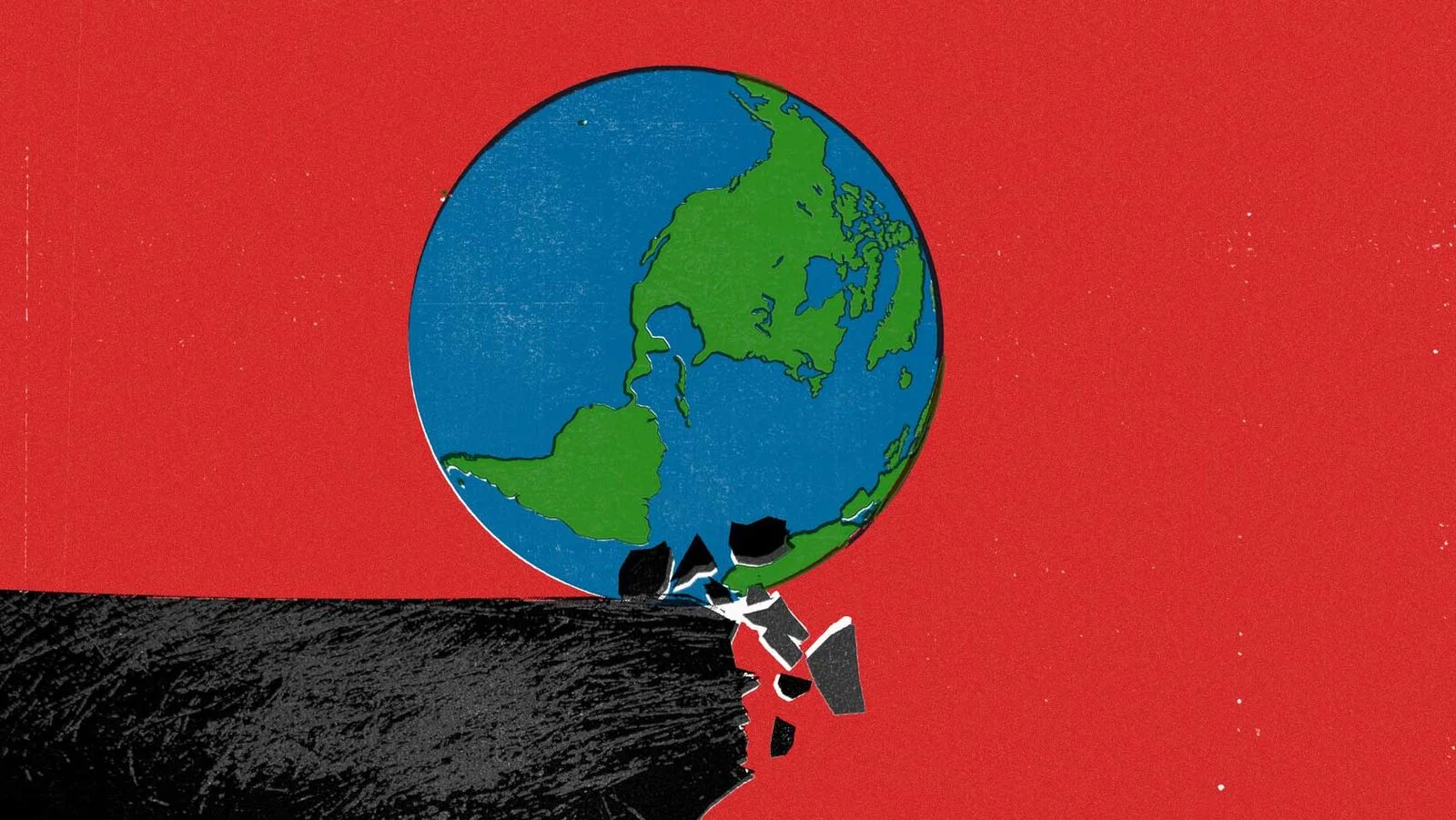
For more than three decades, global politics operated under a shared assumption that economic interdependence, institutional density, and normative restraint had fundamentally altered the behavior of states. Power, it was believed, had been tamed by law, markets, and multilateral governance. That assumption has now collapsed. What is unfolding is not a temporary disruption or cyclical crisis, but a structural break, a recognition that the post-1945 order no longer corresponds to the material and political realities of the international system.
The present moment marks the end of what might be called the era of managed illusion, the belief that globalization could substitute for balance-of-power politics. The shift is visible not only in great-power rivalry, but in the language and strategic posture of Western elites themselves. Institutions once designed to discipline power now struggle to survive it. Economic divergence, technological concentration, and the weaponization of interdependence have hollowed out the foundations of the rules-based order, leaving behind a vacuum where law no longer constrains agency.
The central issue is no longer how to restore the old system, but how states will adapt to a post-legal environment where security, not legitimacy, is the primary currency of survival.
The Diagnosis
The consensus emerging from Western policymakers, the main backers and beneficiaries of the liberal order is no longer about managing strain but acknowledging a fundamental rupture in the operating logic of international relations. The divergence between American realism and European institutionalism, a gap that defined transatlantic relations for two decades, has closed, replaced by a unified, albeit grim, assessment of the new reality.
The theoretical underpinning of this new era was most sharply articulated by Mark Carney, who declared that the rules-based order is broken, not in crisis. This distinction is critical: a crisis implies a temporary deviation from a functioning norm, while a broken system requires replacement. Carney’s analysis frames the last decade not as a series of unfortunate events but as a collective illusion, where the West mistakenly believed that economic integration would enforce political compliance. This sentiment has been reinforced by German Chancellor Friedrich Merz, who stated that the old order is unraveling and the world has entered an era of great power politics.
French President Emmanuel Macron has amplified this warning, describing a world without rules not as a future risk but as a present condition. In his assessment, conflict and coercion have been normalized, and the international arena is now defined by the bigger stick rather than the better argument. Perhaps most alarmingly, Spanish Prime Minister Pedro Sánchez has linked this disregard for sovereignty of Greenland to the death knell of alliance structures like NATO. When mid-tier powers begin to question whether economic coercion and territorial disputes in the Arctic signal the end of collective security, the rot is systemic.
The collapse of the political order is downstream of economic and material divergence. The rules-based order required a rough equilibrium of power that no longer exists.Europe’s pivot toward strategic autonomy is motivated by both political concerns and existential economic anxieties. The US’s increasingly transactional and unpredictable diplomatic approach was already apparent, but its recent focus on Greenland has amplified existing worries in many European capitals.
In addition to this, economic numbers also paint a grim picture. The data paints a stark picture of relative decline. Between 2015 and 2025, US stock market capitalization more than doubled, driven by the AI and tech companies. In contrast, European productivity has stagnated. The Eurozone-US GDP gap, while projected to narrow slightly by late 2026, remains structurally vast in per capita terms. The US economy has effectively decoupled from the stagnation of the Atlantic, leaving Europe vulnerable to external shocks without the cushion of robust growth.
Additionally, The global economy has shifted from efficiency to security. The 1930s saw the Smoot-Hawley tariffs trigger a 60% collapse in global trade, the 2020s are seeing a more targeted, but equally destructive, fragmentation. The protectionist spiral, from EV tariffs to semiconductor bans, has dismantled the World Trade Organization in all but name.
Five Possible Scenarios
With the autopsy complete, the strategic debate must turn to the structure of the successor system. We are not moving toward a single new order, but rather a hybrid ecosystem where different regions operate under different physical and political laws.
The most consequential proposal to emerge is the US-led board of peace. While ostensibly a stabilization mechanism for the Levant, its structure betrays a broader ambition: the privatization of global security. This mechanism operates as a pay-to-play executive directorate, requiring a substantial participation fee and kinetic military capacity from its members. Historically, this represents the Concert of Europe reimagined for the corporate age. Just as the Concert empowered Great Powers to manage the peace over the heads of smaller states, the Board of Peace replaces the UN’s sovereign equality with a shareholder model. Influence is strictly proportional to capital and firepower, effectively institutionalizing transactional multilateralism where security is a commodity rather than a right.
Europe’s response to this transactional world is the rapid construction of geopolitical Europe. The shift is already visible in the ledger, with European military expenditure surging by 17% in 2024 alone, the fastest rise since the Cold War. Germany, long the pacifist giant, has pushed defense spending to unprecedented levels relative to its modern history. Strategically, the EU is repurposing its single market as a weapon.
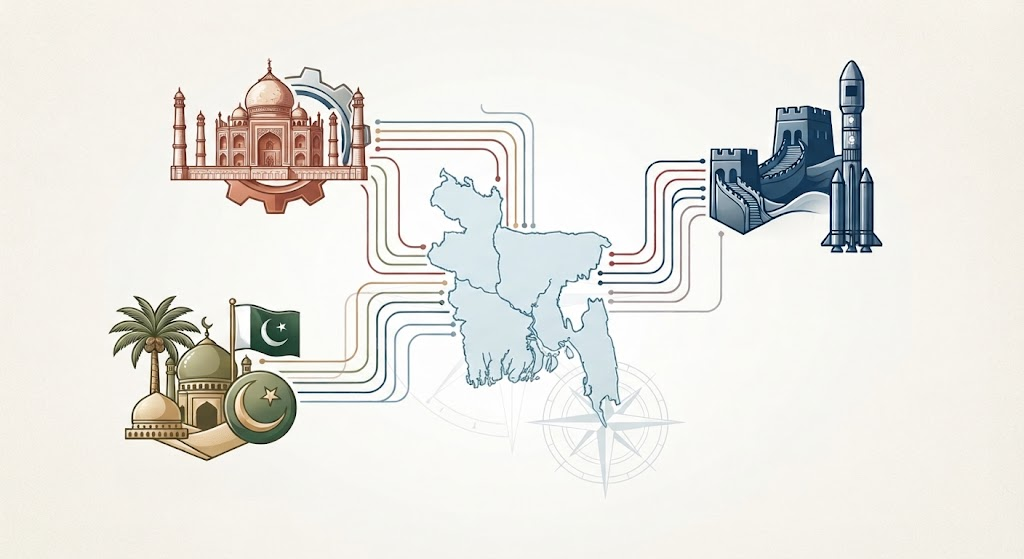
With the G2 (US-China) paralyzed and the UN moribund, the most dynamic action is found in the middle. We are seeing a pick-your-partner geopolitics where alliances are fluid and issue-specific. One recent example is the emergence of a nascent Axis (Pakistan-Saudi Arabia-Turkey) that is coalescing around defense cooperation and nuclear ambiguity. This reflects 19th-century diplomacy at warp speed, where countries are multi-aligned, partnering with Russia on energy, the US on tech, and each other on security, ignoring the binary bloc logic of the Cold War.
Another scenario, favored by realists, envisions the formal fragmentation of the globe into exclusionary zones. In this dynamic, international law retreats, applying only within blocs (an American sphere, a Sinosphere), while relations between blocs are governed by raw balance-of-power mechanics. The goal shifts from conflict prevention to conflict management. The inherent risk is peripheral instability, where borderlands, Taiwan, Ukraine, the Caucasus, become permanent friction points where the tectonic plates of these spheres grind against each other.
The darkest scenario is that no order forms at all. This managed disorder” mirrors the 1930s following the collapse of the League of Nations. Just as the League failed to check Japanese aggression in Manchuria or Italian ambition in Abyssinia, today’s institutions are failing to check revisionist powers in the Arctic and South China Sea.
The acceptance of this new reality comes with a price tag that Western electorates have yet to fully comprehend. The post-Illusion age implies the permanent end of the peace dividend. For thirty years, the global economy was subsidized by the assumption of peace, defense spending could be cut, supply chains could be stretched for efficiency, and energy could be bought from rivals. That discount window is now closing.
The rearmament of Germany, the walling off of the European market, and the transactional nature of new institutions signal an inflationary future. Security is expensive. Resilience is inefficient. In this new era, the metric of statecraft is no longer GDP growth but survival capacity.

Your go-to editorial hub for policy perspectives and informed analysis on pressing regional and global issues.