The death of Sharif Osman Hadi in a Singapore hospital on December 18, 2025, marks more than the passing of a youth leader, it signals the formal internment of the 1971 Consensus. For over fifty years, the geopolitical relations of India and Bangladesh rested on a shared, if often contested, understanding of the 1971 Liberation War as the foundational event of the Bangladeshi state and its special relationship with India.
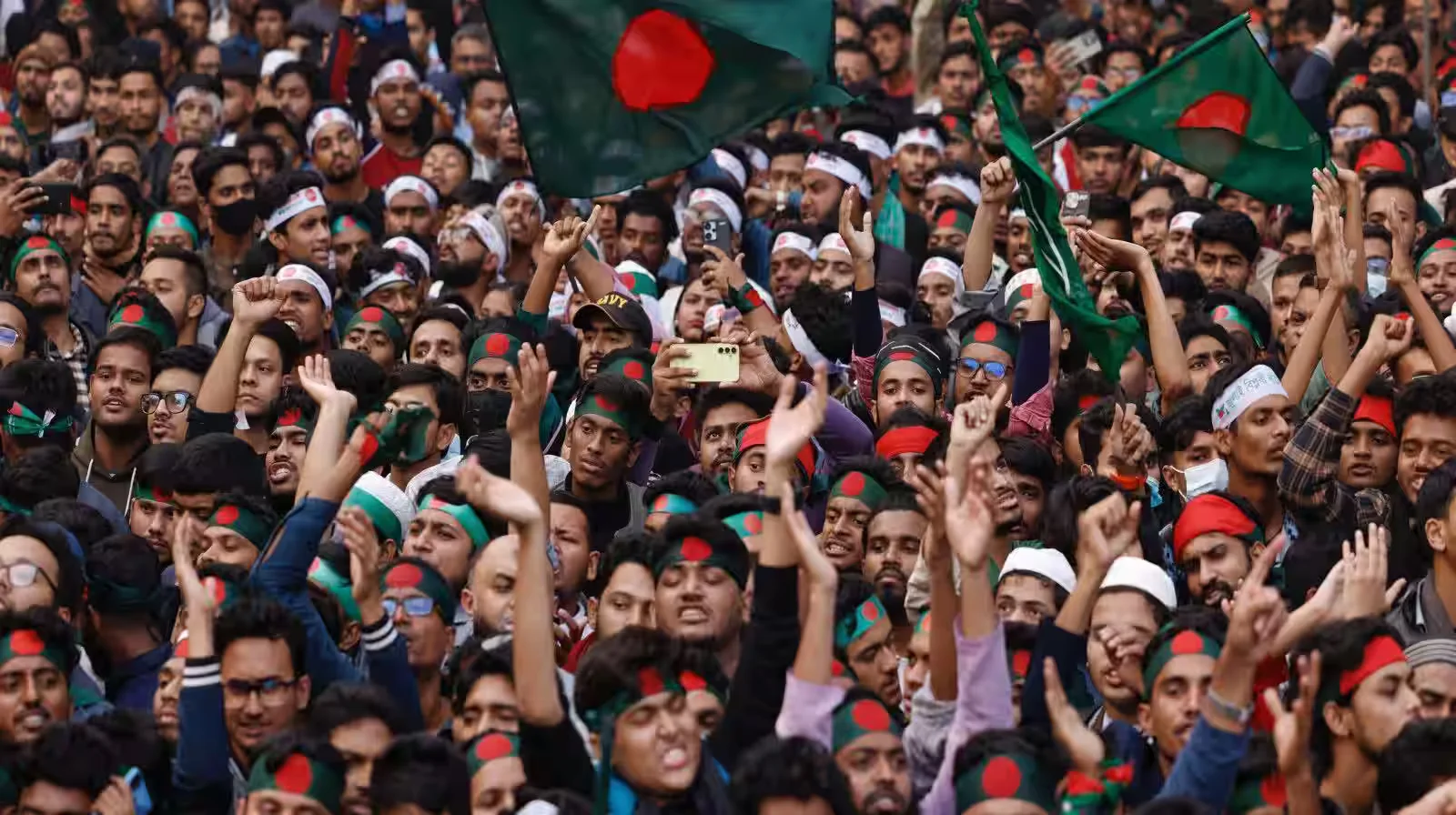
Today, that foundation has turned to ash. The murder of Hadi, a central figure of the July Uprising who had been airlifted to Singapore following a targeted assassination attempt in Dhaka on December 12, has acted as a kinetic trigger. The resulting organic eruptions of violence across Bangladesh are not mere riots; they are the architectural demolition of an old order.
To understand the current volatility, one must understand Sharif Osman Hadi. In the eyes of his supporters, particularly the youth who orchestrated the 2024 ouster of Sheikh Hasina, Hadi was the personification of a Second Independence. This ideology posits that while 1971 was a liberation from Pakistan, it simultaneously inaugurated a period of Indian hegemony. Under this new framework, true sovereignty is defined as beginning only after Hasina’s flight in August 2024. This ideological shift has led to targeted resentment, where the violence following Hadi’s death has specifically focused on media houses and secular-liberal institutions. These are viewed by the street not as pillars of democracy, but as gatekeepers of an intellectual dependency on New Delhi.
This momentous shift is being carried out by a generation with no lived memory of 1971. By naming India as the primary antagonist responsible for Hadi’s assassination, the younger generation has provided itself with a clear, external enemy. The banning of the Awami League in May 2025 and the death sentence handed to Sheikh Hasina in absentia by the International Crimes Tribunal on November 17, 2025, removed the final political buffers.
The new generation now possess both a martyr and a mandate to rewrite the state narrative from scratch.
While Dhaka burns with anti-India hatred, New Delhi’s response has been dictated more by electoral cycles than by strategic foresight. Relations are at a historic nadir, complicated further by India’s continued protection of Sheikh Hasina. Anti-Bangladesh rhetoric has migrated from the fringes of Indian politics to its institutional core, becoming a staple of domestic wedge politics rather than a matter of foreign policy. Home Minister Amit Shah’s rhetoric during the Jharkhand campaign, where he vowed to identify and throw out every single infiltrator, has framed the neighbor as an existential demographic threat rather than a sovereign partner.
This normalization of hostility is further exacerbated by military brinkmanship. Assam CM Himanta Biswa Sarma’s recent reminder to Dhaka that India is a nuclear nation and the fourth-largest economy marks a dangerous shift. Using military intimidation for domestic political consumption in the Northeast risks a Reciprocal Radicalization, where Indian bellicosity validates the most extreme anti-India stance in Dhaka.
The digital landscape has amplified this friction significantly. Posts from prominent influencers and political figures have used the chaos in Dhaka to attack domestic Indian rivals, arguing that secular politics invites such violence. For instance, recent commentary from Amit Malviya and further strategic messaging have framed the burning of Dhaka as a cautionary tale for Indian voters. This contagion narrative, painting the entire Bangladeshi population as a monolithic, violent force, as seen in viral social media posts, travels back to Dhaka, providing the street with proof of Indian hostility and fueling further unrest.
The power vacuum left by the Awami League’s collapse and the BNP’s inability to control the street has been filled by more disciplined, ideological forces. The Islami Chhatra Shibir, the student wing of Jamaat-e-Islami, has executed a clean sweep of university union elections throughout late 2025. This generational shift suggests that the next decade of Bangladeshi leadership will be staunchly anti-India and pro-sovereignty.
In a stunning reversal of 1971, Dhaka is rapidly warming to Islamabad. A restored Dhaka-Islamabad axis provides Pakistan with a friendly footprint on India’s eastern flank for the first time in over half a century. This realignment effectively signals the death of BIMSTEC. With the region’s two largest economies in open hostility, multilateral progress is frozen, and South Asia has returned to a fragmented state of bilateral cold wars.
For India, the strategic fallout of this realignment is catastrophic, centering primarily on the extreme vulnerability of the Siliguri Corridor, colloquially known as the Chicken’s Neck. New Delhi now faces a classic two-front pressure point where the presence of a hostile Pakistan to the West is mirrored by a radicalized, uncooperative Bangladesh to the East. This pincer effect forces a massive redistribution of military assets, stretching the Indian Army’s Eastern Command to its breaking point. The strategic depth once provided by a friendly government in Dhaka has vanished, leaving the narrow 22-kilometer-wide corridor exposed to potential interdiction by state and non-state actors alike.
The internal security of the Northeast is equally imperiled by the resurgence of cross-border insurgencies. Historically, a cooperative Dhaka was the linchpin of India’s counter-insurgency successes, as the Awami League government actively dismantled camps belonging to the ULFA and various Naga factions. Today, that cooperation has vanished. This threatens to undo decades of stability gains, forcing India back into a high-intensity internal security posture in its border states.
Beyond the kinetic military threat, the collapse of the 1971 Consensus signals the economic strangulation of the Northeast. The hard-won transit and transshipment agreements that allowed Indian goods to move through Chittagong and Mongla ports have been summarily suspended. This reversal effectively isolates the Seven Sister states, turning them back into a landlocked archipelago dependent entirely on the congested Siliguri bottleneck. As borders harden and trade ties are severed, the cost of living in the Northeast is expected to skyrocket, fueling domestic resentment and providing further fertile ground for radicalization. The 1971 Consensus was the anchor of Indian regional strategy, its destruction has transformed a manageable neighbor into a permanent strategic disaster.

Your go-to editorial hub for policy perspectives and informed analysis on pressing regional and global issues.