
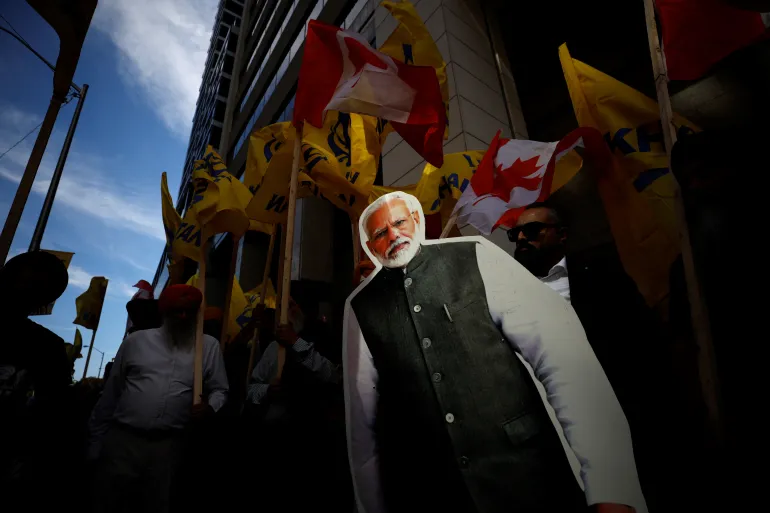
Trudeau Accuses India of Targeting Sikh Separatist Leaders

Trudeau alleges India's government targeted Sikh separatist leaders in Canada, escalating diplomatic tensions between the nations.

Canada’s Prime Minister Justin Trudeau has accused India’s government of orchestrating violence in the country, the latest chapter in a growing rift over New Delhi’s alleged targeting of Canada-based Sikh separatist groups.

Trudeau levelled the charges during an inquiry on foreign interference Wednesday, saying there are “ever clearer indications” that India violated Canada’s sovereignty by targeting Sikh dissidents in its territory.

India’s actions, Trudeau said, are a “horrific mistake”.

The statement comes two days after India and Canada kicked out each other’s top envoys over the rift, which started with the assassination of Sikh separatist leader Hardeep Singh Nijjar in Vancouver in June 2023.

Later that year, Trudeau stated that Canada obtained credible evidence. This evidence linked Indian agents to the assassination of Nijjar. Nijjar was a Canadian citizen who advocated for a Sikh homeland in the form of an independent Khalistani state.

Canadian authorities have since arrested four Indian nationals in connection with the murder, which New Delhi has repeatedly denied involvement in.

On Monday, India again rejected claims linking it to Nijjar’s killing, labeling him a “terrorist.” It called the allegations “preposterous” and a “strategy of smearing India for political gains”.

However, Trudeau spoke at Wednesday’s inquiry. He stated that Nijjar’s murder was part of a more extensive Indian operation. Indian government representatives systematically targeted dissidents inside Canada.

“Violence towards Canadians … has been enabled by and in many cases directed by the Indian government,” said the Canadian premier, citing a national police investigation. He added that New Delhi, when presented with the allegations, had simply doubled down “on attacks against this government”.

While Canada’s government does not want to pick “a fight with a significant trading partner”, Trudeau said he would not waver when “standing up for Canadian sovereignty”.

Also See: Canada-India Tensions Rise Over Expelled Diplomats

US accusations

India’s government has also faced accusations from the United States of attempting to assassinate a Sikh separatist on its soil. In November 2023, the US Department of Justice announced charges against Indian national Nikhil Gupta. He allegedly plotted to target Sikh American activist Gurpatwant Singh Pannun. The Department claimed that an Indian government employee and others coordinated the effort.

On Wednesday, a US State Department spokesperson said a meeting between the US and India regarding a probe into the foiled plot was productive

This news is sourced from Aljazeera and is intended for informational purposes only.

News Desk

Your trusted source for insightful journalism. Stay informed with our compelling coverage of global affairs, business, technology, and more.
Recent

An analysis of Qatar’s neutrality, Al Jazeera’s framing of Pakistan, and how narrative diplomacy shapes mediation and regional security in South Asia.

Qatar’s Dubious Neutrality and the Narrative Campaign Against Pakistan

Qatar’s role in South Asia illustrates how mediation and media narratives can quietly converge into instruments of influence. Through Al Jazeera’s selective framing of Pakistan’s security challenges and Doha’s unbalanced facilitation with the Taliban, neutrality risks becoming a performative posture rather than a principled practice. Mediation that avoids accountability does not resolve conflict, it entrenches it.

Read More »
An analysis of how Qatar’s mediation shifted from dialogue to patronage, legitimizing the Taliban and Hamas while eroding global counterterrorism norms.

From Dialogue to Patronage: How Qatar Mainstreamed Radical Movements Under the Banner of Mediation

Qatar’s diplomacy has long been framed as pragmatic engagement, but its mediation model has increasingly blurred into political patronage. By hosting and legitimizing groups such as the Taliban and Hamas without enforceable conditions, Doha has helped normalize armed movements in international politics, weakening counterterrorism norms and reshaping regional stability.

Read More »
AI, Extremism, and the Weaponization of Hate: Islamophobia in India

AI, Extremism, and the Weaponization of Hate: Islamophobia in India

AI is no longer a neutral tool in India’s digital space. A growing body of research shows how artificial intelligence is being deliberately weaponized to mass-produce Islamophobic narratives, normalize harassment, and amplify Hindutva extremism. As online hate increasingly spills into real-world violence, India’s AI-driven propaganda ecosystem raises urgent questions about accountability, democracy, and the future of pluralism.

Read More »
AQAP’s Threat to China: Pathways Through Al-Qaeda’s Global Network

AQAP’s Threat to China: Pathways Through Al-Qaeda’s Global Network

AQAP’s threat against China marks a shift from rhetoric to execution, rooted in Al-Qaeda’s decentralized global architecture. By using Afghanistan as a coordination hub and relying on AQIS, TTP, and Uyghur militants of the Turkistan Islamic Party as local enablers, the threat is designed to be carried out far beyond Yemen. From CPEC projects in Pakistan to Chinese interests in Central Asia and Africa, the networked nature of Al-Qaeda allows a geographically dispersed yet strategically aligned campaign against Beijing.

Read More »
The Enduring Consequences of America’s Exit from Afghanistan

The Enduring Consequences of America’s Exit from Afghanistan

The 2021 US withdrawal from Afghanistan was more than the end of a long war, it was a poorly executed exit that triggered the rapid collapse of the Afghan state. The fall of Kabul, the Abbey Gate attack, and the return of militant groups exposed serious gaps in planning and coordination.

Read More »