
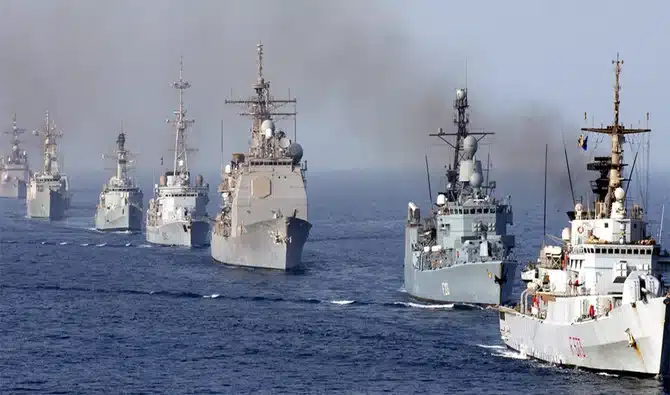
Pakistan Navy Strengthens Regional Maritime Security in Bahrain

PNS Yarmook Strengthens Regional Maritime Security in Bahrain

KARACHI: Pakistan Navy warship PNS Yarmook has conducted bilateral exercises with allied navies. This was part of a Regional Maritime Security Patrol (RMSP) deployment in Bahrain. The exercises aimed to enhance naval coordination and improve joint operation capabilities in the region. The military’s media wing reported this on Thursday.

Last month, the Pakistan Navy commissioned an offshore patrol vessel, PNS Hunain, during a ceremony in Romania. This move aims to strengthen regional maritime security in the Indian Ocean. In July, the Pakistan Navy also assumed command of a multinational task force. This task force is responsible for ensuring maritime security in the southeastern waters of the Middle East. It covers the Arabian Sea, Gulf of Oman, and Gulf of Aden.

Regional Maritime Security

“Pakistan Navy warship Yarmook visited Bahrain during a regional maritime security patrol,” the military’s media wing said in a statement. The warship participated in bilateral exercises alongside ships from Bahrain, the US, and Japan.

“The exercises were aimed to develop synergy and mutual understanding among partner navies while rehearsing interoperability to undertake joint operations in the region,” the Navy said in a separate statement. 

“Pakistan Navy is maintaining permanent presence in the Indian Ocean to keep the national and international Sea Lines Of Communications (SLOC) under surveillance,” the statement added. 

“Pakistan Navy (PN) believes in collaborative efforts for maintenance of rule-based order at sea. PN actively collaborates with regional and international partners deployed in Indian Ocean to counter piracy and to undertake anti-narcotics operations for protecting global common interests.”

During the visit to Bahrain, the commanding officer of the Pakistani ship met with Commander Royal Bahrain Naval Force, Rear Admiral Ahmed Mohammad Ibrahim Al Bin Ali. He also met with Commander Royal Bahrain Coast Guards, Brig Saqib Qamar, and other senior officials of the Bahrain Navy. He also visited the HQ Combined Maritime Forces (CMF) and called on Dy Commander CMF, Commodore Mark Anderson. 

“During the interactions, professional matters of mutual interests were discussed and enhancement of bilateral ties in all spheres was reaffirmed,” the navy said. 

During the stay at port Mina Salman, the ambassador of Pakistan to Bahrain visited PNS Yarmook. Commander Maritime Coalition Forces and officials of the Bahrain Navy also visited the ship. Prominent businessmen, notables from the Pakistani community, and many diplomats and defense attachés from friendly countries were among the visitors as well.

This news is sourced from Arab News and is intended for informational purposes only.

News Desk

Your trusted source for insightful journalism. Stay informed with our compelling coverage of global affairs, business, technology, and more.
Recent

A critical analysis of Drop Site News’ report alleging a UK–Pakistan “swap deal,” exposing its reliance on anonymous sources, partisan framing, and legally impossible claims.

Anonymous Sources, Big Claims, Thin Ground

A recent Drop Site News report claims a covert UK–Pakistan exchange of convicted sex offenders for political dissidents. But a closer look shows the story rests on hearsay, anonymous insiders, and a narrative shaped more by partisan loyalties than evidence. From misrepresenting legally declared propagandists as persecuted critics to ignoring the legal impossibility of such a swap, this report illustrates how modern journalism can slip into activism. When sensational claims outrun facts and legality, credibility collapses, and so does the line between holding power accountable and manufacturing a story.

Read More »
A sharp critique of Zabihullah Mujahid’s recent evasive remarks on the TTP, exposing Taliban hypocrisy and Afghan complicity in cross-border militancy.

Zabihullah Mujahid’s Bizarre Statement on TTP: A Lesson in Hypocrisy and Evasion

Zabihullah Mujahid’s recent statement dismissing the TTP as Pakistan’s “internal issue” and claiming Pashto lacks the word “terrorist” is a glaring act of evasion. By downplaying a UN-listed militant group hosted on Afghan soil, the Taliban spokesperson attempts to deflect responsibility, despite overwhelming evidence of TTP sanctuaries, leadership, and operations in Afghanistan. His remarks reveal not linguistic nuance, but calculated hypocrisy and political convenience.

Read More »
Beyond the Rhetoric: What Muttaqi’s Address Reveals About Afghan Policy

Beyond the Rhetoric: What Muttaqi’s Address Reveals About Afghan Policy

Interim Foreign Minister Amir Khan Muttaqi’s recent address sought to reframe Afghanistan’s strained ties with Pakistan through a narrative of victimhood and denial. From dismissing cross-border militancy to overstating economic resilience, his claims contradict on-ground realities and historical patterns. A closer examination reveals strategic deflection rather than accountability, with serious implications for regional peace and security.

Read More »
We Want Deliverance

We Want Deliverance

Political mobilization in South Asia is not rooted in policy or institutions but in a profound yearning for deliverance. From Modi’s civilizational aura in India to Imran Khan’s revolutionary moral narrative in Pakistan, voters seek not managers of the state but messianic figures who promise total transformation. This “Messiah Complex” fuels a cycle of charismatic rise, institutional erosion, and eventual democratic breakdown, a pattern embedded in the region’s political psychology and historical imagination.

Read More »