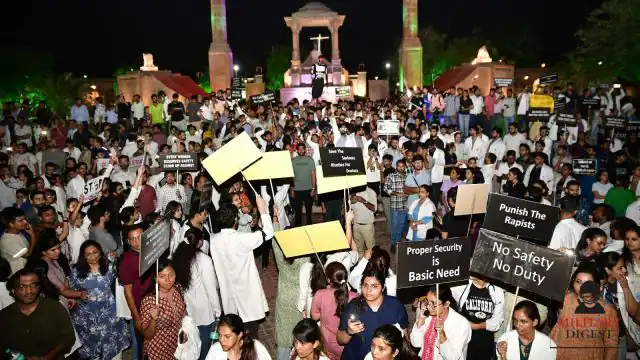
Supreme Court Acts on Kolkata Doctor Rape Case

Kolkata Doctor Rape Case, IMA Nationwide Strike Live, August 18: The Supreme Court on Sunday took suo motu cognisance of the rape and murder of a woman junior doctor at R G Kar Medical College in Kolkata, West Bengal. A bench led by Chief Justice of India D Y Chadrachud will hear the case on Tuesday (August 20). This comes a day after the Indian Medical Association held a 24-hour nationwide strike in protest against the incident. The medical body wrote to Prime Minister Narendra Modi. It listed five “solutions and demands.” These demands include issues related to hospital security, shift timings, the ongoing probe of the Kolkata case, and compensation to the family. The medical body expects the government to address these concerns.

Meanwhile, the Central Bureau of Investigation (CBI) interrogated Dr. Sandip Ghosh, the former principal of RG Kar Medical College and Hospital, for the third consecutive day. The central agency also requested details of the calls he made before and after the incident. This information was reported by news agency PTI. The report further said that the CBI was mulling contacting the mobile service provider to access Ghosh’s call records. The CBI grilled Ghosh for nearly 13 hours on Saturday, from 10 am until past midnight.

Status of the Probe


A CBI team is probing the case after the Calcutta High Court transferred it from the Kolkata Police on August 13. Investigators have discovered that Sanjay Roy’s wife, the man accused of raping and killing the doctor, lodged a complaint at Khalighat police station.

In connection with the August 14 vandalism case, authorities have identified and arrested two TMC workers, several men in their teens or 20s, and a couple of women. Additionally, authorities have summoned several Left leaders for questioning. This includes DYFI’s West Bengal secretary Minakshi Mukherjee and six other state-level youth and student leaders of the CPIM.

This news is sourced from Indian Express and is intended for informational purposes only.

News Desk

Your trusted source for insightful journalism. Stay informed with our compelling coverage of global affairs, business, technology, and more.

Recent

Herat tragedy claims 30 lives, exposing Afghanistan’s governance failures, unsafe migration, and escalating humanitarian crisis.

Herat Border Tragedy: The Deadly Consequences of Afghanistan’s Governance Failures

The Herat border tragedy, is a stark illustration of the human cost of Afghanistan’s governance failures. With limited economic opportunities, widespread poverty, and insufficient social support, families are forced to undertake life-threatening journeys across freezing mountains. The incident underscores the urgent need for the Afghan government to provide stable livelihoods, establish safe migration routes, and strengthen healthcare and social services, as humanitarian risks continue to escalate across the country.

Read More »
A fact-based rebuttal of claims about Pakistani troop deployment in Gaza, exposing disinformation and reaffirming Pakistan’s UN-mandated peacekeeping doctrine.

Debunking the Gaza Deployment Narrative

False claims of a Pakistani troop deployment to Gaza, amplified by disinformation networks, were firmly rejected by the Foreign Office, reaffirming that Pakistan’s military operates only under UN mandates and constitutional limits.

Read More »
The death of Sharif Osman Hadi marks the collapse of the 1971 Consensus, reshaping Bangladesh’s identity and triggering a strategic crisis for India.

The End of the 1971 Consensus

Sharif Osman Hadi’s death has become the symbolic burial of the 1971 Consensus that long structured India–Bangladesh relations. For a generation with no lived memory of the Liberation War, Hadi embodies a Second Independence, reframing 1971 as the start of Indian dominance rather than true sovereignty. His killing has accelerated Bangladesh’s rupture with India and exposed a deep strategic crisis across South Asia.

Read More »
Afghanistan’s Taliban uses pharmaceutical policy to assert autonomy, decouple from Pakistan, and expand strategic ties with India.

Afghan Taliban’s Biopolitics

The Taliban’s health diplomacy is reshaping Afghanistan’s geopolitical landscape. By phasing out Pakistani pharmaceuticals and inviting Indian partnerships, Kabul securitizes its healthcare infrastructure as a tool of strategic realignment. The shift highlights the intersection of sovereignty, economic statecraft, and regional influence, with Afghan patients bearing the immediate consequences.

Read More »
Islamophobia after violent attacks fuels polarization, legitimizes collective blame, and undermines security while strengthening extremist narratives.

Who Benefits from Islamophobia?

In the wake of global violence, political actors often replace evidence-based analysis with collective blame. Islamophobia, when elevated from fringe rhetoric to state discourse, fractures society and weakens security.

Read More »