After becoming a member of the Indian Ocean Commission (IOC) as Observer in March, India is seeking to post Navy Liaison Officers on the Regional Maritime Information Fusion Centre (RMIFC) in Madagascar and also on the European maritime surveillance initiative in the Strait of Hormuz for improved Maritime Domain Awareness (MDA).
\”We are running carefully with France who\’s a pre-eminent member of IOC to put up a Naval LO on the RMIFC in Madagascar. We also are working on posting a Naval LO on the European Maritime Awareness inside the Strait of Hormuz (EMASOH) in Abu Dhabi,\” a defence source advised The Hindu. \”This will be in the basic realm of enhancing linkages of the Navy\’s Information Fusion Centre for Indian Ocean Region (IFC-IOR) in Gurugram with other IFCs and emerge as the repository for all maritime information inside the IOR,\” the supply said. The Los are anticipated to be published in the following few months.
The RMFIC capabilities under the aegis of the IOC of which India became an Observer in March 2020 along with Japan and the United Nations. The IOC is a regional forum within the southwest Indian Ocean, comprising 5 nations — Comoros, France (Reunion), Madagascar, Mauritius and Seychelles. China and the European Union (EU) were Observers inside the IOC given that 2016 and 2017, respectively.
The Navy LO is expected to be posted at EMASOH with the aid of July and on the RMIFC via September or October, the supply said. India has an LO at the IFC in Singapore for over 4 years now.
The EMASOH headquarters is composed of Belgium, Denmark, the Netherlands and French officers and based at the French naval base in Abu Dhabi. The intention is \”to screen maritime pastime and assure freedom of navigation in the Persian Gulf and the Strait of Hormuz.\” On February 5, the initiative was declared operational via the French Ministry of Armed Forces.
The Navy installation the IFC-IOR in December 2018 inside the premises of the Information Management and Analysis Centre (IMAC) in Gurugram to music maritime movements inside the vicinity. France has become the first united states of America to set up a Liaison Officer at the IFC-IOR accompanied with the aid of the U.S. And several other countries inclusive of Australia, Japan and the United Kingdom have announced their intention to publish LOs. Currently, infrastructure is being constructed to house overseas officers. Pre-fabricated structures are being constructed and are predicted to be geared up utilizing the quit of the year, a second supply said.
Of late, India has signed a sequence of white transport agreements, Logistics Support Agreements (LSA) and maritime cooperation agreements with numerous countries. For instance, on the digital summit, India and Australia announced a joint statement on a shared imaginative and prescient for maritime cooperation within the Indo-Pacific wherein they agreed to \”deepen military-to-navy cooperation and toughen MDA within the Indo-Pacific area via enhanced alternate of information\”.
As reported by The Hindu in October last, the IFC-IOR is coordinating with similar centres throughout the globe. These include Virtual Regional Maritime Traffic Centre (VRMTC), Maritime Security Centre- Horn of Africa(MSCHOA), Regional Cooperation Agreement on Combating Piracy and Armed Robbery (ReCAAP), Information Fusion Centre-Singapore (IFC-SG), and International Maritime Bureau – Piracy Reporting Centre (IMB PRC).


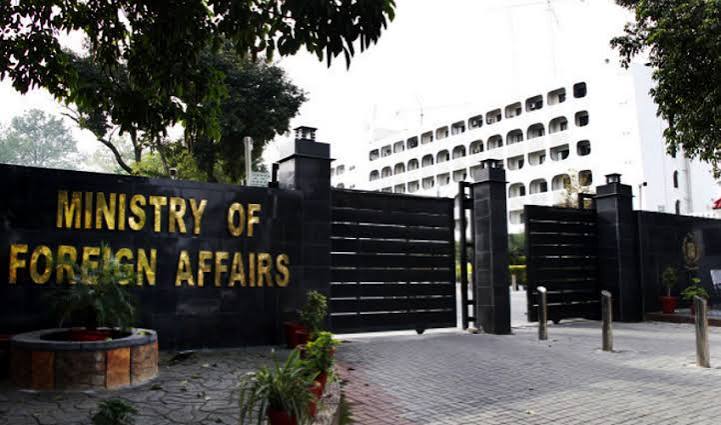
Pakistan Condemns Colombia’s Recognition of Israeli Sovereignty Over Occupied Syrian Golan Heights
Colombia’s decision to recognize Israeli sovereignty over the occupied Syrian Golan Heights marks a troubling milestone in the erosion of international consensus on territorial occupation.