Outrage in Tamil Nadu over Cases of Custodial Death

Outrage in Tamil Nadu over Cases of Custodial Death

The sad demise of a father and son in police custody in Santhakulam, Thoothukudi district, Tamil Nadu, has left many shocked. Mr. P. Jayaraj, 58, and his son Mr. J. Bennix, 31, were detained by the police last Friday (June 19) for allegedly defying lockdown measures and keeping their shop open after 8 pm. Mr. Jayaraj was summoned to the station and detained. When his son, Mr. Bennix went to inquire about his father, the police detained him too.

The duo was kept at the sub-jail of Kovilpatti for two days. The sub-jail is around 100km away from their residence. Relatives allege they were beaten brutally by the police while they were retained.

Eyewitnesses, family, and friends, saw the two men when they were brought to the government hospital for a general check-up. This was in the morning on June 20th, before a magistrate approved an extension of their police custody.

“Their legs and hands were swollen, and Bennix was bleeding from the buttocks. (Jayaraj) had bad injuries in his knees. The police even asked for new lungis (sarongs) because the ones they wore were bloody,” said Mr. S. Rajaram, a lawyer, and Mr. Bennix’s friend.

A police complaint, however, alleges that Mr. Bennix and Mr. Jayaraj “violated the lockdown, and picked a fight with and assaulted the police.” It also states that they “rolled on the ground and injured themselves.”

The father-son duo died in the hospital between the evening of the 22nd and the morning of the 23rd of June. The family of the deceased is accusing the police of sexual assault and custodial murder.

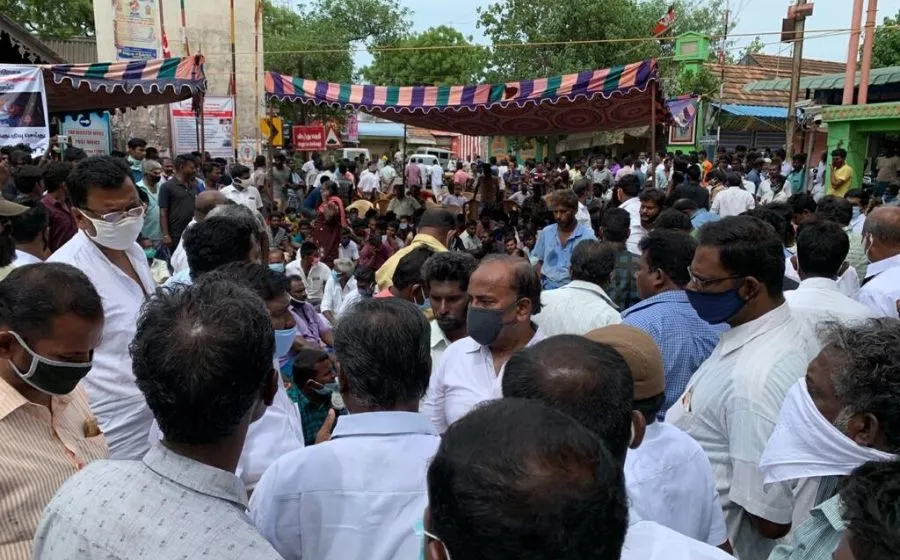
Angry traders in Santhakulam closed their shops on June 24 and staged protests.  There are rising demands for an inquiry against the police officials involved. Soon after the strike, two sub-inspectors were suspended and 12 other policemen transferred.

The Madurai bench of the Madras High Court has demanded a judicial magistrate’s inquiry report. Post-mortems took place on Thursday and were recorded. The deaths have sparked outrage across Tamil Nadu. Film director Karthik Subbaraj, actors Jayam Ravi and Jiiva, and singer Suchitra took to twitter demanding urgent action against the police officials.

Mr. Jayaraj is survived by his wife and three daughters. Chief Minister, E. Palaniswami announced a donation of 4 million rupees to them and a government job for a family member.

Shocking data from India’s National Human Rights Commission show nearly 1,400 people died in police custody in the last decade. A 2016 Human Rights Watch report said that nearly 600 people died in police custody, between 2010 and 2015, but no police officer was ever convicted.


News Desk

Your trusted source for insightful journalism. Stay informed with our compelling coverage of global affairs, business, technology, and more.

Recent

An analysis of Qatar’s neutrality, Al Jazeera’s framing of Pakistan, and how narrative diplomacy shapes mediation and regional security in South Asia.

Qatar’s Dubious Neutrality and the Narrative Campaign Against Pakistan

Qatar’s role in South Asia illustrates how mediation and media narratives can quietly converge into instruments of influence. Through Al Jazeera’s selective framing of Pakistan’s security challenges and Doha’s unbalanced facilitation with the Taliban, neutrality risks becoming a performative posture rather than a principled practice. Mediation that avoids accountability does not resolve conflict, it entrenches it.

Read More »
An analysis of how Qatar’s mediation shifted from dialogue to patronage, legitimizing the Taliban and Hamas while eroding global counterterrorism norms.

From Dialogue to Patronage: How Qatar Mainstreamed Radical Movements Under the Banner of Mediation

Qatar’s diplomacy has long been framed as pragmatic engagement, but its mediation model has increasingly blurred into political patronage. By hosting and legitimizing groups such as the Taliban and Hamas without enforceable conditions, Doha has helped normalize armed movements in international politics, weakening counterterrorism norms and reshaping regional stability.

Read More »
AI, Extremism, and the Weaponization of Hate: Islamophobia in India

AI, Extremism, and the Weaponization of Hate: Islamophobia in India

AI is no longer a neutral tool in India’s digital space. A growing body of research shows how artificial intelligence is being deliberately weaponized to mass-produce Islamophobic narratives, normalize harassment, and amplify Hindutva extremism. As online hate increasingly spills into real-world violence, India’s AI-driven propaganda ecosystem raises urgent questions about accountability, democracy, and the future of pluralism.

Read More »
AQAP’s Threat to China: Pathways Through Al-Qaeda’s Global Network

AQAP’s Threat to China: Pathways Through Al-Qaeda’s Global Network

AQAP’s threat against China marks a shift from rhetoric to execution, rooted in Al-Qaeda’s decentralized global architecture. By using Afghanistan as a coordination hub and relying on AQIS, TTP, and Uyghur militants of the Turkistan Islamic Party as local enablers, the threat is designed to be carried out far beyond Yemen. From CPEC projects in Pakistan to Chinese interests in Central Asia and Africa, the networked nature of Al-Qaeda allows a geographically dispersed yet strategically aligned campaign against Beijing.

Read More »
The Enduring Consequences of America’s Exit from Afghanistan

The Enduring Consequences of America’s Exit from Afghanistan

The 2021 US withdrawal from Afghanistan was more than the end of a long war, it was a poorly executed exit that triggered the rapid collapse of the Afghan state. The fall of Kabul, the Abbey Gate attack, and the return of militant groups exposed serious gaps in planning and coordination.

Read More »