![Senate debates Starlink's registration in Pakistan as Elon Musk faces backlash over anti-Pakistan remarks on social media. [File photo via The Express Tribune]](https://southasiatimes.org/wp-content/uploads/2025/01/Express-Tribune-21736070587-0.webp)
The National Assembly Senate Standing Committee on Information Technology, chaired by Senator Palwasha Khan, convened on Wednesday to discuss the licensing process for satellite internet services in Pakistan, with a particular focus on the registration of Starlink’s operations.
During the session, Pakistan Telecommunication Authority (PTA) chairman provided an update on Starlink’s application for registration, which was submitted on February 24, 2022.
He noted that the matter had been referred to the Ministry of Interior for security clearance. The case is currently under review by the newly established Pakistan Authority for Space and Regulatory Bodies (PASRB), which will make the final decision regarding the license.
During the meeting, Senator Palwasha Khan raised concerns over the actions of Starlink’s owner, Elon Musk, in light of his recent social media activity. She criticised Musk for his alleged anti-Pakistan tirade, accusing him of aligning with India’s narrative against Pakistan.
“It seems Elon Musk has partnered with India to propagate false allegations against Pakistan,” she remarked.
In response, Senator Afnan Ullah Khan suggested that Starlink should only be granted a license if Musk issues a public apology for his remarks.
“The PTA must consider Musk’s campaign against Pakistan before issuing a license. He should apologise for his statements before any further steps are taken,” he argued.
Earlier, IT and Telecom Minister Shaza Fatima Khawaja announced that the satellite-based internet company, Starlink, had been officially registered in Pakistan. Elon Musk later responded on the social media platform X, confirming that the company was in negotiations with the government.
Also See: Elon Musk’s Grooming Gangs Debate: Is There More Than Meets the Eye
Musk joins anti-Pakistan tirade
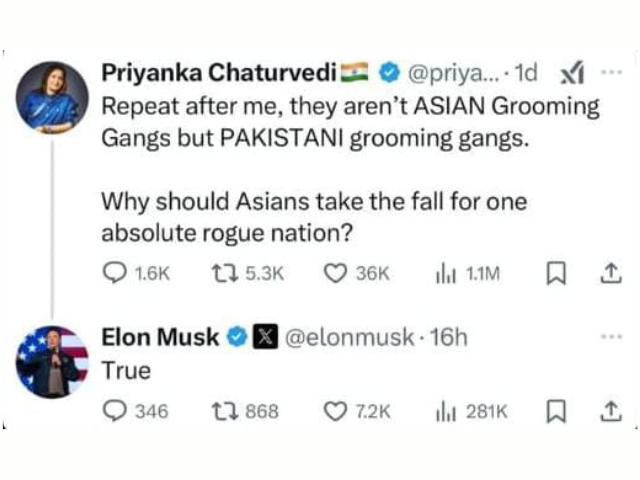
Recently, Musk has endorsed an anti-Pakistan narrative promoted by Priyanka Chaturvedi, a Rajya Sabha MP linked to the India’s Shiv Sena (UBT) party.
Chaturvedi sparked controversy when she claimed that the blame for grooming gangs in the UK should not be placed on Asia as a whole, but rather on “one rogue nation”—Pakistan. Musk, the CEO of SpaceX and Tesla, publicly supported this statement, calling it “true” on social media, aligning himself with Chaturvedi’s position.
The debate around grooming gangs in the UK has intensified following remarks by Labour leader and Prime Minister Keir Starmer, who recalled overseeing the first prosecution of an Asian grooming gang while heading the Crown Prosecution Service (CPS) between 2008 and 2013. Chaturvedi criticised Starmer’s narrative, questioning the tendency to associate the issue of grooming gangs with entire ethnic communities.
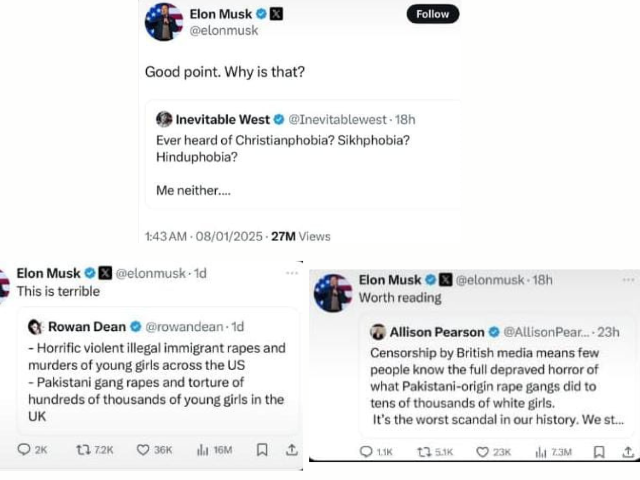
Musk also voiced his disapproval of Starmer, who has rejected calls for a new national inquiry, advocating instead for the implementation of recommendations from an earlier seven-year inquiry into child sexual exploitation.
This news is sourced from The Express Tribune and is intended for informational purposes only.