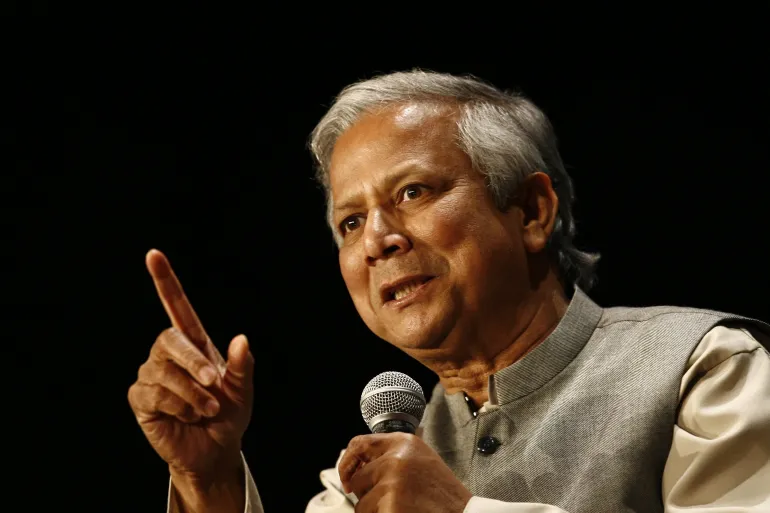
Bangladesh’s Nobel laureate Muhammad Yunus will head the country’s interim government. Former Prime Minister Sheikh Hasina stepped down and fled the country. This happened amid a mass uprising against her rule, led mostly by students.
The announcement early on Wednesday came from Joynal Abedin, the press secretary of President Mohammed Shahabuddin.
Abedin also said they would decide the other members of the Yunus-led government soon. They will make this decision after discussing with political parties and other stakeholders.
The leaders of the student protests, the chiefs of the country’s three military divisions, civil society members, and some business leaders held a meeting with the president. The meeting lasted for more than five hours late on Tuesday. They discussed and decided on the head of the interim administration.
The students had earlier proposed Muhammad Yunus and said the 83-year-old microfinance pioneer had agreed. Local media reported his expected return to the country from Paris soon.
Following the decision, student leaders left the president’s official house shortly after midnight, satisfied and welcoming the decision.
Nahid Islam, a leader of the student group, called the talks “fruitful.” He said Shahabuddin had agreed to form the interim government “within the shortest time” possible.
Shahabuddin also sacked the national police chief following the deadly protests that led to Hasina’s departure. His office said he named a replacement for the position.
Longtime Hasina critic
Muhammad Yunus is a well-known critic and political opponent of Hasina. He called her resignation the country’s “second liberation day”. She had once called him a “bloodsucker”.
The Nobel committee awarded Yunus, an economist and banker by profession, the Nobel Peace Prize in 2006 for pioneering the use of microcredit to help impoverished people, particularly women.
The Nobel Peace Prize committee credited Yunus and his Grameen Bank “for their efforts to create economic and social development from below”.
Yunus founded Grameen Bank in 1983 to provide small loans to entrepreneurs who would not normally qualify to receive them. The bank’s success in lifting people out of poverty led to similar microfinancing efforts in other countries.
He ran into trouble with Hasina in 2008, when her administration launched a series of investigations into him. He announced his plan to form a political party in 2007, when a military-backed government ran the country, but he did not follow through.
During the investigations, Hasina accused Yunus of using force and other means to recover loans from poor rural women as the head of Grameen Bank. Yunus denied the allegations.
In 2013, authorities put him on trial for receiving money without government permission, including his Nobel Prize and royalties from a book. He later faced more charges involving other companies he created, including Grameen Telecom, which is part of the country’s largest mobile phone company, Grameenphone, a subsidiary of Norwegian telecom giant Telenor.
In 2023, some former Grameen Telecom workers filed a case against Yunus accusing him of siphoning off their job benefits. He denied the accusations.
Earlier this year, a special judge’s court in Bangladesh indicted Yunus and 13 others on charges over the $2m embezzlement case. Yunus pleaded not guilty and is out on bail for now.
Yunus’s supporters say he has been targeted because of his frosty relations with Hasina.
The news content provided here is sourced from Al Jazeera.