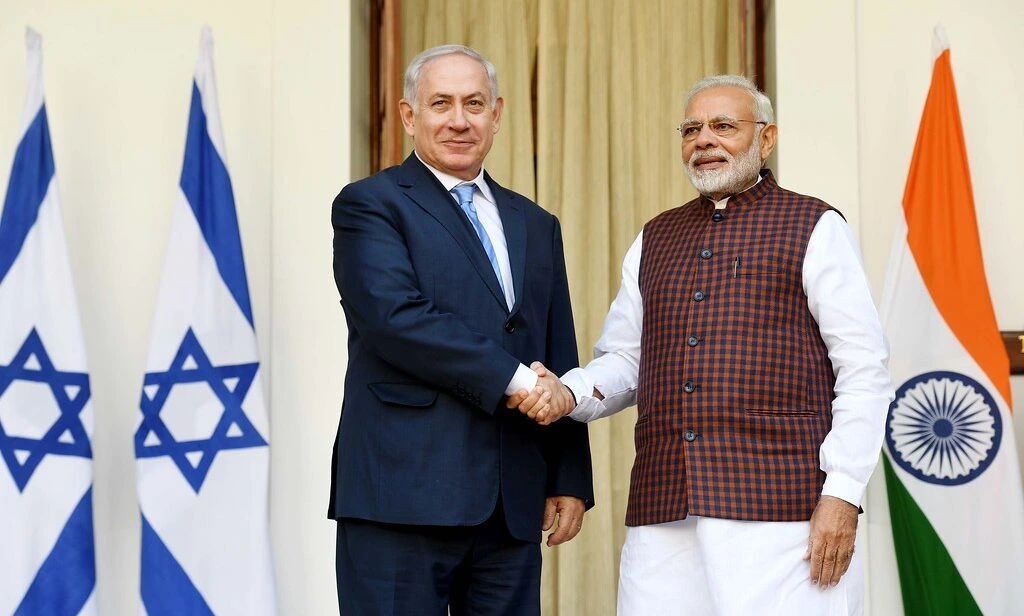
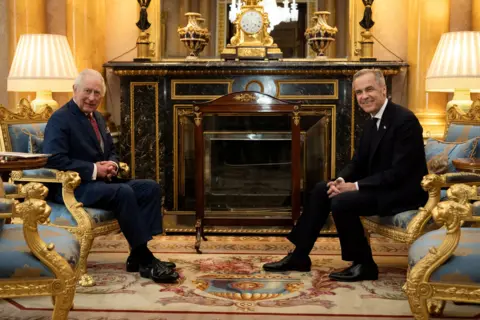
![King Charles welcomes Canadian PM Mark Carney, signaling support for Canada amid Trump tensions through symbolic gestures. [Image via BBC]](https://southasiatimes.org/wp-content/uploads/2025/03/p0kyqrnh.webp)
King Charles gave a warm welcome to the new Canadian Prime Minister Mark Carney when he visited Buckingham Palace.
It was another symbolic gesture of support for Canada from a King, wearing a red tie, who has to send coded signals rather than spell things out in words, as Canada faces threats from US President Donald Trump.
But the King has sought to make clear his commitment to Canada – and if it had not been for his cancer diagnosis, the BBC understands he would have travelled there for an intended visit in 2024.
There are also suggestions that once Canada’s election is out the way, a visit to Canada will be a priority, where he can further demonstrate his support.
The new Canadian prime minister told the King that his Order of Canada pin had broken this morning. The King joked: “Do you want mine?”
The King congratulated Carney on becoming the new PM, ushering him to a seat, and perhaps hoping that the broken pin was not a symbol of a Commonwealth relationship under strain.
“These things are rather important,” said the King, ahead of a 30-minute conversation with no one else in attendance.
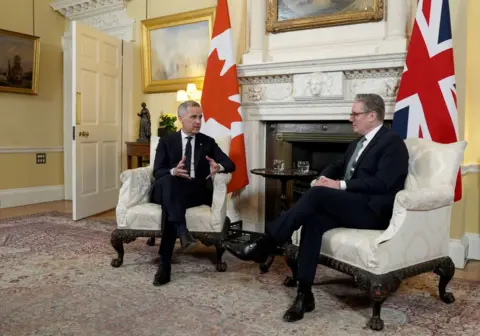
Carney later went on to meet UK prime minister Sir Keir Starmer at Downing Street.
Sir Keir hailed the relationship between the two countries and said they had “so much in common – shared history, shared values, shared King.”
Carney said he was “grateful for the welcomes and the constructive discussions” with Starmer and French president Emmanuel Macron – whom he had met earlier in the day.
At a news conference, he was asked if he felt let down by the lack of public support for Canada from other allies, given Trump’s trade war with Canada, and his remarks about making Canada the 51st state of the US.
“We don’t need another country to validate our sovereignty, we are sovereign, we don’t need praise from another country, we are proud in and of ourselves,” he said, adding that Sir Keir had made a point of referring to Canada’s sovereignty and to “our shared sovereign in King Charles III.”
Also See: Prime Minister Carney To Bolster Canada’s Relations With France, UK, And Assert Sovereignty
Symbolic displays
The meeting with Carney is the latest scene in an intricate diplomatic balancing act for a King who is head of state of both the UK and Canada.
King Charles has to show solidarity with Canada without disrupting the UK’s relationship with Trump.
The King also has to avoid getting directly involved in politics – and has to speak on advice of ministers. Whatever he might personally believe about Trump’s comments about taking over Canada, the King has to keep his thoughts to himself.
Adding to this complicated choreography is that the royals are one of the strongest cards the UK can play with President Trump. He seemed delighted by his second state visit invitation from the King.
So messages from the King are sent in symbolic displays. In case anyone missed the signs over Canada, there have been multiple moments. And then some more.
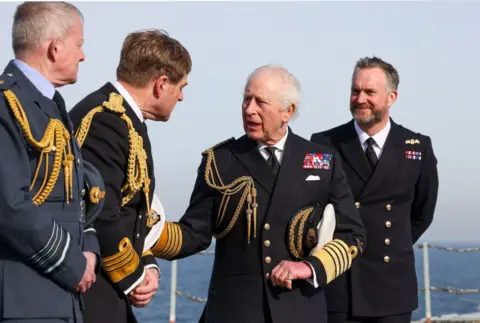
When the King visited aircraft carrier HMS Prince of Wales, he appeared wearing a set of Canadian medals.
The 60th anniversary of Canada’s maple leaf flag might usually have passed without any royal intervention, but there was a fulsome message sent by the King, praising the “proud, resilient and compassionate country”.
A ceremonial sword for Canada became an event at Buckingham Palace with a formal presentation by the King.
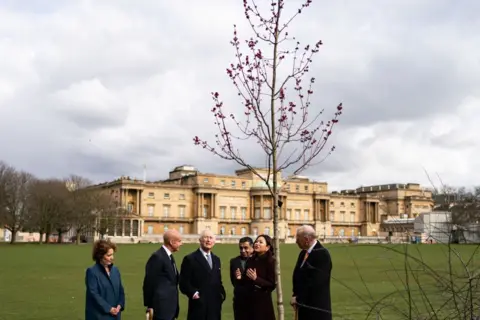
At a tree planting ceremony in Buckingham Palace, the tree chosen was a maple. And when the King sat down at the Commonwealth Service last week, it was on a Canadian chair.
If any of these moments were accidental, they were not being rejected by Buckingham Palace, with royal sources emphasising the King’s commitment to Canada.
But there is no avoiding the tensions and contradictions in this balancing act. Emails from Canadians to the BBC’s Royal Watch newsletter show that many want a much more robust defence from the King.
“What a cop out! Throw Canada to the wolves. Giving us back pats for our flag’s anniversary doesn’t quite cut it. Here sits a monarchist who is seriously rethinking his allegiance to the crown!” emailed Brian, a Canadian military veteran.
Carol in Vancouver was unhappy at the invitation from the UK for a second state visit by President Trump.
“I feel ashamed for the Brits feeling they have to follow through with inviting such a boor for dinner. For the life of me I do not understand why he has this power over you,” she wrote.
“As a Canadian, the invitation is a slap in the face to the people of Canada. If the King is our King (as we are a Commonwealth country), and Trump is basically at war with us, how dare King Charles give him any credence?” emailed Patricia.
“As a Canadian I am saddened, appalled, disgusted and angry that King Charles appears to be joining the conga line of supplicants,” said Jo-Ann in Ontario.
But King Charles will have to keep to the line set by ministers, and if that means maintaining good relations with Trump, he is unlikely to be saying anything more outspoken.
This news is sourced from BBC and is intended for informational purposes only.



![A view of Islamabad, as evolving regional dynamics reshape Pakistan’s security environment. [Image via Wikimedia].](https://southasiatimes.org/wp-content/uploads/2026/03/Islamabad_top_view.webp)