
 Skip to content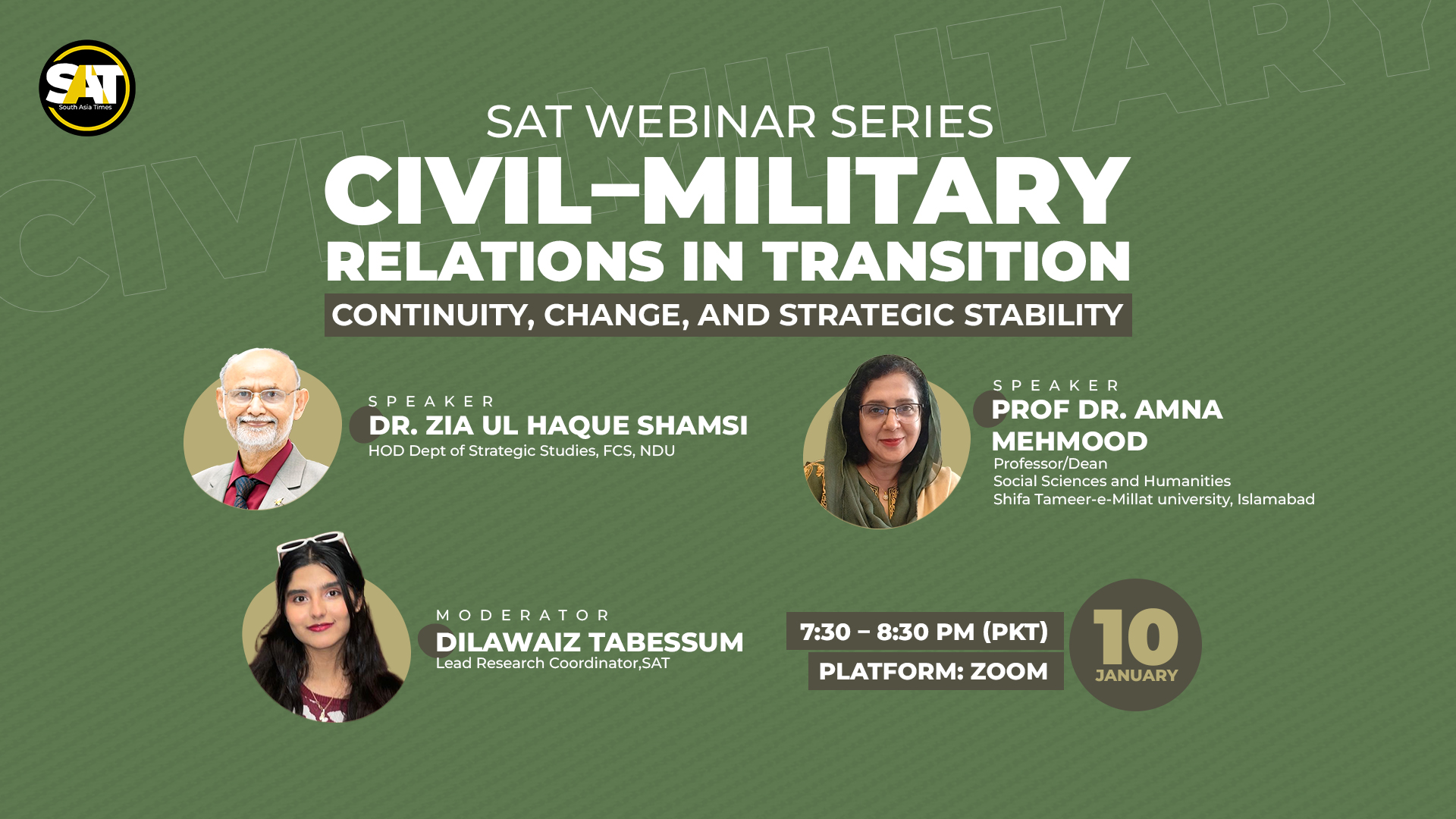
Janurary 2025
Background and Context:
Pakistan’s civil–military relations have long shaped the country’s political stability, democratic
development, and national security decision-making. Emerging from early security threats, regional
conflicts, and weak civilian institutional capacity, the military assumed a prominent role in governance,
producing a hybrid institutional framework marked by periods of cooperation, imbalance, and
recalibration. In recent years, this relationship entered a phase of heightened polarization following
political upheavals and leadership transitions, straining constitutional norms, deepening societal divisions,
and weakening public trust in state institutions.
This polarization complicated democratic governance and raised concerns over strategic coherence amid
evolving regional security challenges. The post-2025 security environment particularly the limited
Pakistan–India conflict marked a critical turning point. The crisis underscored the importance of alignment
between civilian leadership and military command, demonstrating how coordination, preparedness, and
restraint contribute to strategic stability and credible deterrence. It also triggered institutional learning
and reconciliation efforts, leading to improved public perceptions of the military and a cautious shift
toward functional cooperation.
The South Asia Times webinar, Civil–Military Relations in Transition: Continuity, Change, and Strategic
Stability in Pakistan, was convened to examine these developments through a historical and policy
oriented lens. Moving beyond polarized narratives, the discussion assessed whether recent coordination
reflects a durable civil–military operating norm or a contingent adjustment, while exploring future
pathways for constitutional balance, democratic stability, and long-term strategic coherence in Pakistan.
Historical Security Orientation: Pakistan’s civil–military relations developed within a security-centric
framework shaped by early conflicts, regional threats, and limited state capacity, embedding defense
priorities deeply into governance structures.
Institutional Continuity and Hybrid Governance: Military influence became institutionalized through
political instability and constitutional arrangements, resulting in a hybrid governance model that
continues to define state functioning.
Coordination over Confrontation: Recent trends suggest a shift toward functional coordination between
civilian and military institutions, particularly in security and crisis management domains.
Strategic Stability and Restrain: Post-2025 security developments highlighted improved institutional
alignment, operational preparedness, and restraint, reinforcing Pakistan’s deterrence posture.
Public Welfare as Legitimacy: The legitimacy of any governance arrangement ultimately depends on
public consent, citizen welfare, and the protection of territorial integrity.
Ms. Dilawaiz Tabessum, Lead Research Coordinator at SAT and co-host of the webinar, along with Kaiwan
Rad, Researcher opened the session by emphasizing the centrality of civil–military relations to Pakistan’s
political stability and democratic development. She noted that the objective of the discussion was to
examine continuity and change through an academic and policy-oriented lens, focusing on institutional
learning rather than historical blame.
Dr. Amna Mahmood, Dean, Faculty of Social Sciences and Humanities at Shifa Tameer-e-Millat University,
traced the historical foundations of Pakistan’s civil–military relations. She highlighted how early security
threats, Cold War alliances, and recurring political crises strengthened the military’s role in state affairs.
Dr. Amna emphasized that contemporary civil–military relations are structural in nature and operate
through coordination mechanisms, arguing that any governance model is viable if it ensures public welfare
and national cohesion.
Dr. Zia-ul-Haque Shamsi, Head of the Department of Strategic Studies at the National Defense University
and former Air Commodore of the Pakistan Air Force, focused on operational coordination and strategic
stability. He stressed the importance of alignment between political leadership and military command,
particularly during crises. Referring to recent security developments, he highlighted Pakistan’s emphasis
on preparedness with restraint, noting that responsible crisis management strengthens deterrence and
prevents escalation.
The webinar reaffirmed that Pakistan’s civil–military relations are evolving rather than static, shaped by
historical continuity and gradual institutional adjustment. The discussion underscored that sustainable
democratic stability requires mutual respect, constitutional boundaries, and constructive engagement
between institutions. By prioritizing coordination over confrontation, Pakistan can strengthen governance
while maintaining strategic stability
 Optimized by Seraphinite Accelerator