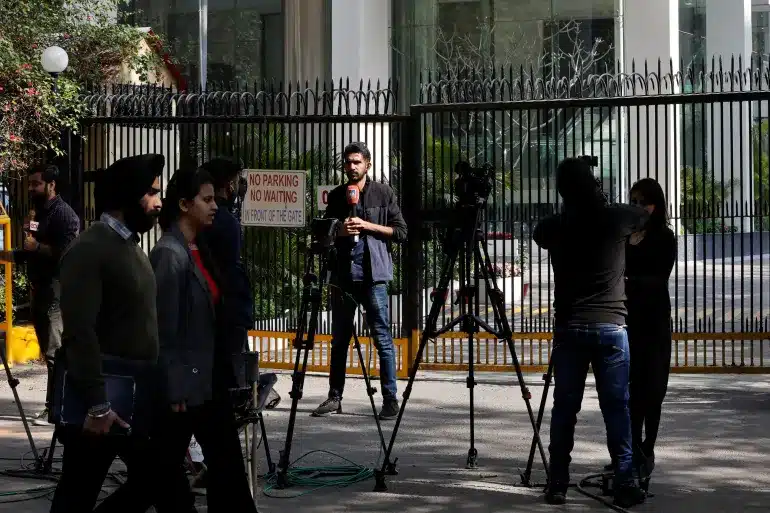
Documents & phones of several journalists taken & offices sealed on Tuesday morning as part of a tax evasion investigation into business operations of the BBC in India
Tax officials raid BBC India, just weeks after the release of a documentary critical of the prime minister, Narendra Modi, which was later blocked by the government.
According to broadcaster staff, income tax officials arrived at BBC offices in Delhi and Mumbai, conducting a “survey”. Authorities took documents and phones from several journalists and sealed their offices.
Officers told local media the searches on Tuesday morning were part of a tax evasion investigation into the business operations of the BBC in India and several accounts and financial files were seized, as Tax officials raid BBC India.
The BBC confirmed the raids at the offices and said it was fully cooperating. “We hope to have this situation resolved as soon as possible,” said the statement.
The raids come as the BBC is at the centre of a controversy in India over a two-part documentary series, India: The Modi Question, which focused on the role that Modi, who was then the chief minister of Gujarat, played in violent Hindu-Muslim riots that ripped through his state in 2002 and left more than 2,000 people, mostly Muslims, dead.
Modi faced long-standing allegations of complicity in the violence, leading to a nearly decade-long US ban. The BBC documentary revealed a British government document implicating Modi directly in failing to halt Muslim killings during riots.
Public Outcry
The Modi government accused the broadcaster of bias, citing a supreme court panel’s 2012 clearance of Modi of all charges.
Authorities invoked emergency laws to ban any sharing of links or clips of the documentary on social media. Despite the ban, police detained several students for staging screenings.
The BBC has stood firm by the documentary, affirming that it rigorously researched it according to the highest editorial standards.
Following the searches, BJP spokesperson Gaurav Bhatia called the BBC the “most corrupt organization,” criticizing its reporting as agenda-driven.
“If any company or organization is working in India, they have to comply with the Indian law. Why are you scared if you are adhering to the law? The [tax] department should be allowed to do their work,” said Bhatia.
Members of the opposition criticized the raids on the BBC. Congress MP Gaurav Gogoi tweeted that PM Modi is showcasing India’s descent into authoritarianism and dictatorship during its G20 presidency.
Akhilesh Yadav, leader of the Samajwadi party, said: “When a government stands for fear and oppression instead of fearlessness, then one should realize the end is near.”
Media Under Pressure
Since the documentary uproar, the BBC has faced increased scrutiny, including a petition to India’s Supreme Court for its ban. The judges dismissed the petition.
The raids come amidst an increasingly pressured environment for media since Modi came to power in 2014. The BJP government has harassed critical journalists and news organizations through raids, criminal cases, and tax investigations. As a result, India has dropped to 150 out of 180 in the World Press Freedom Index.
The Editors Guild of India labeled the income tax department’s actions part of a trend to intimidate critical press organizations.
Tax evasion investigations targeted organizations like the BBC, Oxfam, and think-tanks after reports reflected poorly on the Modi government. The central government agency froze Amnesty International’s accounts, leading to the closure of its India operations in 2020 due to its documentation of human rights erosion and minority persecution.
Original Source: The Guardian

Your trusted source for insightful journalism. Stay informed with our compelling coverage of global affairs, business, technology, and more.