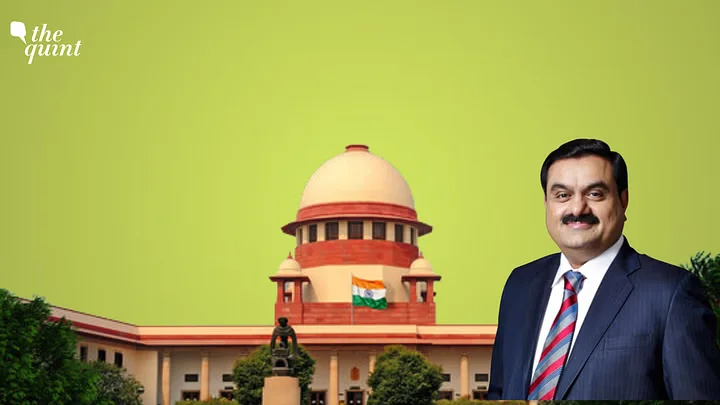
India’s top court orders investigation into Adani Group after US short-seller Hindenburg Research accused the conglomerate of fraudulent practices, prompting a significant loss in market value.
India’s top court has ordered an expert committee to probe for any regulatory failures related to the country’s second-largest conglomerate, the Adani Group.
The order of investigation on Thursday was prompted by allegations made by US short-seller Hindenburg Research in a report that accused Adani companies of engaging in market manipulation and other fraudulent practices.
Shares in the group’s flagship, Adani Enterprises, and other affiliated companies have lost tens of billions of dollars in market value since Hindenburg issued its report.
The Adani Group has denied any wrongdoing, defending itself against the allegations in a 413 page rebuttal.
In a tweet on Thursday, it welcomed the court order.
“It will bring finality in a time-bound manner. Truth will prevail,” the company said.
The expert committee will submit its findings to the Supreme Court within two months, said Chief Justice DY Chandrachud and justices PS Narasimha and JB Pardiwala.
Hindenburg Research published a report “Adani Group: How The World’s 3rd Richest Man Is Pulling The Largest Con In Corporate History” alleging that Adani Group “has engaged in a brazen stock manipulation and accounting fraud scheme over the course of decades”.
Improvement suggestions
The top court also directed the government-run Securities and Exchange Board of India to investigate whether there had been a violation of rules or manipulation of stock prices by the Adani Group.
The court acted on petitions filed by some activists and lawyers.
Apart from investigating allegations against Adani, the expert committee is to suggest measures to improve regulatory oversight and protections for investors.
Adani Enterprises cancelled a share offering meant to raise $2.5 billion last month after Hindenburg issued its report and its share price plummeted.
Opposition lawmakers blocked parliamentary proceedings last month demanding a probe into the business dealings of coal tycoon Gautam Adani, who is said to enjoy close ties with PM Narendra Modi.
The investigation comes on the same day US boutique investment firm GQG Partners Inc has bought shares worth $1.87 billion in four Adani group companies, marking the first major investment in the Indian conglomerate since the report.
Before investing, Rajiv Jain, GQG’s chairman and chief investment officer said GQG did a “deep dive on our own” as part of due diligence, including conversations with the group’s vendors, bankers and partners.
“We actually disagree with [Hindenburg’s] report,” he said, adding that infrastructure companies are subject to tight regulation and therefore the risk of fraud is low.
Source: TRT World

Your trusted source for insightful journalism. Stay informed with our compelling coverage of global affairs, business, technology, and more.