
Janurary 2025
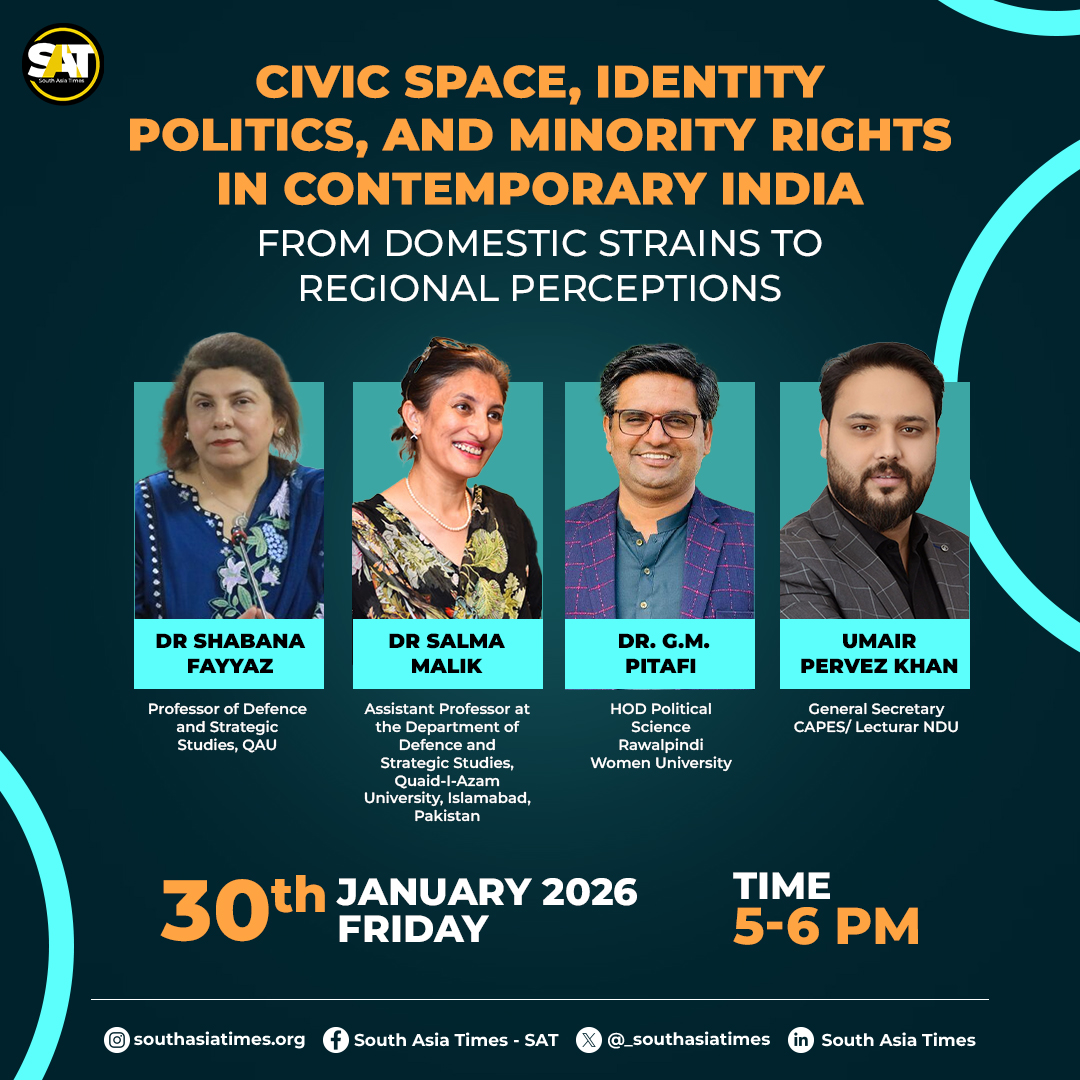
Key Participants:
Background and Context:
India’s political landscape has increasingly shifted toward identity-based politics, resulting in a narrowing of civic space and heightened marginalization of minorities, particularly Muslims. Despite its international projection as a secular democracy, domestic developments reveal deep-rooted religious and cultural divisions shaped by historical and institutional factors.
The rise of Hindutva under the BJP has intensified debates over national identity, human rights, and minority inclusion, with issues such as the hijab controversy underscoring concerns around education, freedom of expression, and equality. These dynamics also carry regional and international implications.
In this context, South Asia Times convened a policy-oriented roundtable to examine the structural drivers of identity politics in India and their broader consequences.
The roundtable opened with Dr. G.M. Pitafi, who contextualized India’s ethnic and religious crises within a broader historical framework. He argued that the current dominance of identity politics is rooted in structural and historical factors rather than short-term political developments. Dr. Pitafi highlighted how religious mobilization has long been present in Indian politics, gradually intensifying over time and culminating in the present political climate under BJP leadership.
Dr. Salma Malik provided a comprehensive analysis of identity, human rights, and cultural representation. She emphasized that violations against women particularly Muslim women must be understood as human rights issues, especially when access to education and freedom of expression are curtailed. Drawing on sociocultural examples, she illustrated how identity is formed and reinforced from childhood, later becoming politicized through media, stereotypes, and state narratives. Dr. Salma Malik highlighted how popular culture has played a subtle yet powerful role in projecting Muslims as backward or incompatible with modernity, contributing to societal exclusion and narrowing civic space. She further argued that state endorsement of exclusionary practices, as seen in the hijab controversy, reflects a broader institutional failure to protect minority rights.
Expanding on historical continuity, Usama Khan challenged the notion that anti-Muslim sentiment emerged only after 2014. He traced such attitudes back to the early years of Indian independence, citing events such as the occupation of Hyderabad and the marginalization of Muslims as a national group. He argued that India’s internal divisions religious, caste-based, linguistic, and economic have been instrumentalized for political consolidation. According to him, Kashmir represents the most extreme and violent expression of this exclusionary project, which he characterized as a settler-colonial enterprise.
Dr. Shabana framed the discussion around fundamental questions of national identity and minority inclusion. She questioned whether minorities are genuinely accommodated within India’s national identity or merely tolerated symbolically. Highlighting the erosion of India’s secular foundations, she pointed to media narratives, pandemic-era discrimination, and digital and economic divides as indicators of systemic exclusion. She stressed that minority marginalization is deeply linked to economic vulnerability and argued that Pakistan must adopt a multi-dimensional strategy combining research, media engagement, cyber literacy, and economic resilience to effectively counter dominant narratives.
The roundtable underscored that identity politics and minority marginalization in India are deeply embedded in historical trajectories, institutional practices, and political narratives rather than isolated policy failures. Participants emphasized that symbolic controversies such as the hijab issue serve as entry points into understanding broader patterns of exclusion, coercion, and identity enforcement. The discussion reaffirmed that sustainable responses to these challenges require rigorous research, strategic communication, economic strength, and principled engagement at both domestic and international levels. Without addressing the structural roots of identity-based exclusion, tensions within India and across South Asia are likely to persist and intensify.
