
Janurary 2025
Background and Context:
Militancy in South Asia has entered a phase of structural transformation, moving beyond geographically
bounded insurgencies and hierarchical command models toward adaptive, networked ecosystems.
Contemporary militant groups increasingly exploit governance vacuums, economic fragility, cross-border
mobility, and permissive political environments to expand operational reach, diversify targets, and
recalibrate narratives. This evolution has blurred the lines between domestic insurgency, regional
instability, and transnational terrorism.
The post-2021 Afghan context has emerged as a central node in this evolving militant ecosystem. Political
exclusion, economic collapse, and weak institutional control have generated conditions conducive to
militant mobility and facilitation networks. As multiple militant organizations operate simultaneously
from Afghan territory, instability has increasingly spilled across borders, affecting Pakistan, Iran, Central
Asia, and Chinese interests in the region. This spillover has complicated counterterrorism responses,
strained regional diplomacy, and heightened risks to civilian populations, infrastructure, and economic
corridors.
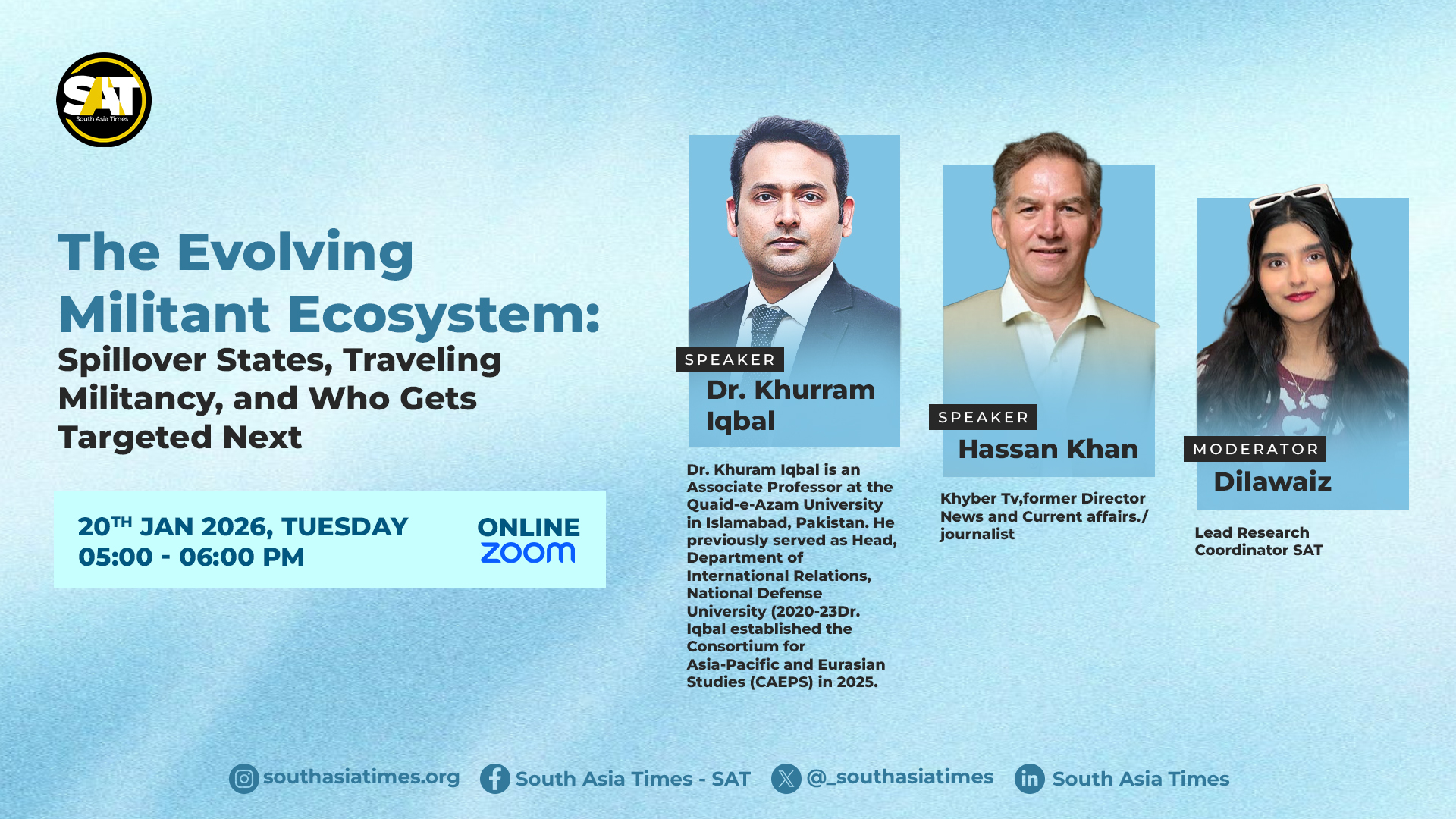
Against this backdrop, South Asia Times convened the policy-oriented webinar The Evolving Militant
Ecosystem: Spillover States, Traveling Militancy, and Who Gets Targeted Next to critically examine the
drivers, patterns, and implications of contemporary militancy. Moving beyond alarmist narratives, the
discussion assessed whether current trends reflect strategic escalation or adaptive survival, while
exploring policy challenges related to governance, regional coordination, and state resilience.
Ms. Dilawaiz Tabessum, Lead Research Coordinator at South Asia Times, opened the session by framing
militancy as a transnational and adaptive phenomenon rather than a localized security challenge. She
emphasized that the objective of the discussion was to analyze structural drivers, evolving target
selection, and regional implications through a policy-focused lens.
Mr. Hassan Khan, senior journalist and former Director of News and Current Affairs at Khyber TV,
examined the concept of spillover states through the Afghan experience. He highlighted the presence of
multiple terrorist syndicates operating from Afghan territory, many of which are oriented toward Pakistan
and neighboring states. Mr. Khan stressed that governance vacuums, weak institutional control, and
permissive environments have facilitated militant mobility and diversification. He also underscored the
deteriorating security situation in southern Khyber Pakhtunkhwa, noting that the absence of effective
administrative, judicial, and policing reforms has created exploitable vacuums.
Addressing shifting target profiles, Mr. Khan argued that increased attacks on civilians and infrastructure
reflect militant adaptation under intensified counterterrorism pressure. He noted that proactive security
operations have forced militant groups to expand target selection in order to retain relevance and disrupt
state authority. On regional responses, he observed a lack of coordinated pressure on Afghanistan,
cautioning that unilateral measures without regional alignment risk limited effectiveness.
Dr. Khuram Iqbal, Associate Professor at Quaid-e-Azam University and former Head of the Department of
International Relations at the National Defense University, provided a structured assessment of
transformations in Pakistan’s militant landscape. He identified shifts in tactics, geography, and
organizational capacity, highlighting increased civilian targeting by Baloch militant groups and the
movement of militancy from former tribal areas to southern Khyber Pakhtunkhwa.
Dr. Iqbal emphasized the reduced operational capacity of Islamic State Khorasan Province due to
sustained intelligence-based operations, while cautioning against interpreting isolated attacks as strategic
resurgence. He identified two primary drivers of militancy: the continued presence of militant sanctuaries
in Afghanistan and political discord between federal and provincial authorities in Pakistan. He stressed
that counterterrorism effectiveness depends on political clarity and unified threat perception.
In discussing recruitment and traveling militancy, Dr. Iqbal argued that economic collapse, governance
failure, and survival incentives now play a role comparable to ideology. He noted that militant
externalization of internal governance failures has become a tool for maintaining cohesion and deflecting
accountability
The webinar underscored that militancy in South Asia is evolving in form, scope, and intent, shaped by
governance failures, regional fragmentation, and adaptive militant strategies. The discussion reaffirmed that sustainable security requires more than kinetic responses; it demands political cohesion, institutional
reform, and coordinated regional engagement. Without addressing governance vacuums and political
disunity, militant ecosystems will continue to regenerate, posing persistent threats to civilian security and
regional stability.
