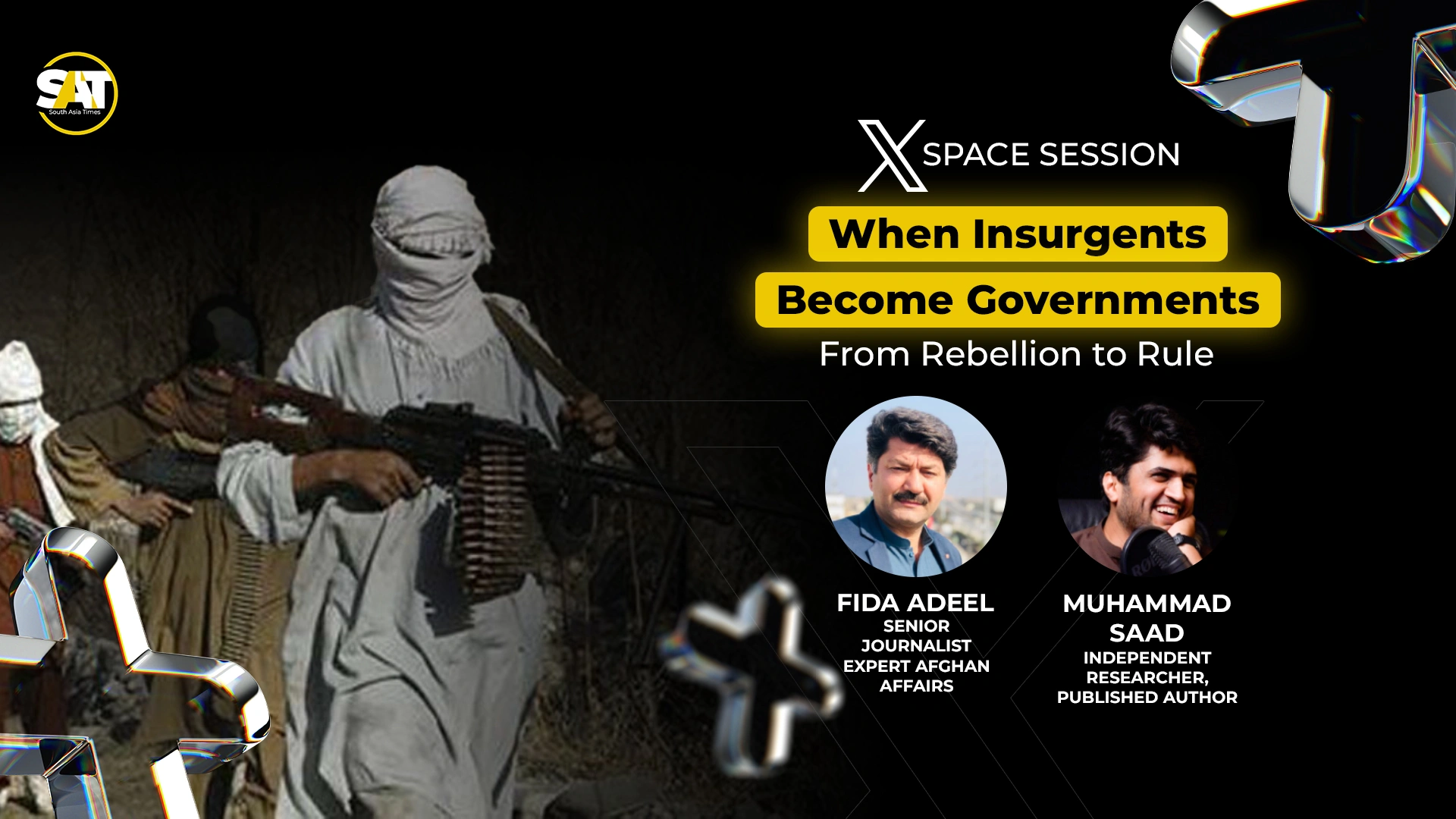
On January 7th, 2026, South Asia Times (SAT) hosted an X Space session titled “When Insurgents Become Governments: From Rebellion to Rule”. Moderated by Usama Khan, the session featured Fida Adeel, Senior Journalist and expert on Afghan affairs and Muhammad Saad, Independent Researcher and Published Author. The discussion focused on the transition of armed insurgent movements into governing authorities, with a comparative lens on Afghanistan (Taliban) and Syria. The panel examined military effectiveness, governance challenges, regional security implications, and the socio-political realities shaping these insurgent-to-government transitions.
Key Analysis Points
From Insurgency to Governance (Afghanistan)
The Taliban emerged from the collapse of governance and widespread public distrust in the 1990s. While their second stint post-Doha Agreement showed improved preparation, they remain dominated by hardline Kandahar leadership. The government is neither inclusive nor representative of minority groups or women, and no political parties operate within the system. Youth engagement is the only notable shift from their first era, but core policies remain rigid.
Diplomacy vs. Internal Rigidity
Despite strict internal policies, the Taliban have demonstrated pragmatic diplomacy by engaging regional and global actors. International recognition remains limited, currently only Russia formally acknowledges the regime. Governance structures are underdeveloped, bureaucratic systems weak, and leadership lacks a coherent long-term vision.
Syria’s Case: Ambition without Unity
Ahmed al-Sharaa (Jolani), formerly linked to global jihadist networks, repositioned his movement toward regime change, signaling tactical openness to Western engagement. In Syria, a metropolitan society, with deep ethnic divisions, its anti-Russia stance has fostered good relations with Europe, and the presence of foreign communities, Tajiks, Uzbeks and anti-Russia chechens, adds further complexity.
However, Syria remains fractured, with military forces lacking unified command and immense economic and geopolitical challenges. The presence of foreign fighters and opposition factions further complicates governance and central authority.
Military-Centric Movements and State Failure
Both cases highlight that insurgent groups excel militarily but struggle with civilian governance. Afghanistan’s post-2021 collapse of NATO-supported institutions left a vacuum, with the Taliban assuming control of a largely untrained bureaucracy. Syria faces similar issues of fragmented command and a dysfunctional bureaucratic system, limiting prospects for effective governance.
TTP–TTA Nexus and Regional Security
The Taliban maintain close ties with the TTP, reinforced by Pashtun cultural norms and Haqqani alliances. Afghan-based TTP attacks and ideological overlap present direct security challenges for Pakistan. Attempts at dialogue or religious decrees (fatwas) discouraging cross-border militancy have largely failed, emphasizing the resilience and autonomy of these networks.
Transition Requires Time and Vision
The panel stressed that moving from insurgency to stable governance requires political vision, inclusive policies, economic reforms, and regional accommodation. Afghanistan shows little progress in this regard, while Syria showing promising signs may require years to achieve economic stability, military cohesion, and internal political consolidation.
Strategic Takeaways
1. Hardline Roots vs Pragmatic Engagement: Afghanistan demonstrates a continuity of hardline internal governance while engaging diplomatically externally. In contrast, Syria exhibits a more pragmatic policy regarding both internal and external affairs.
2. Military Strength Does Not Guarantee Governance Capacity: Effective insurgency does not automatically translate into competent state administration.
3. Fragmentation Hampers State-Building: Syria exemplifies the challenges of militarized movements attempting centralized control, but there have been some positive signs and a willingness for inclusivity, while the Taliban shows signs of a movement with no long-term vision and avoiding the transition from a military organization to a functional state.
4. Regional Security Implications: TTP ties with the Taliban directly influence Pakistan’s domestic security landscape.
5. Time and Vision are Critical: Sustainable transition from insurgency to rule requires years of policy, economic, and social institution-building.
The recording of the space session is available Here.